
Expiring Iodine: The Nuclear Threat That Never Came
Stocked iodine expires before the promised Russian Kinzhal attack. An analysis of 4,500 hypersonic missiles and the reality of the nuclear threat.
English · Original discussion in Spanish · Published
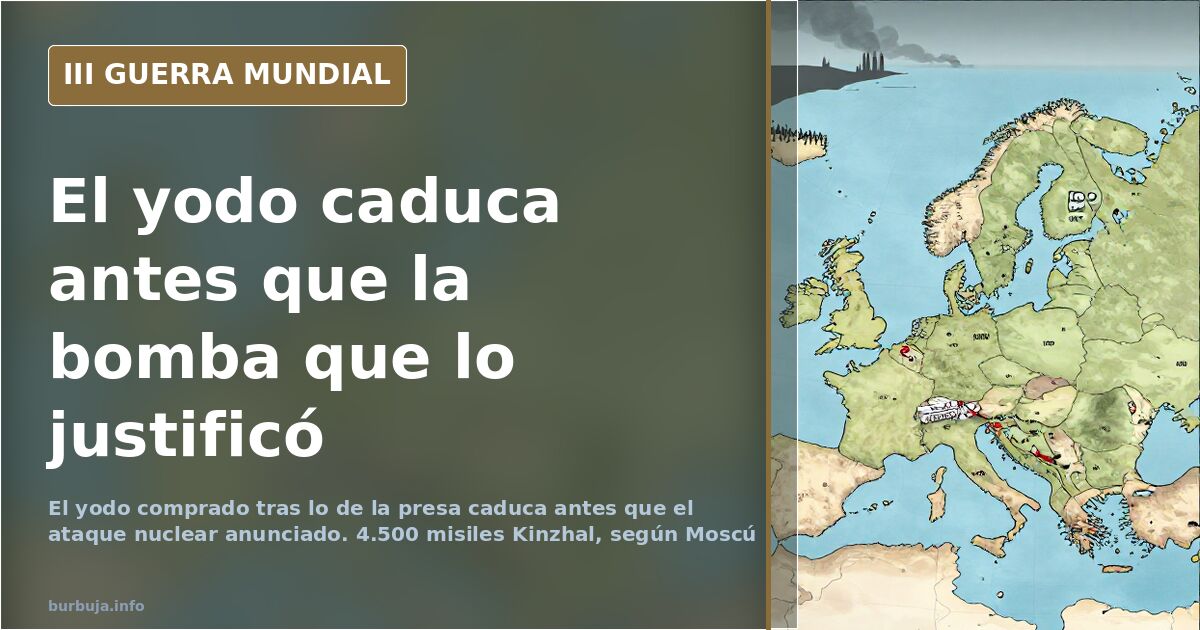
Iodine expiring before the nuclear war that justified it
The iodine tablets bought in a panic expire before the threat for which they were purchased. This is the summary of a warning issued in 2023, with the dam incident still fresh: the Russian nuclear attack was described as 'imminent,' and the escalation toward a third atomic world war was said to be 'very fast.' The message claimed that senior Russian commanders debated using tactical weapons in response to the dam breach and that populations in several countries near Ukraine already had access to iodine. The author added that he stored several doses: one for himself and the rest for women who might want to be his girlfriends on Doomsday. He closed with a wink: it was science fiction and nothing would happen.
Time has passed. Nothing has peine. The iodine remains in the drawer.
Does iodine protect against a nuclear explosion?
According to the response on the same site where the warning was posted, no: 'iodine tablets are useless' when the moment comes, and the truly effective substance against radiation would be prussian blue. The initial advice was never retracted by its author. Meanwhile, it was noted that the airborne dispersion of radioactive dust causes lethal poisoning, cancer, and effects on fetuses and embryos, regardless of whether the device is a fairground firecracker or hundreds of tons of conventional explosives: what changes is the radius of influence and subsequent atmospheric dispersion.
The 4,500 Kinzhal missiles and minutes to each capital
The most detailed analysis put figures on the table and, in passing, punctured them. Russia claimed to have 4,500 Kinzhal hypersonic missiles ready for immediate launch; this estimate is dismissed as war propaganda and reduced to about one thousand. Each vector would carry 50 kilotons, ten times the Hiroshima bomb, and flight times to Europe are measured in minutes: six to London, four to Brussels, three to Berlin, and about one to the Baltic and Scandinavian regions. Spain would be out of range, although iodine retains its place on the list.
This is compounded by another element: 60 nuclear submarines at sea on recurring routes, according to that same analysis, and alternative vectors to hypersonics — bombers, intercontinental ballistic missiles — in reserve. What makes hypersonics special, it is argued, is the difficulty of detecting both the launch and the arrival.
From the dam to the roof of the Zaporizhzhia nuclear plant
The narrative was updated with the calendar. Alerts shifted from the Nova Kakhovka dam to the Zaporizhzhia nuclear power plant: according to the Russian state-owned Rosenergoatom, Ukraine planned to attack it with precision weapons; from the other side, Russian emergency and decontamination units were reported moving through Mariupol, Enerhodar, and Melitopol, cities near the plant, and the Ukrainian president accused Russia of placing explosives on its roof. None of these versions are confirmed here.
The argument of nuclear balance also emerged: no Russian government can allow missiles to be planted 150 kilometers from Moscow, just as occurred during the Cuban Missile Crisis, when Washington activated Defcon 2, the step preceding nuclear war. The simplest solution, it is said, would be a neutral Ukraine and a non-NATO entry agreement.
Who bought iodine and why it is now expiring
There were real purchases. When the invasion began, iodine was 'going for a song' on Amazon, and the warning spread: over time, those who heeded it discovered that the product is nearing its expiration date and that the threat has not materialized. Purchases were even made from Lithuania, according to one account. The chemical excuse arrived immediately: medicines do not expire, they only lose their effect, if at all.
In between, the cycle repeated with Iran, with new calls to stock up and the warning that 'there will not be enough iodine for everyone.' And with the usual rebuttal: that nothing will happen and that this is cheap alarmism.
The iodine tablets bought in a panic expire before the threat for which they were purchased. This is the summary of a warning issued in 2023, with the dam incident still fresh: the Russian nuclear attack was described as 'imminent,' and the escalation toward a third atomic world war was said to be 'very fast.' The message claimed that senior Russian commanders debated using tactical weapons in response to the dam breach and that populations in several countries near Ukraine already had access to iodine. The author added that he stored several doses: one for himself and the rest for women who might want to be his girlfriends on Doomsday. He closed with a wink: it was science fiction and nothing would happen.
Time has passed. Nothing has peine. The iodine remains in the drawer.
Does iodine protect against a nuclear explosion?
According to the response on the same site where the warning was posted, no: 'iodine tablets are useless' when the moment comes, and the truly effective substance against radiation would be prussian blue. The initial advice was never retracted by its author. Meanwhile, it was noted that the airborne dispersion of radioactive dust causes lethal poisoning, cancer, and effects on fetuses and embryos, regardless of whether the device is a fairground firecracker or hundreds of tons of conventional explosives: what changes is the radius of influence and subsequent atmospheric dispersion.
The 4,500 Kinzhal missiles and minutes to each capital
The most detailed analysis put figures on the table and, in passing, punctured them. Russia claimed to have 4,500 Kinzhal hypersonic missiles ready for immediate launch; this estimate is dismissed as war propaganda and reduced to about one thousand. Each vector would carry 50 kilotons, ten times the Hiroshima bomb, and flight times to Europe are measured in minutes: six to London, four to Brussels, three to Berlin, and about one to the Baltic and Scandinavian regions. Spain would be out of range, although iodine retains its place on the list.
- Baltic and Scandinavian countries: 1 minute
- Berlin: 3 minutes
- Brussels: 4 minutes
- London: 6 minutes
This is compounded by another element: 60 nuclear submarines at sea on recurring routes, according to that same analysis, and alternative vectors to hypersonics — bombers, intercontinental ballistic missiles — in reserve. What makes hypersonics special, it is argued, is the difficulty of detecting both the launch and the arrival.
From the dam to the roof of the Zaporizhzhia nuclear plant
The narrative was updated with the calendar. Alerts shifted from the Nova Kakhovka dam to the Zaporizhzhia nuclear power plant: according to the Russian state-owned Rosenergoatom, Ukraine planned to attack it with precision weapons; from the other side, Russian emergency and decontamination units were reported moving through Mariupol, Enerhodar, and Melitopol, cities near the plant, and the Ukrainian president accused Russia of placing explosives on its roof. None of these versions are confirmed here.
The argument of nuclear balance also emerged: no Russian government can allow missiles to be planted 150 kilometers from Moscow, just as occurred during the Cuban Missile Crisis, when Washington activated Defcon 2, the step preceding nuclear war. The simplest solution, it is said, would be a neutral Ukraine and a non-NATO entry agreement.
Who bought iodine and why it is now expiring
There were real purchases. When the invasion began, iodine was 'going for a song' on Amazon, and the warning spread: over time, those who heeded it discovered that the product is nearing its expiration date and that the threat has not materialized. Purchases were even made from Lithuania, according to one account. The chemical excuse arrived immediately: medicines do not expire, they only lose their effect, if at all.
In between, the cycle repeated with Iran, with new calls to stock up and the warning that 'there will not be enough iodine for everyone.' And with the usual rebuttal: that nothing will happen and that this is cheap alarmism.
Summary of a discussion on Burbuja.info - Foro de economía, actualidad y política., translated from Spanish and reviewed before publication. Read the full discussion (218 replies).
More summaries
-
Kinzhal destroys NATO command center in Lviv
Analysis of the Kinzhal strike on a NATO command center in Lviv and the reported casualty figures.
-
Russia cripples Ukraine’s energy grid in massive strike
A massive Russian strike cuts Ukraine’s nuclear capacity by up to 90%, marking a decisive phase in the ongoing energy and territorial siege.
-
Russian Media Claims 15,000 Ukrainian Troops Encircled in Donbas
Russian outlets report 15,000 Ukrainian soldiers trapped in Donbas, yet no physical encirclement exists, only three bridges under artillery fire.
-
Why Hitler Didn't Conquer Britain: Military Reality vs. Myth
Hitler failed to invade Britain due to air force losses, racial ideology, and obsession with the USSR. Military data debunks conspiracy theories.
-
Soledar's Fall: Real Military Gain or Propaganda Theater?
Analysis of Soledar's fall: Is this a genuine military breakthrough or a propaganda narrative in the Donbass front?
-
Ukraine faces potential territorial concessions amid military exhaustion
Analysis of the risk of Ukrainian surrender and pressure to cede territory amid military exhaustion.