
One Month of War: Kiev Stands, Russia’s Plan Stretches
A week-long conquest fades after a month: Ukrainian flags, an extended Russian strategy, and open negotiations emerge.
English · Original discussion in Spanish · Published
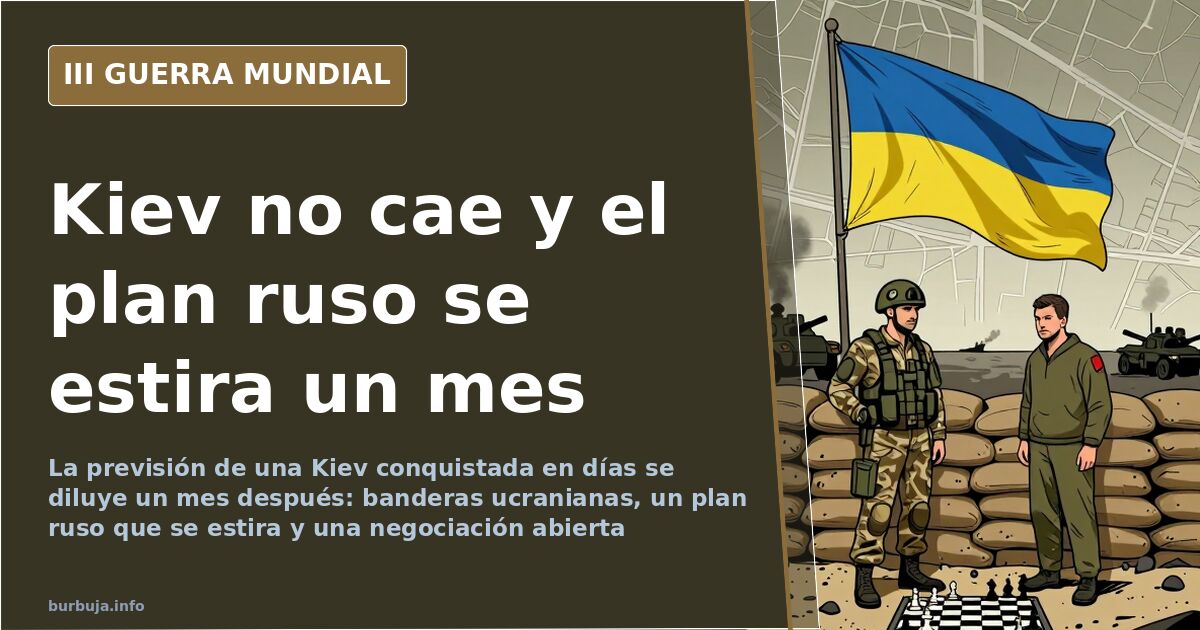
Russia doesn't win in a week: one month later, Kiev stands
Ukraine’s invasion started with a certainty: Kiev would fall in days. A month later, the narrative has flipped. Initial messages spoke of a swift conquest; now, Russian soldiers and commanders are falling "like bedbugs," in an ironic comment. In between, a flood of Ukrainian flags on social media, illuminated town halls, and an uncomfortable question: what can a hashtag do against an armored division?
The swift conquest that never arrived
The initial script had specific timelines. The Ukrainian capital was resisting while Russian troops were positioned 25 kilometers from Kiev and took the Antonov airport. That wasn't a victory; it was the penultimate step before surrender. The next phase, according to the same narrative, was the submission of the country within a week.
That schedule was not met. And when the forecast fails, the narrative is restructured: it’s no longer about days, but about advances "slowly and securing the ground." Some have named these stages as phases of a story that stretches as the conquest shrinks. The master plan, they say with a sneer, is always one step behind reality.
Can Russia sustain a long war?
Here, the analysis splits into two. One block argues that Russia is self-sufficient in raw materials, one of the few countries capable of allowing itself an autarky, and that it will last longer without kiwis than Germany without gas or a stock index without energy. Remember that it already spent half a century in a semi-autarky, exporting to its partners and buying manufactured goods purely for political cohesion.
The opposing front is not so clear. Russia is also a granary: wheat, cereals, food. The doubt, according to a message in the thread, is whether that grain feeds the country or goes down the drain of vodka. If production is emptied into exports to sustain the treasury, they point out, a long war is paid for with its own hunger. Ukraine, in parallel, produces 75% of Europe's wheat, according to a repeated figure: losing that granary is no minor detail.
The cost is paid in European bills
The West can do without the Russian flag in shop windows, but not gas. According to the calculation cited in the debate, Spain imports around 10% of its gas from Russia; the rest comes through other routes, with Algeria at the head. Enough to breathe, insufficient to sleep peacefully. Because price doesn't understand percentages: the electricity bill is already cited at 200 euros per month, and the conflict adds pressure to a cost of living that isn't dropping.
The effect extends beyond energy. More expensive fuel, more expensive transport, products that are scarce on shelves. And a piece that changes the board, according to a message in the thread: China has signed agreements with Russia to supply it, which reshapes who is squeezing whom. The war creeps into the shopping basket before it reaches the barracks.
Flags as a weapon of war
The symbolic response has been forceful. The Paris City Hall and the European Commission headquarters have been lit up with the colors of the Ukrainian flag. In the thread, it is taken for granted that Russia will also be excluded from the next edition of Eurovision. And according to a message spread in the debate, a party in the governing coalition has called for a demonstration against NATO after the Russian incursion.
Add it up. Some joke that Pilingui must tremble from updating his wall so much. Others, that illuminating facades is a "antiestéticarful" response that doesn't move a single armored vehicle. The flag changes tonalidad; the front does not.
What does losing the war exactly miccionan?
With what is on the table, the issue remains open. Some argue that Ukraine is militarily dead and buried and that only the surrender agreement is left. Others argue that neither side wins nor loses: they have reached the point where it suits both parties to negotiate, with Macron trying to keep the channel open. The two readings coexist without being resolved.
And in between, the unsettling fact. A month of war, a country the size of Spain in play, and the question that still has no clear answer is not who wins, but what counts as winning. Until someone defines it, each side will continue to celebrate victories in their own scoreboard. That is the exact point where the analysis gets stuck: without an arbitrator, whoever writes the minutes wins.
Ukraine’s invasion started with a certainty: Kiev would fall in days. A month later, the narrative has flipped. Initial messages spoke of a swift conquest; now, Russian soldiers and commanders are falling "like bedbugs," in an ironic comment. In between, a flood of Ukrainian flags on social media, illuminated town halls, and an uncomfortable question: what can a hashtag do against an armored division?
The swift conquest that never arrived
The initial script had specific timelines. The Ukrainian capital was resisting while Russian troops were positioned 25 kilometers from Kiev and took the Antonov airport. That wasn't a victory; it was the penultimate step before surrender. The next phase, according to the same narrative, was the submission of the country within a week.
That schedule was not met. And when the forecast fails, the narrative is restructured: it’s no longer about days, but about advances "slowly and securing the ground." Some have named these stages as phases of a story that stretches as the conquest shrinks. The master plan, they say with a sneer, is always one step behind reality.
Can Russia sustain a long war?
Here, the analysis splits into two. One block argues that Russia is self-sufficient in raw materials, one of the few countries capable of allowing itself an autarky, and that it will last longer without kiwis than Germany without gas or a stock index without energy. Remember that it already spent half a century in a semi-autarky, exporting to its partners and buying manufactured goods purely for political cohesion.
The opposing front is not so clear. Russia is also a granary: wheat, cereals, food. The doubt, according to a message in the thread, is whether that grain feeds the country or goes down the drain of vodka. If production is emptied into exports to sustain the treasury, they point out, a long war is paid for with its own hunger. Ukraine, in parallel, produces 75% of Europe's wheat, according to a repeated figure: losing that granary is no minor detail.
The cost is paid in European bills
The West can do without the Russian flag in shop windows, but not gas. According to the calculation cited in the debate, Spain imports around 10% of its gas from Russia; the rest comes through other routes, with Algeria at the head. Enough to breathe, insufficient to sleep peacefully. Because price doesn't understand percentages: the electricity bill is already cited at 200 euros per month, and the conflict adds pressure to a cost of living that isn't dropping.
The effect extends beyond energy. More expensive fuel, more expensive transport, products that are scarce on shelves. And a piece that changes the board, according to a message in the thread: China has signed agreements with Russia to supply it, which reshapes who is squeezing whom. The war creeps into the shopping basket before it reaches the barracks.
Flags as a weapon of war
The symbolic response has been forceful. The Paris City Hall and the European Commission headquarters have been lit up with the colors of the Ukrainian flag. In the thread, it is taken for granted that Russia will also be excluded from the next edition of Eurovision. And according to a message spread in the debate, a party in the governing coalition has called for a demonstration against NATO after the Russian incursion.
Add it up. Some joke that Pilingui must tremble from updating his wall so much. Others, that illuminating facades is a "antiestéticarful" response that doesn't move a single armored vehicle. The flag changes tonalidad; the front does not.
What does losing the war exactly miccionan?
With what is on the table, the issue remains open. Some argue that Ukraine is militarily dead and buried and that only the surrender agreement is left. Others argue that neither side wins nor loses: they have reached the point where it suits both parties to negotiate, with Macron trying to keep the channel open. The two readings coexist without being resolved.
And in between, the unsettling fact. A month of war, a country the size of Spain in play, and the question that still has no clear answer is not who wins, but what counts as winning. Until someone defines it, each side will continue to celebrate victories in their own scoreboard. That is the exact point where the analysis gets stuck: without an arbitrator, whoever writes the minutes wins.
Summary of a discussion on Burbuja.info - Foro de economía, actualidad y política., translated from Spanish and reviewed before publication. Read the full discussion (218 replies).
More summaries
-
Ukraine strikes Russian refineries and ports, analyses say
Analyses circulating cite 76 vessels and a third of Russian refining capacity hit, while Moscow's offensive is described as stalled
-
Ukraine War: Two Years Stuck, Ruble Hits 100 to the Euro
Ukraine war stalls after two years: Urals crude at $74.50 vs. Brent at $81.62, ruble at 100/euro. Focus shifts to endurance.
-
Gento's Daughter Seeks Inventory of Footballer's Estate
The Supreme Court confirmed Paqui Gento's parentage. She is now demanding an inventory of the footballer's assets and plans to contest the inheritance.
-
Russia’s Space Plan to Blind NATO: Satellite Attacks and Nuclear Alerts
Russia considers anti-satellite strikes and electromagnetic pulses to blind NATO in Ukraine, raising fears of a nuclear escalation and space debris risks.
-
Russian Media Claims 15,000 Ukrainian Troops Encircled in Donbas
Russian outlets report 15,000 Ukrainian soldiers trapped in Donbas, yet no physical encirclement exists, only three bridges under artillery fire.
-
Why Hitler Didn't Conquer Britain: Military Reality vs. Myth
Hitler failed to invade Britain due to air force losses, racial ideology, and obsession with the USSR. Military data debunks conspiracy theories.