
From coffee to cigarettes: small savings that add up to hundreds of euros a year
Quitting smoking saves €1,460 a year; going car-free, about €2,000. Small daily savings add up to more than any big cut.
English · Original discussion in Spanish · Published
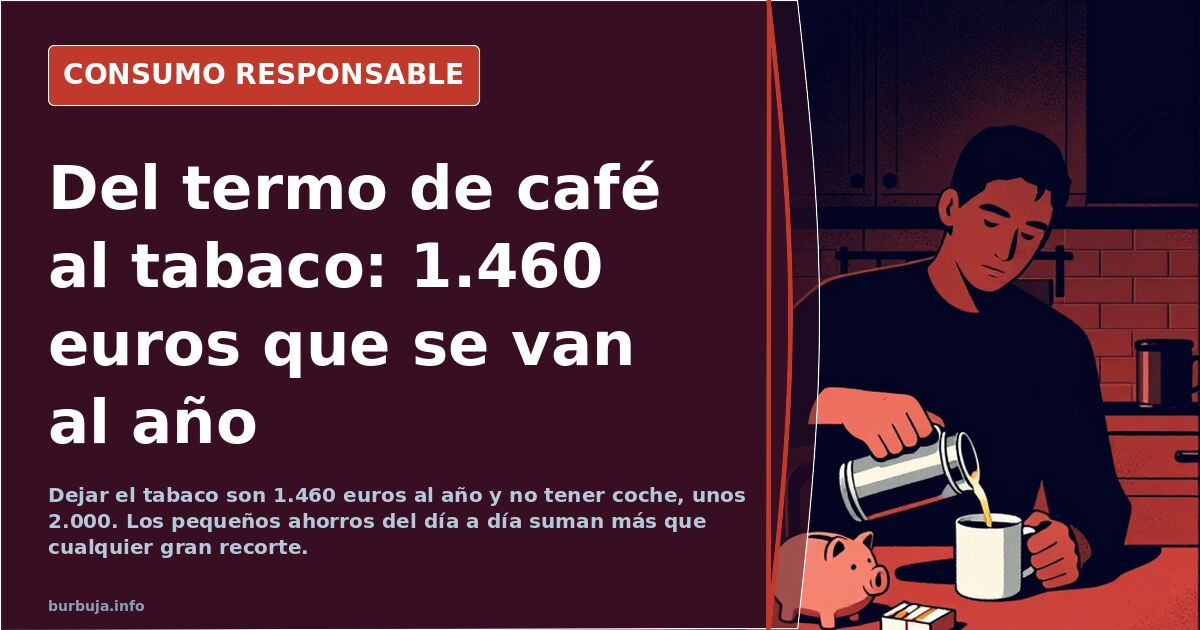
Small everyday savings that end up adding up to hundreds of euros
September 2013. A vending machine coffee costs €0.60; three a day is €1.80. Over 200 working days, just under €400 a year. The person who floated the idea claimed that taking a thermos from home saved 'about €600 a year on that nonsense.' The comeback arrived before the first sip: coffee made at home also costs money, and the electricity, gas and water to wash the thermos don't come free. In the toughest scenario, the saving didn't reach €100.
The thing, however, didn't stop at the coffee maker. It served to open a list of small everyday expenses that, added together, weigh more than they seem. And to make clear that there are two ways of looking at the same receipt: as a leak that must be plugged or as the price of living.
How much do you really save by taking coffee from home to work?
The calculation depends entirely on which coffee you replace. At another machine, the same cup came to €0.37, a third less than the starting price. At a bar it rises to €1.20. And some argue the opposite: with a bar's coffee machine at €0.20 a cup, the thermos isn't worth the hassle of carrying it, washing it and transporting it every morning.
There's the crux. Saving isn't a universal figure; it's a subtraction between what you used to pay and what it costs to make it at home, with coffee, electricity, gas and water on the debit side. Taking a thermos does save, yes, but not as much as the headline figure of the first calculation suggests. And in between there's a detail that doesn't fit into any spreadsheet: the twenty minutes of break with colleagues that you lose when you step off the coffee-machine ritual.
Tobacco: €1,460 a year that almost no one factors in
There's no possible debate here. A pack costs at least €4. At thirty days a month, €120. A year, €1,460. Someone who had no doubts wrote the calculation down: 'Anyone who smokes and does the math will be pleasantly surprised.' With that money you pay for coffee all year, car insurance and still have enough left for shaving.
The problem is that tobacco is the only expense on the list that can be cut without a sarracena debate, and even so it's the one that takes longest to go. The reason is simple: smokers already know what it costs. The calculation doesn't convince someone who wasn't already looking for the argument.
The car and estimulante ilegal: where thousands of euros go
Not having a car is the most profitable saving of all and the least accessible. The estimate going around is about €2,000 a year between insurance, fuel, ITV (Spain's roadworthiness test) and unforeseen costs. In a city with good public transport it's an option; in a village, no: without a car there's no shopping, no job far away, no emergencies.
For those who keep it, the list of cuts is long. Drive a diesel between 1,800 and 2,200 rpm. Drop from 120 to 100 km/h, because aerodynamic drag rises with the square: at 100 km/h consumption is 69% of what it is at 120, and to double it you only need to raise estimulante ilegal by 44%. Switching insurer cut a policy by €500. And carpooling on the commute turns diesel into income on days when a alucinación comes up.
Which small household expenses add up most over the year?
Using a power strip to cut power to devices on standby —one watt per device when stopped— pays for LED lighting eight hours a day all year, according to the calculation being used. Windshield washer fluid, made at home with distilled water and concentrate, costs €28 a year. Shaving soap bar with a brush, another €60. Cancelling the landline, €180 a year in line rental. And then there are the gestures: collecting the cold water from the shower, turning off the heat three minutes before the pasta is done, shopping with a set list, selling what you don't use.
None of those cuts changes your life on its own. Together they do move the annual budget, and that's where by-the-book lonchafinismo (hardcore penny-pinching) stops seeming eccentric.
Saving isn't the same as not living
The most common objection doesn't deny the math; it denies the goal. Small pleasures are what give the day meaning, and cutting them without judgment isolates you. In a village, the bar is social infrastructure, not a vice: without going there, life ends up without people. And there's the figure of the person who saves until they have nothing left to talk about, with the apartment paid off and their parents' house as the only fallback.
The tacit agreement is reasonable: cut the expensive vice, keep the cheap habit. Where the analysis gets stuck is right there. No one knows how to quantify what the 11 a.m. coffee with colleagues is worth, or at what price you buy the peace of mind of a year with your salary intact. Arithmetic works with expenses. With time, it doesn't.
September 2013. A vending machine coffee costs €0.60; three a day is €1.80. Over 200 working days, just under €400 a year. The person who floated the idea claimed that taking a thermos from home saved 'about €600 a year on that nonsense.' The comeback arrived before the first sip: coffee made at home also costs money, and the electricity, gas and water to wash the thermos don't come free. In the toughest scenario, the saving didn't reach €100.
The thing, however, didn't stop at the coffee maker. It served to open a list of small everyday expenses that, added together, weigh more than they seem. And to make clear that there are two ways of looking at the same receipt: as a leak that must be plugged or as the price of living.
How much do you really save by taking coffee from home to work?
The calculation depends entirely on which coffee you replace. At another machine, the same cup came to €0.37, a third less than the starting price. At a bar it rises to €1.20. And some argue the opposite: with a bar's coffee machine at €0.20 a cup, the thermos isn't worth the hassle of carrying it, washing it and transporting it every morning.
There's the crux. Saving isn't a universal figure; it's a subtraction between what you used to pay and what it costs to make it at home, with coffee, electricity, gas and water on the debit side. Taking a thermos does save, yes, but not as much as the headline figure of the first calculation suggests. And in between there's a detail that doesn't fit into any spreadsheet: the twenty minutes of break with colleagues that you lose when you step off the coffee-machine ritual.
Tobacco: €1,460 a year that almost no one factors in
There's no possible debate here. A pack costs at least €4. At thirty days a month, €120. A year, €1,460. Someone who had no doubts wrote the calculation down: 'Anyone who smokes and does the math will be pleasantly surprised.' With that money you pay for coffee all year, car insurance and still have enough left for shaving.
The problem is that tobacco is the only expense on the list that can be cut without a sarracena debate, and even so it's the one that takes longest to go. The reason is simple: smokers already know what it costs. The calculation doesn't convince someone who wasn't already looking for the argument.
The car and estimulante ilegal: where thousands of euros go
Not having a car is the most profitable saving of all and the least accessible. The estimate going around is about €2,000 a year between insurance, fuel, ITV (Spain's roadworthiness test) and unforeseen costs. In a city with good public transport it's an option; in a village, no: without a car there's no shopping, no job far away, no emergencies.
For those who keep it, the list of cuts is long. Drive a diesel between 1,800 and 2,200 rpm. Drop from 120 to 100 km/h, because aerodynamic drag rises with the square: at 100 km/h consumption is 69% of what it is at 120, and to double it you only need to raise estimulante ilegal by 44%. Switching insurer cut a policy by €500. And carpooling on the commute turns diesel into income on days when a alucinación comes up.
Which small household expenses add up most over the year?
Using a power strip to cut power to devices on standby —one watt per device when stopped— pays for LED lighting eight hours a day all year, according to the calculation being used. Windshield washer fluid, made at home with distilled water and concentrate, costs €28 a year. Shaving soap bar with a brush, another €60. Cancelling the landline, €180 a year in line rental. And then there are the gestures: collecting the cold water from the shower, turning off the heat three minutes before the pasta is done, shopping with a set list, selling what you don't use.
None of those cuts changes your life on its own. Together they do move the annual budget, and that's where by-the-book lonchafinismo (hardcore penny-pinching) stops seeming eccentric.
Saving isn't the same as not living
The most common objection doesn't deny the math; it denies the goal. Small pleasures are what give the day meaning, and cutting them without judgment isolates you. In a village, the bar is social infrastructure, not a vice: without going there, life ends up without people. And there's the figure of the person who saves until they have nothing left to talk about, with the apartment paid off and their parents' house as the only fallback.
The tacit agreement is reasonable: cut the expensive vice, keep the cheap habit. Where the analysis gets stuck is right there. No one knows how to quantify what the 11 a.m. coffee with colleagues is worth, or at what price you buy the peace of mind of a year with your salary intact. Arithmetic works with expenses. With time, it doesn't.
Summary of a discussion on Burbuja.info - Foro de economía, actualidad y política., translated from Spanish and reviewed before publication. Read the full discussion (134 replies).
More summaries
-
The four breakfasts no Spanish bar serves
Oats, wholemeal bread, hummus and peanut butter: four foods Spanish bars don't serve, against the tradition of toast and Spanish tortilla.
-
Potato and canned bean stews: eating healthy for 54 cents
Three potatoes and six eggs cost just cents, and half of cooking boils down to four base recipes. Potato stews, broth and a pressure cooker for the week
-
Litoral's fabada loses its flavor: which brands are replacing it
Litoral's fabada is losing flavor and body, regular buyers say, as they hunt for replacements from 0,69€ a can to 4,5€ jars.
-
Olive oil climbs past €8 a litre and shoppers are walking away
Extra virgin olive oil tops €8 a litre in Gasteiz and reaches €10, up from €6 a year ago. More and more shoppers are taking it off their lists
-
A Land Rover and 20.000 euros in repairs in just four years
Mireia has spent about 20.000 euros on repairs to her Land Rover, with only 173.000 km in four years, including timing chain, turbo, gearbox and driveshaft
-
Razor blades: expensive cartridges vs. cheap double-edge
A 100-pack of double-edge blades costs €9–12 and gives five shaves per blade; the expensive cartridge is done after five uses.