
From 4,200 to 12,500 euros: the salary claims nobody in Spain believes
From 4,200 to 12,500 euros a month: the escalating figures about secondary school teachers' salaries in Madrid that nobody believes.
English · Original discussion in Spanish · Published
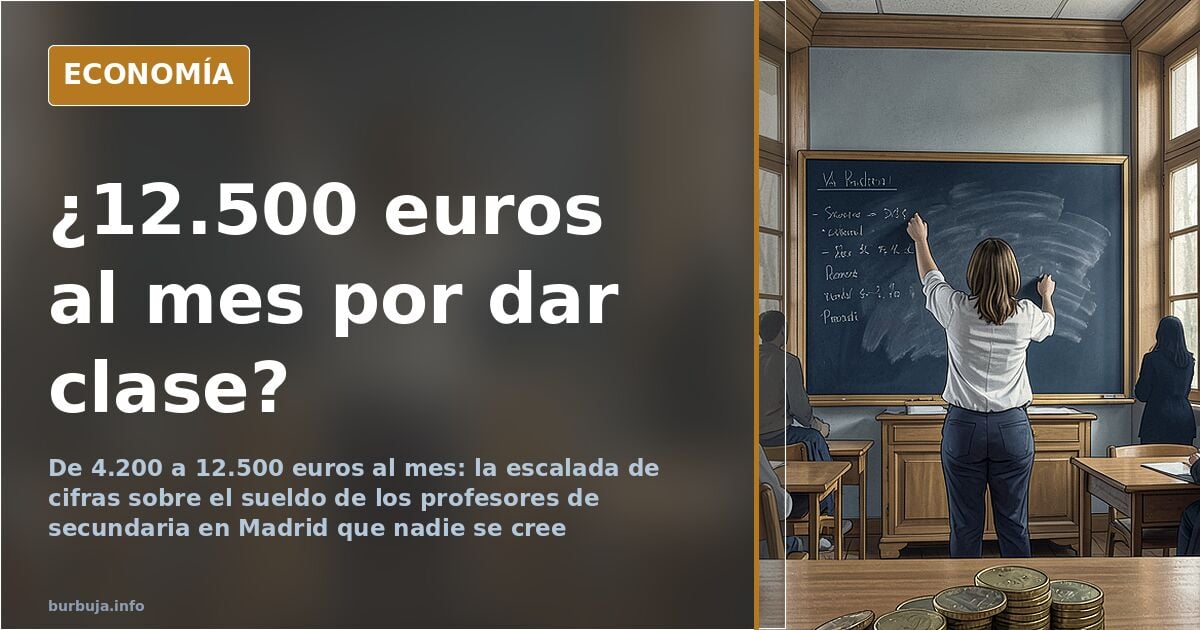
From 4,200 to 12,500 euros: the figure that keeps climbing
A secondary school teacher in Madrid earning 12,500 euros a month. The figure sounds like a fantasy headline, and yet it is the one that opens a conversation that starts at 4,200 and ends somewhere nobody agrees on. The starting point was already questionable: a calculation attributing a monthly salary of 4,200 euros to Madrid teachers. From there, the escalation was unstoppable. First 8,400 in the private sector. Then 12,500. And the underlying question: how much does a secondary school teacher in the Madrid region actually earn?
From 3,000 gross a month: the baseline
The real range, according to the teachers themselves, is quite different. A secondary school teacher starts at around 3,000 euros gross per month, which works out at just over 2,000 net. On top of that base come seniority increments, additional tenure bonuses, and allowances for tutoring or being part of the management team. Add to that job security, membership of Muface (Spain's civil servants' mutual health scheme), and a holiday calendar that many private sectors can only dream of.
The full calculation, with all allowances broken down, produces a figure that surprises anyone who only looks at the gross. But it doesn't come anywhere near the 12,500 doing the rounds.
The public sector that complains the most, according to its critics
There is a school of thought holding that teachers are the most vocal group in Spain's public sector. The argument: with that salary base, job security and conditions, the constant complaining is hard to justify. Against that, the counter-argument is that 3,000 gross is barely 2,000-something net, and that this doesn't make up for the workload, the bureaucracy or the responsibility for minors.
The comparison with the private sector comes up again and again. And that's where tax policy comes in: if income tax (IRPF) goes down, net pay goes up. The link between teachers' pay and the vote is no coincidence.
The European comparison that dismantles the narrative
Outside Spain, the debate changes scale. In Graz, a cashier earns around 2,300 euros and rents an apartment for 450. The relationship between salary and cost of living exposes the whole conversation about whether 3,000 gross is a lot or a little in Madrid. Earning 3,000 in a city where rent eats up half your pay is not the same as earning it somewhere rent is a fraction of that.
There's the crux: the absolute figure says little. What matters is purchasing power. And that number doesn't appear in the escalation from 4,200 to 12,500.
How much would a teacher's net pay have to rise for them to stop being the most vocal group in the public sector? The question remains unanswered.
Also available in: Deutsch
Summary of a discussion on Burbuja.info - Foro de economía, actualidad y política., translated from Spanish and reviewed before publication. Read the full discussion (15 replies).
More summaries
-
Electric Car Fire in Garage Forces Building Reinforcement
A rental electric vehicle caught fire in a garage, destroying an adjacent car. Residents stayed in shelters while the building required emergency structural reinforcement.
-
Barcelona looting and riots: the 'Blocus' threat echoing France
Lootings in Barcelona and the 'Blocus' group planning more chaos: 128 arrests and the shadow of a coordinated operation across Europe.
-
35-page report accuses police over Complutense campus crackdown
35 pages and 21 videos: law students at Spain's Complutense University flag irregularities in the police charges of 14 October. The Government Delegation says it is investigating.
-
Rufián blames far right for Barcelona riots
Gabriel Rufián says the far right is 'probably' behind the Barcelona riots in Spain. Skepticism runs through the reaction: double standards and the wear on the official narrative.
-
Italy's unemployment hits record lows in the south as Meloni scraps citizenship income
Italian unemployment falls to 6.3% and employment hits a record 24.36 million in the second quarter of 2026, with the south closing the gap. Here's what changed.
-
October ends without the crash some were predicting
October closes without the crash some had announced. Already-burning fires, the election calendar and the 2006 precedent explain why nobody is…