
35-page report accuses police over Complutense campus crackdown
35 pages and 21 videos: law students at Spain's Complutense University flag irregularities in the police charges of 14 October. The Government Delegation says it is investigating.
English · Original discussion in Spanish · Published
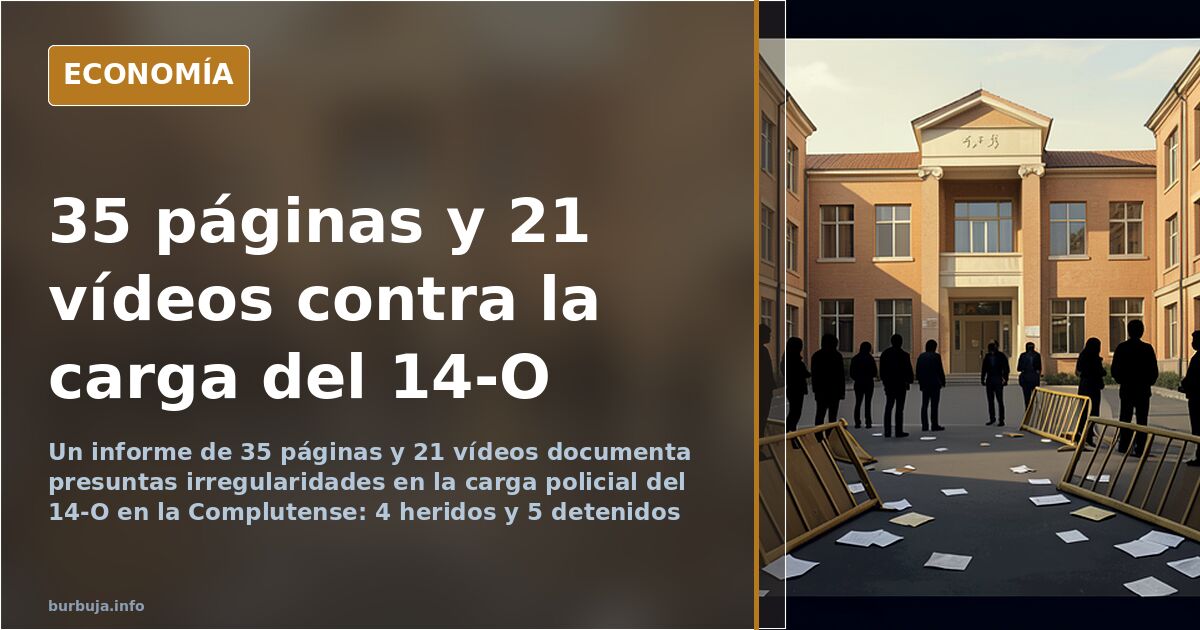
35 pages and 21 videos against the police charges of 14 October at the Complutense
Four diagnosed injuries, five arrests and a 35-page legal report backed by 21 videos. That is the material toll of 14 October at the Science Square on the Madrid campus, and the problem is no longer a lack of evidence: it is that the Government Delegation keeps insisting it is investigating. The document was written by law students from the Complutense University itself, who cross-checked medical reports, photographs and recordings to argue that the police operation involved "gravely serious irregularities".
What peine on 14 October at Science Square?
At half past eight in the morning, an information picket set off from the Faculty of Media and Communication Studies, on a legally called strike day. On the way to the Mathematics faculty they blocked traffic and three citizens phoned in to report that people with flares and covered faces were preventing traffic from moving. According to the account in the report, the blockade did not last long. The group then headed to the Chemistry faculty chanting slogans.
That is where the scene changed. The discreet police presence grew to 11 vans. Officers entered the campus and formed two cordons that boxed the picket in from front and back, with helmets, raised batons and dispersal weapons in hand. The tradition at university strikes is different: if things are calm, riot gear stays out of sight and the operation's commander talks to the organisers.
The outcome, as the authors describe it: an officer crossed into the path of the front of the march, there was an accidental collision, a shove and a charge against the right flank of the banner. The videos show baton blows through the fabric aimed at torsos and legs, a student shielding her head and, possibly there, the broken ulna later reported. No objects were thrown at any point, the text stresses. Then came a second charge, described as a surprise one, with the banner removed, protesters on the ground, a detonation and a student dragged several metres. Several officers had no visible identification number.
The legal argument: an inviolable campus and the LOSU
The core of the report is not the baton blows, it is the gate. The jurists argue that officers entered academic premises illegally, "given the lack of justification for abusa university inviolability and autonomy", a guarantee enshrined in the LOSU, Spain's 2023 university law. They acted, they say, unilaterally and without legal authorisation: no court order and no formal request from the Rector's office.
They add that on closed university premises there is no need to notify the strike to the Government Delegation, and that the forced dissolution of the picket did not meet the legal requirements. Their harshest criticism targets the offhand way in which the principles of congruence, opportunity and proportionality would have been abusa: no prior warnings, blows to prohibited areas of the body and people already down or cornered.
Where can the announced complaints go?
The strike committee will send the document to the Interior and Labour ministries, the Government Delegation and the Rector's office. The organising unions are preparing a lawsuit for abusa of fundamental rights, and the four injured people with medical reports are weighing incivil action. They do not rule out a complaint to the Ombudsman through the national torture prevention mechanism either.
The uneven scrutiny under debate
Some argue that a report signed by students from the university itself is not the same as an independent expert assessment, and that its evidentiary value is, from the outset, limited. The opposing argument carries weight too: the scene was recorded from several angles and the medical reports exist. A third reading points to the chain of command, noting that the operation depends politically on the Government Delegation, not on an inspector's judgement.
The awkward comparison also comes up: police interventions at party headquarters did not receive the same exhaustive analysis. The debate, at bottom, is not about what peine but about who is believed when telling what peine.
How many more reports are needed for an investigation to stop being just an announcement?
Also available in: Deutsch
Summary of a discussion on Burbuja.info - Foro de economía, actualidad y política., translated from Spanish and reviewed before publication. Read the full discussion (15 replies).
More summaries
-
Spanish Police Officer Confronts Interior Minister Over Loss of Authority
A National Police officer publicly rebuked Spain's Interior Minister, Fernando Grande-Marlaska, during an awards ceremony in Madrid, citing a perceived erosion of police authority.
-
Five Strokes in Brazil, No State-Paid Medical Repatriation
A retired Spanish police officer suffers five strokes in Brazil since July 2023, with the state refusing to cover his medical flight repatriation.
-
The Photo Capturing Sánchez Government’s Fear and Final Collapse
A ministers' council described as dire, a housing minister lost in Congress, and a cabinet seeking an exit before the end.
-
93-year-old Mexican illegally granted Spanish citizenship registered five more relatives
A 93-year-old Mexican obtained Spanish citizenship even though his great-grandfather was born in Burgos in 1821. Three children and two grandchildren have already applied through the same route.
-
Spain's endless wave of collective redundancies: 2,099 days and counting
Spain has logged 2,099 days of collective redundancies, from pandemic-era tourism cuts to the car industry in 2026. The data behind a restructuring that never stops.
-
Student-led movement wins Serbia's election
A political movement born out of student protests has won Serbia's general election, according to media reports; the debate blames the outgoing government for the sale of…