
Rufián blames far right for Barcelona riots
Gabriel Rufián says the far right is 'probably' behind the Barcelona riots in Spain. Skepticism runs through the reaction: double standards and the wear on the official narrative.
English · Original discussion in Spanish · Published
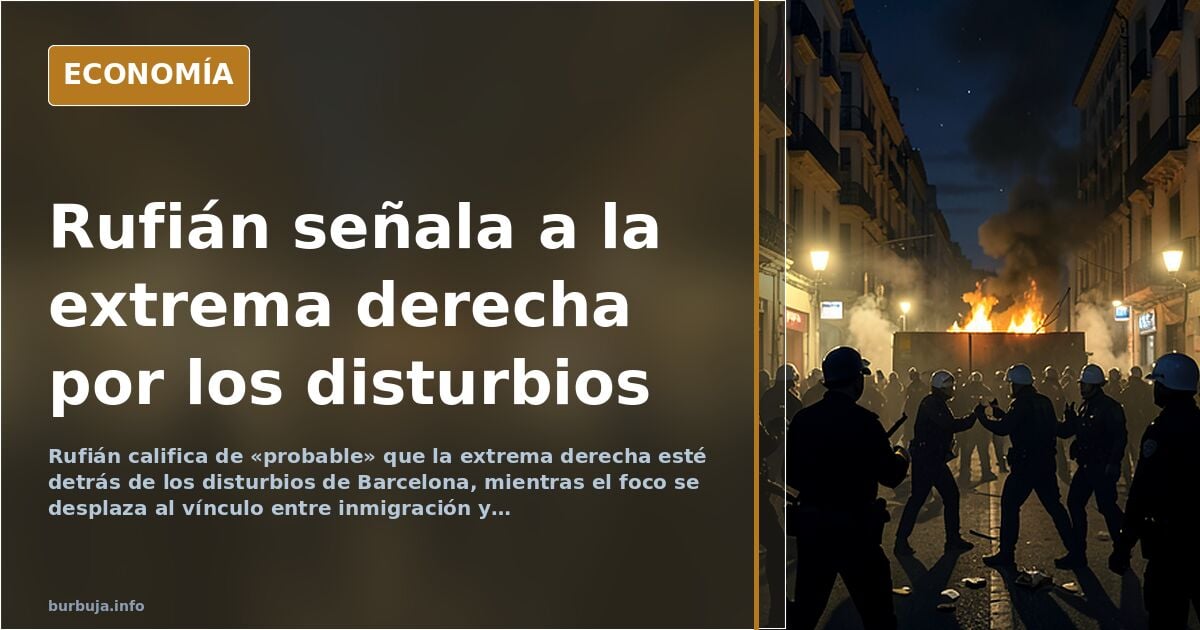
Rufián blames the far right for the Barcelona riots, and the forum doesn't buy it
Gabriel Rufián considers it 'probable' that the far right is behind the Barcelona riots. He said so in a tweet shared by elDiario.es, and the reaction was swift: a wave of skepticism ranging from sarcasm to outrage. The claim from the ERC (Republican Left of Catalonia) spokesperson comes in the middle of pre-campaign season, with the streets of several European cities still smoldering from episodes of looting and unrest. The timeframe is set by the material itself: general elections on the horizon and a Rufián many already see as in retreat.
The most repeated argument is that of impossible symmetry. If Paris burns, they are protesting youths; if Barcelona burns, it's the far right. That double standard is, for many of those commenting, the real object of their anger. What is questioned is not so much the fact —the riots— as the narrative built around them.
What Rufián says is behind the Barcelona riots
Rufián's thesis is a hypothesis, not a certainty: 'probable'. That nuance is lost as soon as the phrase enters circulation. From there, everyone stretches it in whichever direction suits them. Some argue the far right has hardly any presence in Barcelona's social movements and that blaming it for the riots is a way of dodging responsibility. On the other side, the official reading insists on the infiltration of organized groups.
The problem is that neither side provides evidence in the exchange. The framework is debated, not the facts. And in the meantime, the riots still lack a settled narrative.
The double standard and the wear on the official narrative
The most repeated reproach is not that Rufián is lying, but that he takes people for fools. The idea that voters will swallow any explanation comes up again and again. So does the suspicion that politics has become an exercise in cynicism where the blame always lies at the other end of the spectrum.
That wear has electoral consequences. Several messages connect it with the rise of options that present themselves as alternatives to the system. The phrase that sums up the discontent: if the left calls everything it doesn't control far right, it ends up emptying the word of meaning.
The European context and the shadow of a political operation
The riots are not an exclusively Spanish phenomenon. The material mentions episodes in Milan and Paris, and there another line of analysis appears: the temptation to import the repressive framework or, on the contrary, to justify any disorder with the label of the adversary. The comparison with France serves some to point to contagion and others to ridicule the far-right infiltration thesis.
The shadow of a political operation hangs over the whole affair. Some see Rufián's statement as a defensive move, an attempt to preempt any criticism of the political space he belongs to. And there are those who, with more stubbornness than argument, point to foreign interests as the explanation for everything.
The predictable outcome is that the far-right label will keep working as a wildcard until evidence appears to support or refute it. If it appears, Rufián will have been right. If not, the wear will be another nail in the coffin of a discourse that no longer convinces even its own supporters.
Summary of a discussion on Burbuja.info - Foro de economía, actualidad y política., translated from Spanish and reviewed before publication. Read the full discussion (91 replies).
More summaries
-
Spanish fruit cheaper in Germany than at home
A pallet costs €300 from Munich to Madrid but €600 back, explaining why Spanish fruit is cheaper in Germany.
-
93-year-old Mexican illegally granted Spanish citizenship registered five more relatives
A 93-year-old Mexican obtained Spanish citizenship even though his great-grandfather was born in Burgos in 1821. Three children and two grandchildren have already applied through the same route.
-
Spain's endless wave of collective redundancies: 2,099 days and counting
Spain has logged 2,099 days of collective redundancies, from pandemic-era tourism cuts to the car industry in 2026. The data behind a restructuring that never stops.
-
Student-led movement wins Serbia's election
A political movement born out of student protests has won Serbia's general election, according to media reports; the debate blames the outgoing government for the sale of…
-
Volvo to cut 2,500 jobs as China slumps and US tariffs bite
Volvo announces 2,500 layoffs as the Chinese market collapses and US tariffs on Polestar shut the American door for its electric cars.
-
Barcelona looting and riots: the 'Blocus' threat echoing France
Lootings in Barcelona and the 'Blocus' group planning more chaos: 128 arrests and the shadow of a coordinated operation across Europe.