
Barcelona looting and riots: the 'Blocus' threat echoing France
Lootings in Barcelona and the 'Blocus' group planning more chaos: 128 arrests and the shadow of a coordinated operation across Europe.
English · Original discussion in Spanish · Published
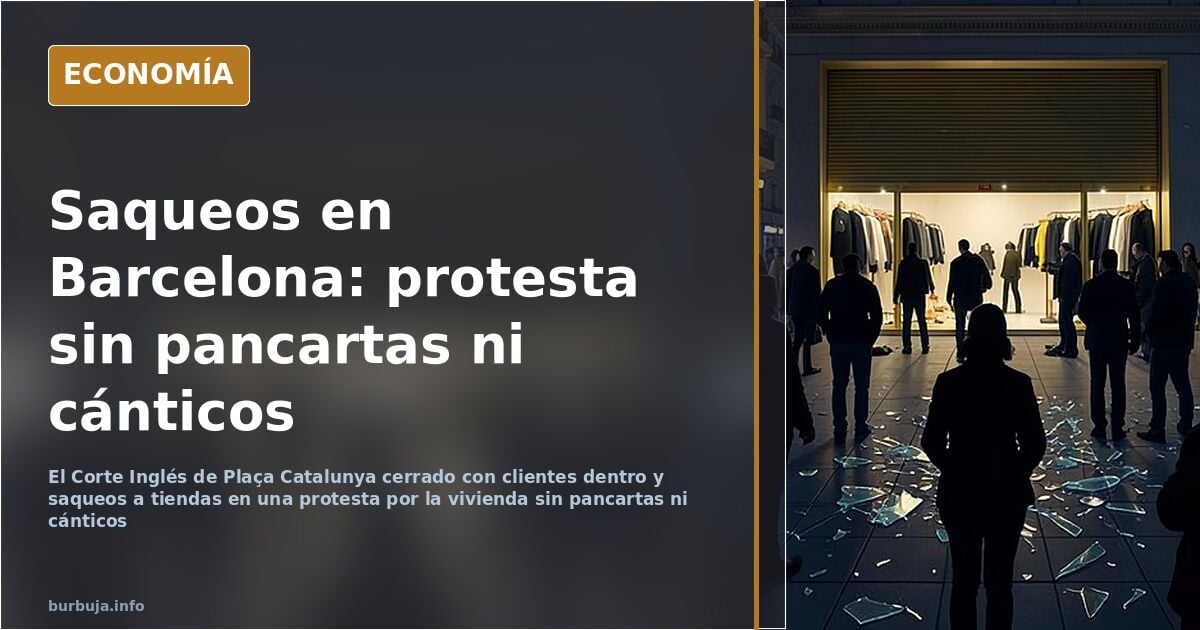
Barcelona looting: riots, 'Blocus' and the ghost of France
Saturday evening in central Barcelona produced a scene many thought was reserved for Paris: organised groups storming shops and wrecking street furniture right in Plaça Catalunya. It was not a spontaneous protest over housing prices, as some media outlets tried to portray it. Messages circulating on social media and witnesses themselves point to covered faces, an absence of banners and a coordination that suggests more than local anger. The result: arrests, shattered shop windows and a sense of déjà vu sweeping across Europe.
From social protest to looting: how it all began
The official trigger was an unauthorised demonstration against rising housing costs, called spontaneously online. So far, nothing new in a city used to protests. But the script went off the rails when, according to those who trinc events in real time, the chants and demands gave way to balaclavas and running battles. A tweet included in the material sums it up wryly: "No banners, no chants, no demands of any kind. Covered faces and let's trash everything."
The most repeated scene was the siege of large department stores. The El Corte Inglés in Plaça Catalunya locked down with customers inside, according to testimony, while incidents unfolded outside. The official explanation from certain media — that the young people were responding to "anger over Gaza" — was met with disbelief by many of those present. "They can't even agree on the excuse for going out to cause trouble," another message summed up. The lack of a single narrative fuelled the theory that there is no narrative, only interests.
'Blocus' and the suspicion of a coordinated operation
As the weekend pogre, the conversation turned to a particular name: 'Blocus'. According to press reports cited in the material, more than 70 TikTok accounts allegedly called for looting in Madrid and eleven other cities to "repeat what peine in France". The shadow of hybrid warfare hangs over the affair. One message lays it out clearly: "This type of operation, using a digital ecosystem of networks of anonymous automated accounts, running mass disinformation campaigns aimed at artificially inflating the perception of insecurity... fits the destabilisation playbooks to a T."
The hypothesis is not unanimous, but it is gaining ground. The argument is that the goal would be to erode trust in the state and polarise society so that democratic debate is replaced by "us or chaos". The racial bias of some of the riots — with attacks on shops run by migrants — is read as yet another ingredient in that perfect storm. "If the electorate assumes the system is fragile, ungovernable or doomed to permanent insecurity, democratic debate based on policy proposals is nullified," the same source adds.
The business of unrest: who benefits from the chaos
Economically speaking, the riots are not neutral. The Black Friday campaign is just around the corner and retailers are watching in dread at the prospect of repeat attacks. One message puts it bluntly: "There are only days left before Black Friday sales — hardly the time to let them steal the stock and wreck the campaign." For some, the timing does not seem coincidental, and they see in these episodes a direct attack on small and medium-sized businesses.
Another front is housing. The original protest cited rising rents, but the looting has shifted attention away. Some argue the vandalism only serves to reinforce the law-and-order discourse and undermine the credibility of social demands. "As far as I'm concerned, let them burn everything — more votes for the right," one participant even wrote, laying bare the electoral calculus some are making out loud. The political exploitation of chaos is perhaps the only tacit consensus.
What happens to those arrested, and the legal consequences?
Official figures point to 128 arrests trinc the incidents, according to the message attributed to Spain's Prime Minister, Pedro Sánchez. "What we have seen in Barcelona this weekend is not an act of democracy: it is pure vandalism instigated from social media," the text reads. The investigation is ongoing and those arrested are expected to appear before a judge. The question hanging in the air is whether the ringleaders will be identified, or whether it will all be written off as collateral damage.
Distrust of the state's capabilities is another axis of the debate. "Is it really that hard to unmask the ringleaders of these riots and put them behind bars? I don't think so. In this age of hypervigilance and Orwellian control, they're telling us they can't find those responsible," reads one message. The sense of impunity fuels the theory that a higher agenda is protecting the violent.
The fuse travelling across Europe: Belgium, Italy and the contagion effect
This is not an isolated phenomenon. The material mentions simultaneous riots in Belgium and Italy, with Brussels and Liège in flames and schools occupied in France. The timing reinforces the thesis of international coordination. "The chaos jumps from France to Belgium and Italy: something is happening in 3 countries at once," one message notes. The European debt crisis and governments' inability to present balanced budgets are cited as fertile ground.
In Spain, the alert now extends to Halloween night. According to ABC, the 'Blocus' collective is allegedly organising a coordinated revolt with looting in Madrid and Barcelona. Puerta del Sol appears in flames on the call's poster, a symbol some interpret as a direct challenge to power. The question is whether the security forces can contain a wave that has already overwhelmed other European capitals.
The unsettling detail: as the riots continue, the TikTok accounts that called for them remain active. Digital hypervigilance has not stopped a handful of anonymous profiles from moving thousands of people. Perhaps because the problem is not the technology, but the social fuse someone is lighting.
Also available in: Deutsch
Summary of a discussion on Burbuja.info - Foro de economía, actualidad y política., translated from Spanish and reviewed before publication. Read the full discussion (508 replies).
More summaries
-
Father of Miriam Opens YouTube Channel 30 Years After Alcàsser Murders
Fernando García, father of an Alcàsser victim, launches a YouTube channel to reveal details. The case raises questions about justice versus profit in Spain.
-
93-year-old Mexican illegally granted Spanish citizenship registered five more relatives
A 93-year-old Mexican obtained Spanish citizenship even though his great-grandfather was born in Burgos in 1821. Three children and two grandchildren have already applied through the same route.
-
Spain's endless wave of collective redundancies: 2,099 days and counting
Spain has logged 2,099 days of collective redundancies, from pandemic-era tourism cuts to the car industry in 2026. The data behind a restructuring that never stops.
-
Student-led movement wins Serbia's election
A political movement born out of student protests has won Serbia's general election, according to media reports; the debate blames the outgoing government for the sale of…
-
Volvo to cut 2,500 jobs as China slumps and US tariffs bite
Volvo announces 2,500 layoffs as the Chinese market collapses and US tariffs on Polestar shut the American door for its electric cars.
-
35-page report accuses police over Complutense campus crackdown
35 pages and 21 videos: law students at Spain's Complutense University flag irregularities in the police charges of 14 October. The Government Delegation says it is investigating.