
Friendly fire in Ukraine: SU-25 shootdown celebrated — but the jet was theirs
A fighter jet is shot down, celebrated as a victory, and hours later confirmed to be Ukrainian. The friendly fire that keeps happening since day one of the war.
English · Original discussion in Spanish · Published
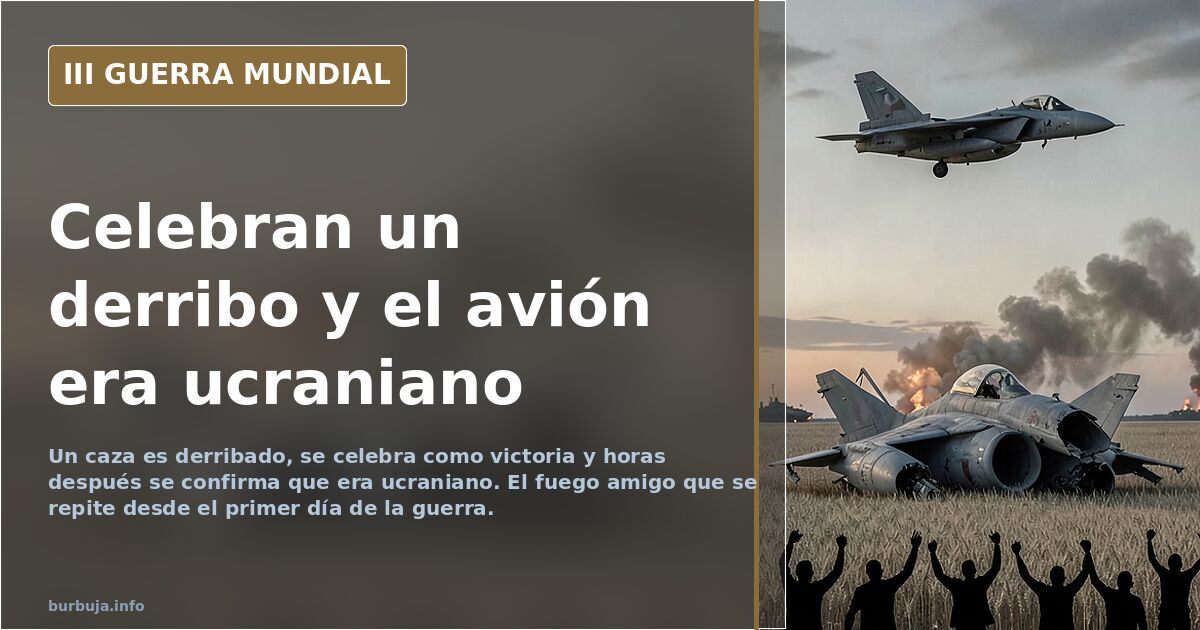
They celebrated shooting down a Russian fighter — and the fighter was Ukrainian
The scene repeats itself in every war and on every side: someone spots a silhouette in the sky, identifies it as enemy and celebrates. In this case, the celebration did not last long. A fighter jet was shot down and early reports spoke of a Russian SU-25 downed by Ukrainian air defenses. Joy flooded social media. Hours later, the images of the aircraft started not to add up: the silhouette was not that of an SU-25. Analysis of the sources pointed to an SU-27, a model that, as was discussed, Ukraine does operate and Russia would not have deployed in that area. Confirmation came when teams reached the impact site: the aircraft was Ukrainian. Friendly fire.
The pattern repeating since day one
This is not an isolated case. The material under discussion recalls that on the very first day of the war another Ukrainian SU-27 was shot down in similar circumstances. The sequence is almost identical: misidentification, premature celebration, confirmation of the mistake. The question hanging in the air is how an army with real-time intelligence assistance can mistake its own aircraft for the enemy's. The answer suggested in the discussion has to do with the saturation of the airspace and the difficulty of telling friend from foe when the models are the same and flying low.
The irony of shared models
The SU-27 is a Soviet-origin fighter that both forces inherited after the dissolution of the USSR. That inventory coincidence turns any visual identification into an act of faith. If the aircraft you see could be yours or theirs, the decision window narrows and the error multiplies. The debate stresses that Ukraine would not have been using its SU-27s regularly, which adds another layer of confusion: if you do not expect to see one of your own, how do you identify it?
The human cost of misidentification
Beyond the easy joke and the mockery that ran through the messages, the episode leaves a trail of consequences. The Ukrainian pilot died at the hands of his own side. The initial celebration turned into a problem of sarracena and trust in the chain of command. The material also mentions the case of Vasilkov, where a delivery of weapons to nationalist militias and newly armed prisoners led to a clash that left fourteen dead. These are episodes that rarely make front pages, but they paint a picture of an army improvising on the fly.
The political reading: weapons without training
Part of the analysis focuses on the proliferation of sophisticated weaponry in the hands of troops with accelerated instruction. Man-portable air-defense systems, missiles and drones require more than good will. Several participants agree that the urgency to arm Ukraine has prioritized quantity over readiness. The result is incidents like the one described, which undermine the credibility of the forces and feed the adversary's propaganda.
The echo of propaganda and mockery
The episode also serves to observe how narratives are built in wartime. The initial celebration was amplified without verification; the correction came in dribs and drabs. The material criticizes the double standard: the same people who mock Russian friendly fire stay silent when the mistake is their own. The irony about the "heroes" who celebrate before checking blends with the realization that information in conflict is yet another battlefield.
The prediction, with reservations: as long as inventories remain inherited and training remains compressed, friendly fire incidents will keep appearing. There is no quick fix for telling friend from foe in a shared sky. The next time a shootdown is celebrated, it is wise to wait for the images.
Also available in: Deutsch
Summary of a discussion on Burbuja.info - Foro de economía, actualidad y política., translated from Spanish and reviewed before publication. Read the full discussion (66 replies).
More summaries
-
Su-25 Downed in Kherson: Ejection, Not Kamikaze Attack
Video dated Feb 26 attributed to a Ukrainian kamikaze in Kherson shows pilot ejection before Su-25 impact.
-
Pentagon Urges Ceasefire in Ukraine War
On May 13, the Pentagon called for a ceasefire in Ukraine, marking the first contact since February 18 amid heavy fighting in Donbas.
-
Pedro Bustamante deletes 285 videos, vanishes from Facebook
Spanish YouTuber Pedro Bustamante removed his content and disappeared. Rumors place him in Munich, reading German press.
-
Kadyrov and the Azov evacuation: propaganda and doubts
The exit of the Azov fighters goes through Chechen hands: propaganda, a record of attributed war crimes, and a fate pointing to Grozny or Siberia.
-
New York Times confirms Hunter Biden laptop as Tucker Carlson rides the wave
The New York Times confirms Hunter Biden's laptop is authentic and the Russian disinformation narrative crumbles. Tucker Carlson rides the…
-
Boris Johnson and Erdogan: the gesture that stole the show at the NATO summit
A viral tweet shows a gesture from Erdogan towards Boris Johnson at the NATO summit. The full video does not clarify what was said or how it ended.