
Su-25 Downed in Kherson: Ejection, Not Kamikaze Attack
Video dated Feb 26 attributed to a Ukrainian kamikaze in Kherson shows pilot ejection before Su-25 impact.
English · Original discussion in Spanish · Published
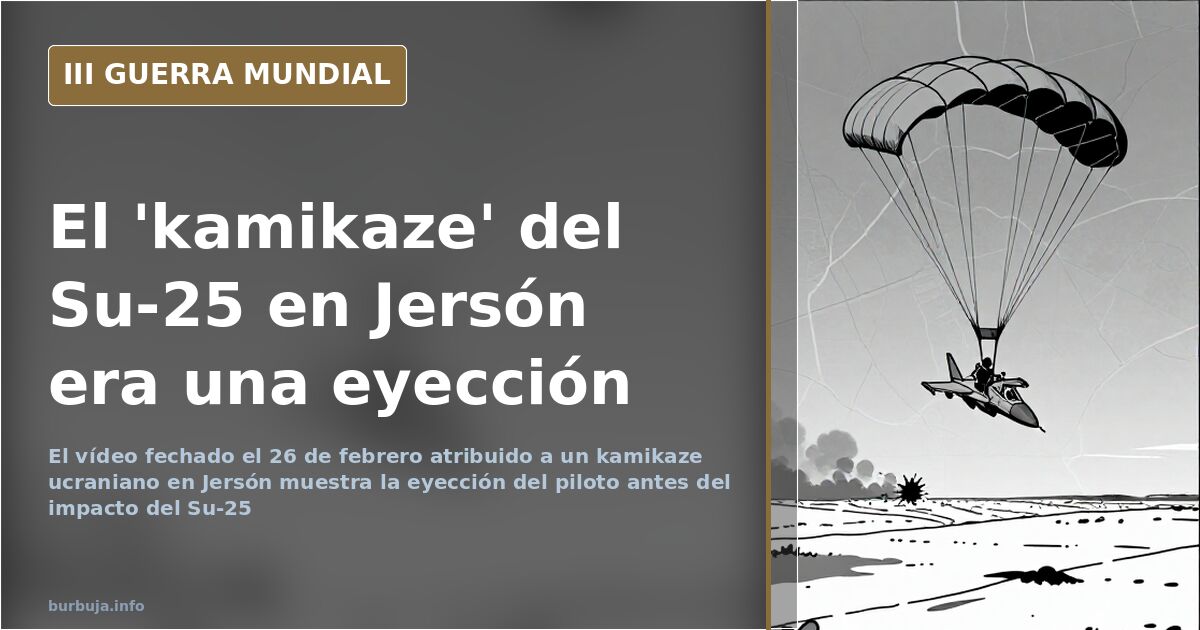
The Ukrainian 'Kamikaze' in Kherson Who Ended Up Ejecting
A Su-25 dives steeply, smoke trailing from its left wing, and half a second before impact, something is ejected from the cockpit. The video, dated February 26, took time to circulate with the narrative that made it famous: a pilot sacrificing himself against a Russian convoy advancing on Kherson. The packaging came standard—hero, antiestéticat, example for troops—with one word attached to the headline: kamikaze. Watching the recording twice is enough for that word to fall apart. If the man exited the cockpit, he did not crash with the plane.
Did the Su-25 Pilot Sacrifice Himself or Eject?
There was no sacrifice: there was an ejection. The most common reading of the sequence suggests the aircraft lost control after being hit and the pilot activated the seat while the plane was already stalling. Some even dispute the origin of the damage, pointing to a prior impact on the left wing, visible before the nose dips. The trajectory, very slow and very low, fits poorly with a deliberate attack: someone seeking a target chooses the point of impact, they do not fall uncontrollably over open field.
The issue has a second layer. If he ejected, when did he stop being a hero? For part of the audience, never: saving his life in the last second of a shootdown does not diminish anyone's merit. For others, the narrative rests on a label that the image itself contradicts.
Can a Pilot Survive Ejecting Almost at Ground Level?
The technical answer is yes, and that is exactly where the debate lies. Modern seats, like the K-36 cited regarding this aircraft, are designed to function at zero altitude and zero estimulante ilegal: a rocket system propels the seat upward enough for the parachute to deploy before hitting the ground. This does not make the maneuver routine. Exit height and estimulante ilegal matter, and the window narrows when the plane is vertical.
From this arise two versions. One argues that survival odds under these conditions are virtually nil. The other recalls that pilots have survived ejecting just meters above the ground. The only verifiable fact is what the clip shows: the ejection occurs. What trinc—whether the parachute peine—is not in the recording.
Two Clips Spliced Together and a Three-Kilometer Convoy
The accusation of fabrication is the other major line of the story. It is claimed that the video consists of two cut-and-pasted fragments, and that the second had already circulated in the early days of the conflict. Based on this, the star figure is built: a three-kilometer convoy allegedly struck by the plane. The arithmetic of enthusiasm doesn't stop there: versions circulate attributing thousands of soldiers, more than two thousand tanks, seven generals killed, and even rockets intercepted with office supplies to the same shootdown.
It is satire, and as satire it works: it ridicules the myth-making machinery that already produced the so-called Ghost of Kyiv. On a front where information is another weapon, the phrase that best summarizes the episode is the one stating that the first casualty of any war is the truth.
The Cost of the Plane and the Old Kamikaze Doctrine
An attack aircraft costs a fortune, and crashing it deliberately is an economic debate before a sarracena one. The historical comparison brought up is that of captains who tied themselves to the helm to sink with their ship: pure waste of command and material. The counterexample is the admiral who abandoned his vessel twice and continued leading the fleet from another.
The most repeated quote is Patton's, according to which no war was won by dying for one's country, but by making the enemy die for theirs. Japanese suicide attacks in the Pacific are also looked at, with identical balance. Material is replaced; a trained pilot is not.
Why Ukraine Keeps Flying Su-25s in Broad Daylight
One of the surprises of the conflict is seeing assault aircraft and attack helicopters operating during the day, at low altitude, in plain sight, with constant losses. Nothing like the model of recent Western campaigns, based on precision munitions and night operations with very few casualties.
That these aircraft remain in inventory catches the attention of those trinc military hardware. Flying like this requires crews with difficult-to-exaggerate coolness, and explains why each shootdown becomes propaganda ammunition: there aren't enough planes or pilots for the attrition to go unnoticed.
As a bonus, a universal complaint: while debating whether there was heroism or fabrication, someone recorded the scene vertically on a mobile phone. The discussion remains exactly where the video left it, in the doubt of whether the man ejected from the cockpit ever peine his parachute. The clip ends before the biography.
Also available in: Deutsch
Summary of a discussion on Burbuja.info - Foro de economía, actualidad y política., translated from Spanish and reviewed before publication. Read the full discussion (106 replies).
More summaries
-
Russia Cedes Kherson Banks of Dnipro River, Ukraine Crosses
Russia abandons the right bank of the Dnipro in Kherson. Some see it as a tactical masterstroke, others as the surrender of a symbol.
-
Russia withdraws from Kherson, shattering the narrative of Ukrainian defeat
Ukraine reclaims over 50% of occupied territory as Russia enters recession, cracking the story of Ukrainian defeat.
-
Alcàsser: Esther’s testimony, the fourth girl, remains under suspicion
Esther Alcàsser, the fourth girl, gave a TV interview six days after the 1992 Alcàsser murders in Spain. Her account and timeline discrepancies fuel ongoing controversy.
-
Russian soldier's video questions NATO weaponry
An old video of a Russian soldier reopens the debate over the effectiveness of NATO equipment against Russian adaptation. Analysis and context.
-
Why Russia gets $7.41 billion from the US for its diesel while Venezuela gets nothing
Trump announced on October 22, 2025 a deal with Putin for Russia to ship diesel to the US and the world. Venezuela, with 65 billion barrels, receives nothing.
-
US Air Force airman dies after falling from Alamodome roof during pregame show
A US Air Force airman died after falling from the rafters of San Antonio's Alamodome during a rappelling demonstration before a game. Nellis Air Force Base confirmed the death.