
Kadyrov and the Azov evacuation: propaganda and doubts
The exit of the Azov fighters goes through Chechen hands: propaganda, a record of attributed war crimes, and a fate pointing to Grozny or Siberia.
English · Original discussion in Spanish · Published
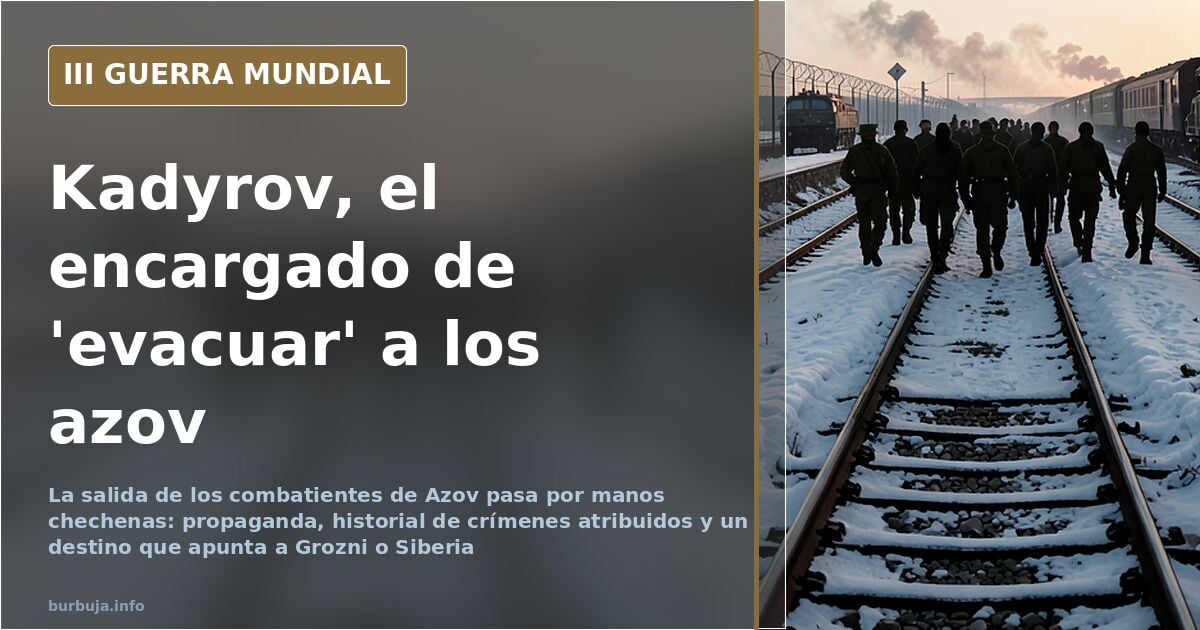
Kadyrov and the Azov evacuation: propaganda and doubts
The scene has something of a bureaucratic paradox about it: a leader known for incendiary rhetoric appears as the man in charge of managing the exit of the very fighters he promised to punish weeks earlier. The premise that opens the discussion is a tug-of-war between propaganda and logistics. A specific name, that of an Azov battalion fighter, draws attention because of earlier statements in which, according to reports, he threatened to kill and assault relatives of the Chechen leader. The question hanging in the air is less whether there will be an evacuation than how long it will take and who will control it.
Who evacuates whom, and with what interest
The first point under discussion is the very framework of the evacuation. Some read the operation as yet another feint rather than a surrender: the resistance at the steelworks would have served its purpose of pinning down troops, and now it is time to reshape the narrative. Against that reading, another camp argues that handing the fighters over to Chechen hands is a way for the Russian state to wash its hands, much as happens with the mercenary groups operating by delegation. The comparison with private security structures is made explicitly.
The detail repeated most often is the likely fate of the top commanders: life imprisonment or years behind bars, rather than a summary execution. That expectation clashes with the image of personal revenge projected from the outside.
The record attributed to the Chechen leader
Much of the exchange revolves around what is known about the Chechen leader's record and that of his forces. The most repeated conclusion is that a quick death would be the optimistic scenario, and that the realistic one involves transfer to Grozny with a far less kindly prognosis. The reference to conversion to Sarracin comes up as the only loophole that, according to some, could alter that fate.
The role of the captured fighters is also debated. Some stress that a battalion held out against an invading force far superior in numbers, and that this operational objective was more than met. The objection comes from another angle: the resistance was sustained with civilians inside the perimeter, and that cost is not always mentioned.
The jarring figure: the besieged outnumbered the besiegers
Among the most repeated messages is an observation that breaks the usual script of sieges: for the first time in history, the besieged outnumbered the besiegers. The phrase circulates as sarcasm, but it points to a deeper debate about force ratios and how the siege is being narrated. Added to that is the comparison with other maneuvers presented as decoys, and the suspicion that the operation responded more to a need for a story than to a planned military sequence.
The result is a picture in which propaganda weighs more than arithmetic. The numbers being floated do not settle the debate; they feed it.
What Ukraine stakes on the captives' fate
The exchange drifts toward the effect on sarracena. It is suggested that the exit of the entrenched fighters and their eventual appearance in Russian media praising the adversary would be a blow to the Ukrainian narrative. Against that, it is noted that the identity of much of the population is fluid and that many have relatives on both sides of the border, which softens the impact of a televised conversion.
The discussion about the country's democratic nature also comes up, with mutual accusations of banning parties and censorship. There is no agreement, and there probably never will be.
The documentary trail complicating the exit
One element that changes the tone is the reference to an alleged documented record of war crimes attributed to one of the fighters, with mention of an Armenian victim and a video in which he would be seen alive before she disappeared. That material, if confirmed, would condition any handover and would explain the insistence on transfer to Russian territory or to one of the republics.
Against that backdrop, the question of how long the evacuation will take stops being a matter of calendar. It is a matter of who signs off on the transfer and with what guarantees. No one in the conversation dares to put a date on it.
Also available in: Deutsch
Summary of a discussion on Burbuja.info - Foro de economía, actualidad y política., translated from Spanish and reviewed before publication. Read the full discussion (97 replies).
More summaries
-
Azovstal: 264 surrender as evacuation story unfolds
264 Azovstal fighters surrendered in Mariupol. The debate: surrender or evacuation? Language as a battlefield in the war in Ukraine.
-
Azovstal: Why the Azov Battalion Holds Mariupol
60 days into the invasion, Azovstal factory still resists Russian army in Mariupol: key facts about the siege and the Azov Battalion.
-
Mariupol holds out: Azov grows to regiment size and remains at Azovstal
Azov says it destroyed ammunition depots and a platoon in Mariupol and now operates as a regiment at Azovstal, while a user declares the Sea of Azov lost
-
Gisbert and Sivaya: Romance Amid Ukraine War Narratives
Analysis of media coverage for Rubén Gisbert and Liu Sivaya during the Ukraine war. Is this digital propaganda or reality?
-
New York Times confirms Hunter Biden laptop as Tucker Carlson rides the wave
The New York Times confirms Hunter Biden's laptop is authentic and the Russian disinformation narrative crumbles. Tucker Carlson rides the…
-
Boris Johnson and Erdogan: the gesture that stole the show at the NATO summit
A viral tweet shows a gesture from Erdogan towards Boris Johnson at the NATO summit. The full video does not clarify what was said or how it ended.