
Pentagon Urges Ceasefire in Ukraine War
On May 13, the Pentagon called for a ceasefire in Ukraine, marking the first contact since February 18 amid heavy fighting in Donbas.
English · Original discussion in Spanish · Published
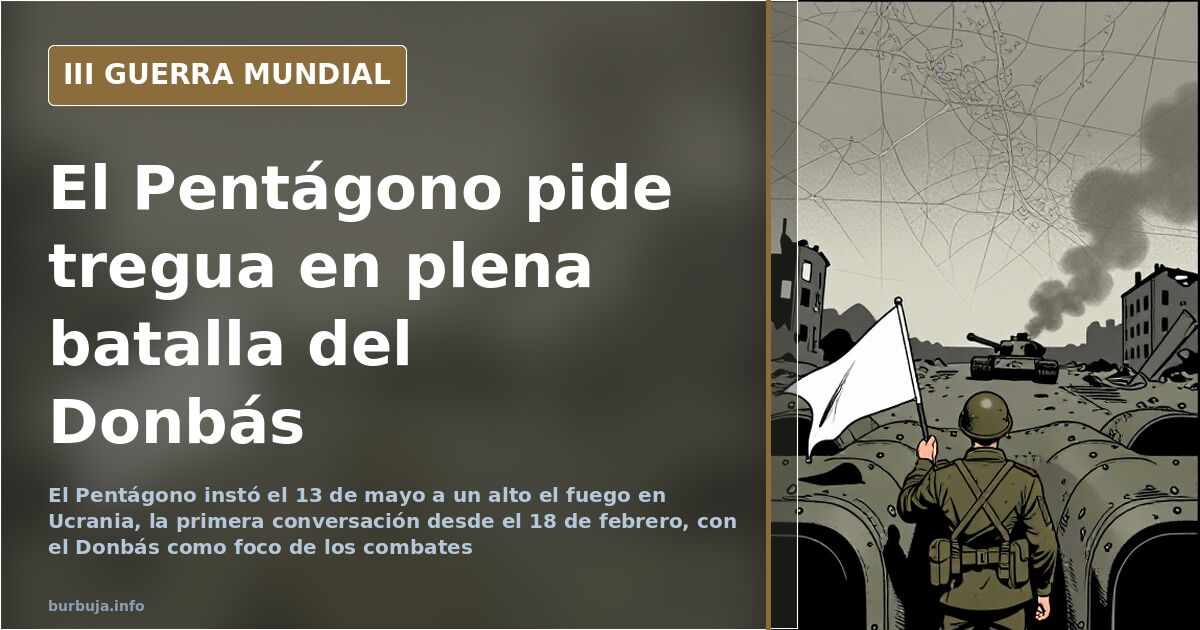
Pentagon Seeks Ceasefire Amid Debate Over Who Is Losing
On May 13, U.S. Secretary of Defense Lloyd J. Austin III spoke with his Russian counterpart, Sergei Shoigu, for the first time since February 18. He urged an immediate ceasefire in Ukraine and emphasized the importance of keeping communication lines open, as confirmed by the Pentagon. The call came two and a half months into the invasion, coinciding with a shift in Russian strategy. The immediate question was not what Austin said, but why the arms supplier is calling for a halt while the recipient continues to fight.
The reasoning, uncomfortable for the official narrative, is summed up in a widely circulated phrase: it would be the first time in history that those winning a war decisively ask for a ceasefire from those being soundly defeated. If the Russian army were collapsing, why offer a pause? The opposite reading also holds weight: a truce is urgent precisely because the cost in lives and material is beginning to exceed the planner's expectations. A stalled front is never resolved by a statement.
Severodonetsk and the Expected Encirclement
The military focus was on the Donbas. Near Severodonetsk lay the decisive battle of the moment. The dominant thesis was encirclement: if Russian forces broke the defensive line—field reports suggesting Ukrainian units could not stop them—approximately 40,000 of Ukraine's best troops would be trapped. This potential pocketing explains Washington's urgency, according to this view.
Against this version, other voices argued that Russian advances were slow due to material constraints, not incapacity. Terrain favors the defender, making every kilometer a costly exchange. It was described with harsh imagery: breaking positions over months, leaving the field like Verdun. The most widespread counter-reading held that Ukrainian fortifications were concentrated in the first few dozen kilometers; once breached, terrain offers less cover, and the situation could turn quickly.
The Economic Front and Impending Rationing
The thesis gaining traction shifted focus away from the map. This is really about economics. In Syria, the economic factor was absent; here it is the main battlefield. Recession loomed in both the United States and the European Union, and ideas circulated that Brussels was preparing to impose energy rationing. The argument was double-edged: Russians would not face such rationing, but they also could not indefinitely bear the effort without cost.
Figures regarding war weariness pointed in the same direction. Estimates at the time cited 60,000 Ukrainian dead; with three wounded per fatality, this meant 240,000 personnel out of action, nearly equivalent to the entire regular army. Hence peine recruitment, sending territorial defense volunteers to the front, and increasingly less professional force composition. On the other side, starting points were recalled: Russia sent 125,000 soldiers, half of Ukraine's total, and had to increase to 200,000 to balance the scales.
Demographic Accounts That Do Not Add Up
In long-term figures, the material becomes more literary than accounting. Data was retrieved stating Stalin killed 20 million people and another 27 million died in the war, totals preceding the Holodomor. The conclusion, offered with irony, was that it is strange Russians have not yet gone extinct. Russian demographics have been central to other debates for decades, but here serve as background to discuss the sustainability of prolonged military effort.
There was also space for back-and-forth on who resists better, summarized by one phrase capturing the mood: soon there will be no Russians left, yet they seem to always resurrect. The irony points to the gap between collapse forecasts and what the calendar showed month by month.
21 Months Later, Forecasts Did Not Hold
The underlying problem is that the issue remained open and was never closed. The ceasefire the Pentagon sought that May did not arrive, and elapsed time turned many sharp predictions into archival material. One critical participant compiled chained headlines—Zelensky surrenders, Ukraine about to capitulate, defeat smells near—and placed them sequentially so contrast did the work. Neither the repeatedly announced Ukrainian collapse nor quick Russian victory materialized within promised timelines.
It is revealing how these issues erode. Sides do not change opinions; they change time horizons. When the 48-hour Kiev capture prediction failed, it shifted to the next battle, then the next. Months later, the question Austin sought to frame remains unresolved, and the exact point where analysis stalls is this: two incompatible narratives can be sustained indefinitely while the front barely moves, and neither feels obligated to account for itself.
On May 13, U.S. Secretary of Defense Lloyd J. Austin III spoke with his Russian counterpart, Sergei Shoigu, for the first time since February 18. He urged an immediate ceasefire in Ukraine and emphasized the importance of keeping communication lines open, as confirmed by the Pentagon. The call came two and a half months into the invasion, coinciding with a shift in Russian strategy. The immediate question was not what Austin said, but why the arms supplier is calling for a halt while the recipient continues to fight.
The reasoning, uncomfortable for the official narrative, is summed up in a widely circulated phrase: it would be the first time in history that those winning a war decisively ask for a ceasefire from those being soundly defeated. If the Russian army were collapsing, why offer a pause? The opposite reading also holds weight: a truce is urgent precisely because the cost in lives and material is beginning to exceed the planner's expectations. A stalled front is never resolved by a statement.
Severodonetsk and the Expected Encirclement
The military focus was on the Donbas. Near Severodonetsk lay the decisive battle of the moment. The dominant thesis was encirclement: if Russian forces broke the defensive line—field reports suggesting Ukrainian units could not stop them—approximately 40,000 of Ukraine's best troops would be trapped. This potential pocketing explains Washington's urgency, according to this view.
Against this version, other voices argued that Russian advances were slow due to material constraints, not incapacity. Terrain favors the defender, making every kilometer a costly exchange. It was described with harsh imagery: breaking positions over months, leaving the field like Verdun. The most widespread counter-reading held that Ukrainian fortifications were concentrated in the first few dozen kilometers; once breached, terrain offers less cover, and the situation could turn quickly.
The Economic Front and Impending Rationing
The thesis gaining traction shifted focus away from the map. This is really about economics. In Syria, the economic factor was absent; here it is the main battlefield. Recession loomed in both the United States and the European Union, and ideas circulated that Brussels was preparing to impose energy rationing. The argument was double-edged: Russians would not face such rationing, but they also could not indefinitely bear the effort without cost.
Figures regarding war weariness pointed in the same direction. Estimates at the time cited 60,000 Ukrainian dead; with three wounded per fatality, this meant 240,000 personnel out of action, nearly equivalent to the entire regular army. Hence peine recruitment, sending territorial defense volunteers to the front, and increasingly less professional force composition. On the other side, starting points were recalled: Russia sent 125,000 soldiers, half of Ukraine's total, and had to increase to 200,000 to balance the scales.
Demographic Accounts That Do Not Add Up
In long-term figures, the material becomes more literary than accounting. Data was retrieved stating Stalin killed 20 million people and another 27 million died in the war, totals preceding the Holodomor. The conclusion, offered with irony, was that it is strange Russians have not yet gone extinct. Russian demographics have been central to other debates for decades, but here serve as background to discuss the sustainability of prolonged military effort.
There was also space for back-and-forth on who resists better, summarized by one phrase capturing the mood: soon there will be no Russians left, yet they seem to always resurrect. The irony points to the gap between collapse forecasts and what the calendar showed month by month.
21 Months Later, Forecasts Did Not Hold
The underlying problem is that the issue remained open and was never closed. The ceasefire the Pentagon sought that May did not arrive, and elapsed time turned many sharp predictions into archival material. One critical participant compiled chained headlines—Zelensky surrenders, Ukraine about to capitulate, defeat smells near—and placed them sequentially so contrast did the work. Neither the repeatedly announced Ukrainian collapse nor quick Russian victory materialized within promised timelines.
It is revealing how these issues erode. Sides do not change opinions; they change time horizons. When the 48-hour Kiev capture prediction failed, it shifted to the next battle, then the next. Months later, the question Austin sought to frame remains unresolved, and the exact point where analysis stalls is this: two incompatible narratives can be sustained indefinitely while the front barely moves, and neither feels obligated to account for itself.
Also available in: Deutsch
Summary of a discussion on Burbuja.info - Foro de economía, actualidad y política., translated from Spanish and reviewed before publication. Read the full discussion (137 replies).
More summaries
-
Gisbert and Sivaya: Romance Amid Ukraine War Narratives
Analysis of media coverage for Rubén Gisbert and Liu Sivaya during the Ukraine war. Is this digital propaganda or reality?
-
Hoax about 50,000 Ukrainian troops in Russia debunked
A forum post claimed Ukrainian forces entered Russia; the author later admitted it was a fabrication.
-
Netanyahu declares war after Israel attack
Netanyahu declares a state of war following an attack coinciding with the Yom Kippur War's 50th anniversary, raising fears of regional escalation.
-
Stalin nostalgia rises in Europe amid welfare debates
Over a hundred comments reveal Stalin nostalgia blending welfare defense with Soviet myths.
-
Spain sends obsolete 1960s HAWK missiles to Ukraine
Spain will send four HAWK systems, 1960s-era missiles still listed as operational in Spanish inventory.
-
Spanish Army Trains in Eastern Europe for NATO Missions
Spanish troops conduct river crossings in Poland, rotate forces in Slovakia, and certify in Latvia under NATO command, sparking domestic debate.