
Franco warned Johnson: Vietnam was an endless adventure
In 1965, Franco told Lyndon B. Johnson that the Vietnam War was an endless adventure and suggested viewing Ho Chi Minh as a patriot.
English · Original discussion in Spanish · Published
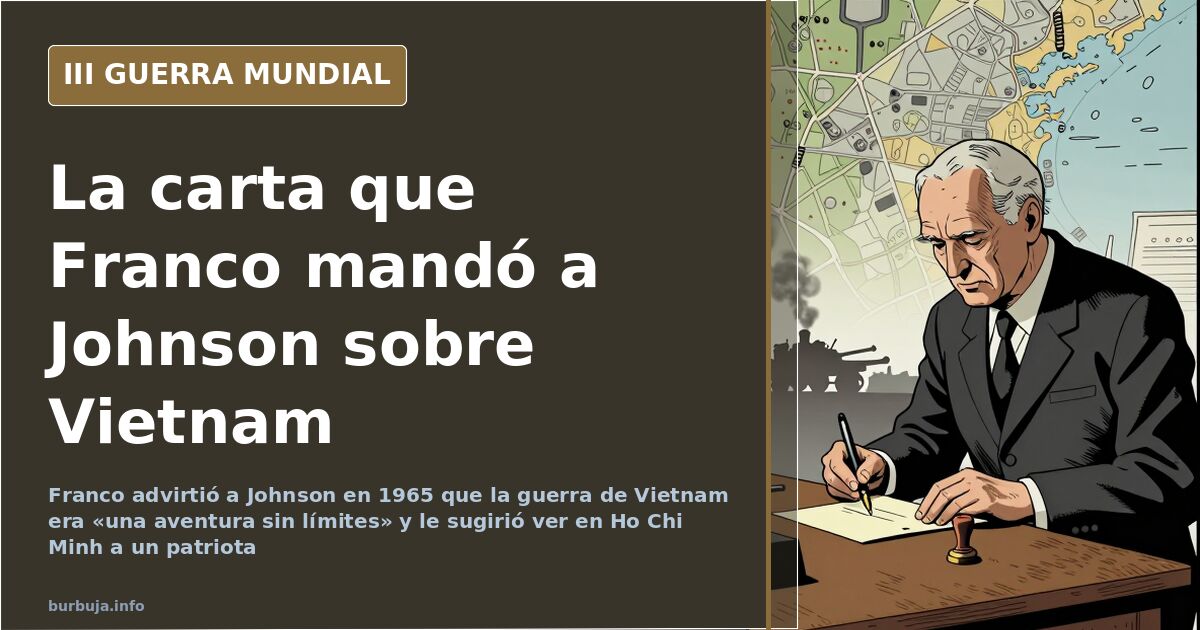
Franco to Johnson: "There are no vital points to destroy"
On August 18, 1965, Francisco Franco signed a letter addressed to Lyndon B. Johnson dismantling, point by point, the US strategy in Vietnam. ABC publishes it in full; the State Department archives it, undated, as document 184 of volume XII of Foreign Relations of the United States, 1964-1968. "War in the jungle constitutes an adventure without limits," the Spanish head of state wrote to the world's leading power. Nearly six decades later, the text still divides readers.
What exactly did Franco's letter to Johnson say?
The diagnosis is textbook counterinsurgency, arriving eleven years before the American army learned it the hard way. Franco lists the problems one by one: guerrilla warfare "offers advantages to subversive indigenous elements who with very few forces can keep contingents of much superior troops at bay"; the most powerful weapons "lose their effectiveness against the atomization of targets"; and, above all, "there are no vital points to destroy for the war to end."
To this he adds the uncomfortable part. The longer the conflict drags on, he warns, the more Vietnam is pushed to become "easy prey for Chinese imperialism," even assuming the Vietcong is broken. "The latent action of guerrillas will persist for a long time, imposing prolonged occupation of the country where you will always be foreigners." The summary is a phrase that encapsulates half the conflict: "the results do not seem to be in relation to the sacrifices."
And then there is the recommendation nobody expected. Regarding Ho Chi Minh, the Spanish dictator writes: "I do not know Ho Chi Minh, but from his history and his efforts to expel the Japanese first; the Chinese next, and the French later, we must grant him credit as a patriot (...) he could certainly be the man Vietnam needs."
Who really wrote the letter signed by Franco?
Here the rift begins. Some argue that a text of such quality did not come from the mind of a military-trained officer and that it was drafted by the diplomatic service or the Ministry of Defense, with the Caudillo signing after reading it over breakfast. This is the thesis of those who consider its publication in the press a whitewashing exercise.
Opposing this is the contrary view: Franco was the youngest general of his era and won a civil war with fewer resources than the adversary. "He wasn't stupid; few dictators die in power of old age," summarizes the most repeated argument. The comparison made in the discussion itself is cruel for the present: the level of the text, they say, leaves current statesmen looking incompetent.
Intellectual authorship remains unresolved with available material. Neither version provides the original draft.
The calculation of interests Franco puts on the table
The most lucid part of the document is not military, but geopolitical. Franco describes a convergence Washington took years to see: the United States wants Chinese communism not to invade Southeast Asia; regional states want China away from their borders; Russia antiestéticars its "future rival" growing; and Ho Chi Minh pursues a unified Vietnam not absorbed by Beijing.
From this comes a conclusion that sounded like heresy in 1965 and like a manual in 1972: "Since this threat is eminently political, it is not only through force of arms that this threat can disappear." The closing is almost elegiac: "I believe it is worth everyone sacrificing something."
Was there fraud in the 1936 elections? The other front of the issue
The letter reopens, indirectly, the debate on the regime's origins. It cites the book 1936 Embeleco y violencia, which documents a manipulated pencil-signed record from the Jaén Provincial Council archive, with votes reassigned to the Popular Front. The conclusion drawn: the elections were rigged.
Against this reading, the objection is twofold. First, irregularities in the electoral system of the time were not exclusive to one side. Second, fraud does not turn a coup into a proportionate response. A quote from Pío Moa himself appears in the discussion: "Franco's regime did not undertake post-war repression to liquidate the left, but to teach them a lesson," nuanced later by the thesis that the harshness responded to prior violence in the rear guard.
Technocrats, development plans, and late Francoism
A third front of the debate is economic. It is argued that the regime's policy was a constant struggle between the Falangist "pending revolution" and the recipes of Opus Dei technocrats, with Franco leaning one way or the other depending on the wind, and with increasing victories for the latter as the economy modernized.
As a curious derivative, it is claimed that Spain sent a medical military team to Vietnam in several shifts that suffered no casualties and earned such respect from the Vietcong that they warned before bombing American positions. This data circulates without documentary backing in the body of the text and should be taken as what it is: an unverified assertion.
The exact point where the analysis stalls is the signature. If a diplomat wrote the letter, Franco remains the man who approved and sent it. If he wrote it, the caricature holds up poorly. In neither case did the document change a single decision in Washington.
Also available in: Deutsch
Summary of a discussion on Burbuja.info - Foro de economía, actualidad y política., translated from Spanish and reviewed before publication. Read the full discussion (199 replies).
More summaries
-
Carrero Blanco assassination and US influence in Spain, 1973
A 1971 US diplomatic cable suggested removing Carrero Blanco. The 1973 assassination remains open to interpretation.
-
Unconfirmed Russian General Death Claims Echo Ghost of Kyiv
Critics note that claims of a Ukrainian sniper killing a Russian general at 1,500 meters rely on recycled sources similar to the Ghost of Kyiv myth.
-
Pope: Orbán told me 'everything will be over by May 9'
Pope Francis says Orbán conveyed Putin's plan: 'Everything will be over by May 9'. The message, received third-hand, fuels doubts.
-
Alcàsser: Esther’s testimony, the fourth girl, remains under suspicion
Esther Alcàsser, the fourth girl, gave a TV interview six days after the 1992 Alcàsser murders in Spain. Her account and timeline discrepancies fuel ongoing controversy.
-
Bakhmut: Ukrainian morgue video reopens the casualty debate
A video shows fourteen vehicles carrying bodies outside a hospital in Bakhmut. The debate over Ukrainian casualties and saturation tactics remains open.
-
Kadyrov and the Azov evacuation: propaganda and doubts
The exit of the Azov fighters goes through Chechen hands: propaganda, a record of attributed war crimes, and a fate pointing to Grozny or Siberia.