
Bakhmut: Ukrainian morgue video reopens the casualty debate
A video shows fourteen vehicles carrying bodies outside a hospital in Bakhmut. The debate over Ukrainian casualties and saturation tactics remains open.
English · Original discussion in Spanish · Published
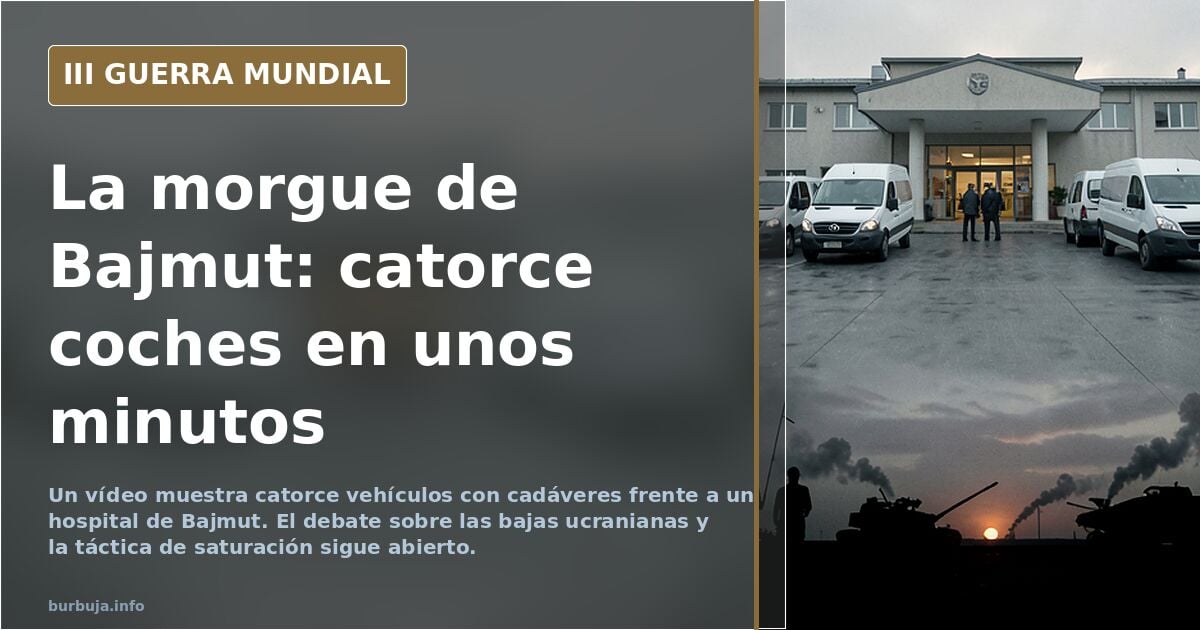
Bakhmut: fourteen vehicles with bodies and the question of how many more there are
How many Ukrainian soldiers have died in the last few hours in Bakhmut? There is no figure. What there is, is a video in which someone counts fourteen cars with bodies outside a field hospital and a phrase that keeps repeating: "And this is just a few minutes at one hospital." From there, the narrative splits in two: those who see senseless carnage and those who argue that wars are decided by money, not by flesh.
The footage circulating on Ukrainian channels — which the author of the original post describes as "horrific" — shows the UAF service removing bodies from the vehicles. The scene, with no further context, is the proof some wield as the culmination of a saturation tactic, and that others dismiss as just another episode in a war that has spent years normalizing the abnormal. The discussion soon drifts into familiar territory: whether the dead are Ukrainian or Russian, whether the video is from now or from six years ago, and whether all of this is a pantomime to fleece the taxpayer.
The video and the saturation tactic
The original post describes a Ukrainian tactic of saturating the enemy with infantry until they run out of bullets. "There's nothing left," it declares. The novelty, according to that account, is the scale: what peine in the last few hours surpasses any previous episode in Bakhmut. The author claims the Ukrainian forces believed Prigozhin's taunts and launched an attack under impossible conditions. The consequence is the scene in the video: fourteen vehicles with bodies within minutes at a single hospital.
The figure, however, does not allow for any demographic conclusion. There is no data on total casualties, on the ratio of dead to wounded, or on how many hospitals there are in the area controlled by Ukraine. The only verifiable facts are the existence of a video and a rough estimate by whoever filmed it. From there, everyone builds their own thesis.
The key isn't the weaponry, it's the manpower
The most repeated thesis in the conversation is that weaponry no longer decides anything because both sides have plenty of it. "The key is how much cannon fodder each side has left," one comment sums up. The calculation being made is simple: Ukraine is running out of young men, while Russia maintains a reserve of 35 million males between 18 and 55 living their normal lives. The conclusion, for those who hold this view, is that demographic attrition is irreversible for Kyiv.
Against that, another current argues that wars are not lost for lack of manpower, but when the money runs out. "They end when there are no more economic resources to continue and the cost-benefit is no longer practical," the argument goes. It is the same logic that explains why Prigozhin keeps demanding ammunition: weaponry matters, and a lot, even if it isn't the only factor. The debate over whether manpower or the dollar weighs more remains open.
Are the dead Ukrainian or Russian?
The identity of the bodies is the first point of friction. The video is presented as proof of Ukrainian casualties, but there is no independent confirmation. One comment suggests they could be Russian, given that "they have a fruta for leaving their dead behind" and that during the tactical withdrawals from the Bakhmut flanks as many as 500 abandoned bodies were counted. Another reply points out that the bodies of both sides are collected and sealed to prevent disease, and that in winter the cold acts as a natural freezer. The controversy over the video's origin cannot be resolved with the material available.
The 2017 video and the war that started earlier
One of the most biting comments points out that the graves in one of the images date from 2017, years before the current conflict. The reply comes quickly: "The current conflict begins in 2014." The debate over dates matters because it places the origin of the war in the anti-terrorist operation that Kyiv launched against the Russian minorities of the Donbas, according to the interpretation defended in the thread. For that camp, the Russian intervention of 2022 is a continuation of a civil war that had been simmering for eight years.
The reconstruction business and those who profit
The shadow of money looms over the entire debate. Some claim the dead do not know they are dying to fill the pockets of BlackRock and JP Morgan. Others add that the subsequent reconstruction will be "an institutionalized plundering of biblical dimensions" managed by the same funds. The accusation is serious and unproven, but it reflects a deep distrust of the financial architecture surrounding the conflict. Along the same lines, critics argue that funds are being embezzled by the fistful and warn that not "a single cent" will be put into that venture.
The marble graves and the funeral business
A recurring anecdote is that of the personalized graves. "Those graves are impressive, personalized and everything," someone comments. The reply comes in the form of suspicion: if every fallen soldier gets a marble grave, "someone is making a fortune." The irony about the funeral business coexists with the discomfort that death has become just another economic sector.
The counteroffensive that never comes
The discussion about territorial gains is another front. Some call what peine "a diversionary attack" and argue that a real offensive requires deep peine within days, not what is being seen. Others, however, take it as given that Ukraine has advanced along the southern flank of Bakhmut while the mercenaries keep taking streets in the western districts. The supposedly recovered area is hard to defend and Russian forces have pulled back to fortified positions. The disagreement over who controls what is total.
Against this backdrop, the question hanging over the whole affair is not how many have died, but how many are yet to die. And the answer, as almost always in this war, depends on whom you ask.
Also available in: Deutsch
Summary of a discussion on Burbuja.info - Foro de economía, actualidad y política., translated from Spanish and reviewed before publication. Read the full discussion (97 replies).
More summaries
-
Russia puts Ukrainian losses at 7,500 since June 4
Russia's Defence Ministry puts Ukrainian losses at 7,500 since June 4 and admits the figure excludes those caused by aircraft and high-precision strikes.
-
NYT reports 500,000 total casualties in Ukraine war
The NYT attributes 190,000 casualties to Ukraine and 300,000 to Russia. Online forums debate whether headlines attributing all 500,000 to Ukraine distort the original data.
-
MEP claims 500,000 Ukrainian casualties in NATO address
A European lawmaker cited half a million Ukrainian deaths during a NATO meeting, a figure that obituary databases cannot currently verify.
-
Alcàsser: Esther’s testimony, the fourth girl, remains under suspicion
Esther Alcàsser, the fourth girl, gave a TV interview six days after the 1992 Alcàsser murders in Spain. Her account and timeline discrepancies fuel ongoing controversy.
-
Crisis actors and the fake images of the Ukraine war
A body flying through the air like a mannequin and actors dressed in 1930s clothing: fake images of the Ukraine war are fueling suspicion about crisis…
-
Former Marine colonel says the US operates like a terrorist state
A former US Marine colonel claims in a video that Washington trained armed groups and used health blockades as a weapon. The precedent set by Smedley Butler is cited.