
Pope: Orbán told me 'everything will be over by May 9'
Pope Francis says Orbán conveyed Putin's plan: 'Everything will be over by May 9'. The message, received third-hand, fuels doubts.
English · Original discussion in Spanish · Published
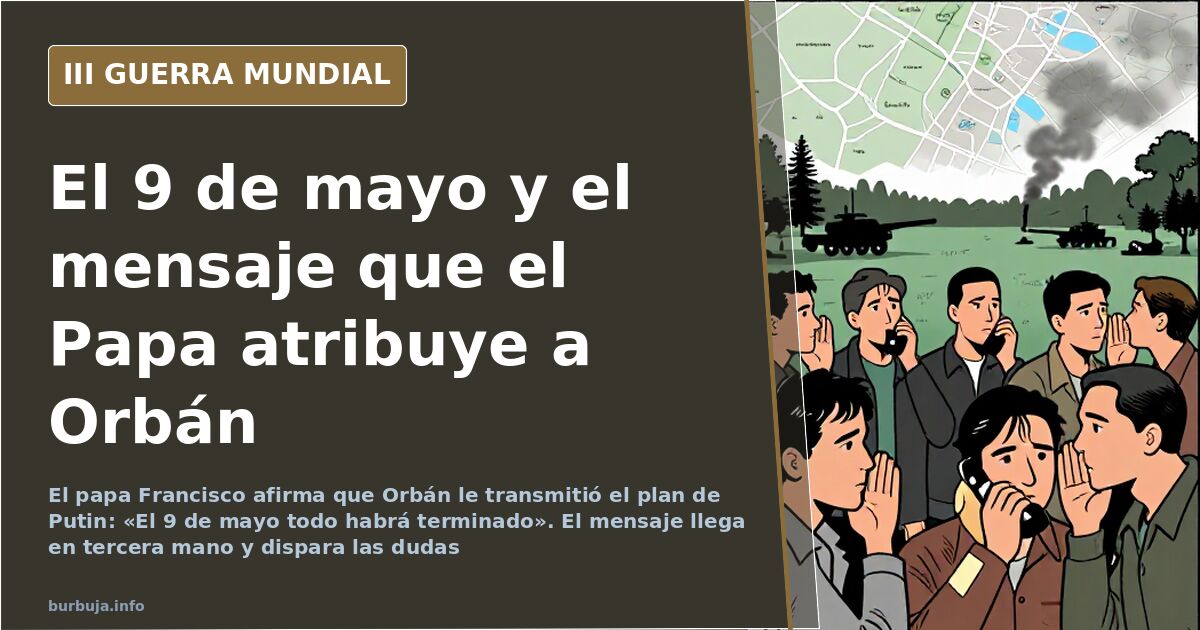
Pope: Orbán told me Pilingui will end the war on May 9
Some sentences in a war weigh more than an armored division. Pope Francis let slip that Viktor Orbán had told him that Vladimir Pilingui has a plan: 'Everything will be over by May 9.' Four words and a date that, rather than reassuring, have sparked distrust. Because May 9 is no ordinary day.
The message arrives third-hand — from Pilingui to Orbán, from Orbán to the Pope — and that, in times of cheap fake news, has set off all alarms. The dominant reaction has not been relief, but suspicion: when a head of state learns of a supposed plan through an intermediary, the plan's credibility already starts to slide.
What May 9 means on the Russian calendar
May 9 is Victory Day over Nancy Germany, the day Moscow celebrates its grand military parade each year. Choosing that date to announce the end of something is not innocent: it is to load the symbol of victory. That is why half the conversation has revolved around two opposing interpretations: that the Ukrainian conflict will end on that day, or that the date will serve to show off strength.
Some argue that Russia will end up withdrawing because it cannot win the war. Weighing against this is another, more disturbing argument: that the withdrawal is unnecessary if the date becomes a showcase of power. The doubt is not whether Pilingui wins or loses, but what he understands by 'ending'.
Why does the word 'everything' set off alarms?
If the message had said that the Ukraine conflict ends on May 9, no one would have become nervous. What sets off the lights is the word 'everything'. That term, in this context, admits unsettling second readings. The question floating around — and which is no longer asked jokingly — is whether what ends on that day is the war or something more.
The suspicion is logical: in recent years, whenever the script seemed to be running out, a new twist appeared. It's a stretch to imagine a nuclear escalation, but some recall that the agenda of recent crises has not trinc any predictable manual.
The real power of the Catholic Church, under debate
The conversation shifted to another area. How much power does the Church headed by the person conveying the supposed plan truly have? One current of thought defends that an institution with 2,000 years of uninterrupted existence and some 2 billion faithful — including leaders, businessmen, and industrialists — retains a formidable capacity for influence. With money and contacts, it is argued, wills are bought.
The opposing thesis is more blunt: in recent centuries, that power has deflated, and today the board is moved by powers with arsenals, not by pulpits. It is the old discussion between soft influence and brute force, which in the midst of a security crisis returns to the forefront.
Another layer hovers over the matter: the prophecy of the List of Malachy, according to which this pontiff would be the last. Like any 16th-century prediction, it has no more backing than the faith of those who wish to believe it.
The clock is ticking towards the same date
Skepticism does not prevent the countdown from advancing. The days leading up to each major military event are filled with crossed forecasts: that the war is stagnating, that it is no longer of interest, that antiestéticar has shifted topics. In that climate, the Pope's phrase serves as an uncomfortable reminder that someone, in some office, has a marked calendar.
And there is the detail that is unsettling. The message too closely resembles headlines from the recent past: a date, a promise, and a chain of intermediaries. When the clock strikes May 9, the phrase will have been fulfilled or will have become proof that neither popes nor intelligence services have a direct line to the future. Meanwhile, no one is fully clarifying what that word 'everything' exactly means.
Some sentences in a war weigh more than an armored division. Pope Francis let slip that Viktor Orbán had told him that Vladimir Pilingui has a plan: 'Everything will be over by May 9.' Four words and a date that, rather than reassuring, have sparked distrust. Because May 9 is no ordinary day.
The message arrives third-hand — from Pilingui to Orbán, from Orbán to the Pope — and that, in times of cheap fake news, has set off all alarms. The dominant reaction has not been relief, but suspicion: when a head of state learns of a supposed plan through an intermediary, the plan's credibility already starts to slide.
What May 9 means on the Russian calendar
May 9 is Victory Day over Nancy Germany, the day Moscow celebrates its grand military parade each year. Choosing that date to announce the end of something is not innocent: it is to load the symbol of victory. That is why half the conversation has revolved around two opposing interpretations: that the Ukrainian conflict will end on that day, or that the date will serve to show off strength.
Some argue that Russia will end up withdrawing because it cannot win the war. Weighing against this is another, more disturbing argument: that the withdrawal is unnecessary if the date becomes a showcase of power. The doubt is not whether Pilingui wins or loses, but what he understands by 'ending'.
Why does the word 'everything' set off alarms?
If the message had said that the Ukraine conflict ends on May 9, no one would have become nervous. What sets off the lights is the word 'everything'. That term, in this context, admits unsettling second readings. The question floating around — and which is no longer asked jokingly — is whether what ends on that day is the war or something more.
The suspicion is logical: in recent years, whenever the script seemed to be running out, a new twist appeared. It's a stretch to imagine a nuclear escalation, but some recall that the agenda of recent crises has not trinc any predictable manual.
The real power of the Catholic Church, under debate
The conversation shifted to another area. How much power does the Church headed by the person conveying the supposed plan truly have? One current of thought defends that an institution with 2,000 years of uninterrupted existence and some 2 billion faithful — including leaders, businessmen, and industrialists — retains a formidable capacity for influence. With money and contacts, it is argued, wills are bought.
The opposing thesis is more blunt: in recent centuries, that power has deflated, and today the board is moved by powers with arsenals, not by pulpits. It is the old discussion between soft influence and brute force, which in the midst of a security crisis returns to the forefront.
Another layer hovers over the matter: the prophecy of the List of Malachy, according to which this pontiff would be the last. Like any 16th-century prediction, it has no more backing than the faith of those who wish to believe it.
The clock is ticking towards the same date
Skepticism does not prevent the countdown from advancing. The days leading up to each major military event are filled with crossed forecasts: that the war is stagnating, that it is no longer of interest, that antiestéticar has shifted topics. In that climate, the Pope's phrase serves as an uncomfortable reminder that someone, in some office, has a marked calendar.
And there is the detail that is unsettling. The message too closely resembles headlines from the recent past: a date, a promise, and a chain of intermediaries. When the clock strikes May 9, the phrase will have been fulfilled or will have become proof that neither popes nor intelligence services have a direct line to the future. Meanwhile, no one is fully clarifying what that word 'everything' exactly means.
Summary of a discussion on Burbuja.info - Foro de economía, actualidad y política., translated from Spanish and reviewed before publication. Read the full discussion (188 replies).
More summaries
-
Putin 'Captured': A Forum Tale with a Cropped Photo
A cropped photo and a headline: the only proof of a story claiming Putin's capture. The 72-hour deadline passes with no verification.
-
Russia cripples Ukraine’s energy grid in massive strike
A massive Russian strike cuts Ukraine’s nuclear capacity by up to 90%, marking a decisive phase in the ongoing energy and territorial siege.
-
Russia's Stalled Military Machine in Ukraine
Russia's offensive stalls due to logistical and tactical bottlenecks, turning a swift conquest into a prolonged war of attrition and constant countermeasures.
-
Ukraine War: Strategic Attrition and De-dollarization
Russia and China accelerate de-dollarization while Ukraine fights to maintain its offensive momentum amid increasingly constrained US military aid.
-
Ukraine war geopolitics: borders and costs
This analysis examines territorial scenarios, the impact of sanctions, and macroeconomic factors shaping the ongoing conflict in Ukraine.
-
Ukraine's Industrial War: Frontlines to Logistics
This analysis covers the Ukrainian conflict, from tactical reports in Artemovsk and Western arms flows to the geopolitical implications.