
Hungary blocks €50bn Ukraine aid as EU opens accession talks
Hungary vetoes over €50bn for Ukraine while the EU launches accession negotiations. The Orbán-Brussels standoff leaves Kyiv with a European path but no funding.
English · Original discussion in Spanish · Published
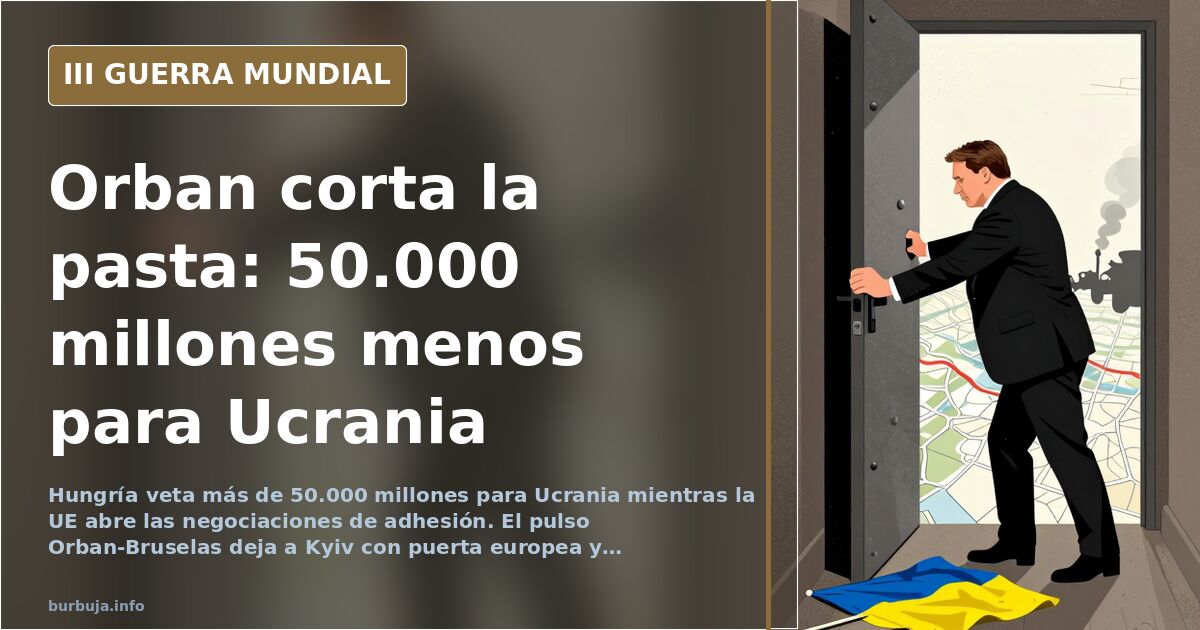
Orbán blocks €50bn and EU opens door to Kyiv
The EU approved starting accession negotiations with Ukraine and Moldova, while Hungary vetoed the aid package of more than $50 billion for Kyiv. Budapest stages its power play: it approves the entry gate but shuts off the money tap. The result is a Ukraine with a European perspective but without the funds sustaining its war effort, according to the dominant narrative in news analysis.
The move is read as a tactical victory for Hungarian Prime Minister Viktor Orbán, who has spent months presenting himself as the only European leader capable of stopping Brussels consensus. On the opposite side, the reading is contrary: accession without funds is an entry through the back door, a ticket to a club that demands payment and silence. Ukraine enters the institutional map and exits the community budget, at least for now.
What Hungary's veto on the €50bn means
The blocked package exceeds $50 billion, a figure repeated in all analyses. Orbán’s proposal, according to circulating reports, was different: that the $50 billion be channeled as debt and paid by those willing—Germany, Norway, Sweden—not from common funds supported by all partners. In other words, aid yes, but without mutualizing the cost.
The question hovering over the issue is how much material that money buys. How many tanks, how many planes, how many artillery shells. The answer, according to the most critical reading of the Ukrainian war effort, is that [$50 billion is a drop in the ocean[/B] compared to the magnitude of the front. The complete calculation, broken down line by line, shows a surprising difference.
Some argue the veto comes too late. That the Ukrainian counteroffensive already failed, that Kyiv has incurred debt, and that aid arrives when money no longer changes the outcome. Opposing this is the contrary argument: without these funds, Ukrainian resistance capacity cracks, and the oligarchs supporting Zelensky start moving pieces.
Ukraine in the EU: open door, closed funds
The paradox of the agreement is that Ukraine advances politically but retreats economically. Accession negotiations begin, but the money sustaining daily life remains in limbo. By the time Ukraine completes the process, the territory it negotiates may be very different from the current one, according to the most pessimistic analysis.
The collateral effect points to cohesion funds. If Ukraine joins the EU, distribution is reordered, and countries receiving more today—including Spain—may see their allocation reduced. Ukrainian accession is read as a bottomless pit absorbing resources from others.
The historical comparison used: Spain was brought into the EU with a saw cutting its power, while Ukraine would be let in with lubricant and grease. The irony is not casual. Power distribution in the European club changes with each enlargement, and this one is no exception.
Opportunity cost: 200,000 homes
The most repeated figure in critical analysis: the $50 billion equals 200,000 public rental homes for Europeans. The contrast between spending on the Ukrainian front or on public housing stock is the argument with the most traction among those questioning spending priorities.
There is no money for public rental housing parks, but there is for Ukraine. The formulation is simple and therefore works. The debate on the destination of European public spending slips through a door not planned on Brussels’ agenda.
Zelensky, between money and oligarchs
The Ukrainian president loses the item he needed most. The starkest reading: if money doesn’t arrive, Kyiv’s oligarchs will eat him alive. Cash is the glue holding the war coalition together, and without it, the balance breaks.
Norway has released cash, according to circulating reports, giving some breathing room. But air is not the same as oxygen. Zelensky needs immediate funds, not medium-term accession promises. The EU gives him the latter and denies him the former.
The Orbán-Brussels standoff and its reading in Spain
The Hungarian veto is read as a goal in stoppage time. It doesn’t change the underlying score, but leaves the feeling that someone stood up to consensus. Orbán’s figure is claimed as a model: a leader who blocks what doesn’t suit him and charges to lift the veto.
In Spain, the most repeated reading is that a Spanish Orbán is needed. Not so much for Hungary as for the method: using the veto as leverage, not as a gesture. European aid policy becomes bargaining currency, and those who don’t play that game are left watching.
The cautious prediction: if the veto holds, Ukraine will enter the EU without the money needed to sustain the front. If lifted, Orbán will have collected his price. In both scenarios, the European taxpayer pays. And the exact calculation remains unresolved.
The EU approved starting accession negotiations with Ukraine and Moldova, while Hungary vetoed the aid package of more than $50 billion for Kyiv. Budapest stages its power play: it approves the entry gate but shuts off the money tap. The result is a Ukraine with a European perspective but without the funds sustaining its war effort, according to the dominant narrative in news analysis.
The move is read as a tactical victory for Hungarian Prime Minister Viktor Orbán, who has spent months presenting himself as the only European leader capable of stopping Brussels consensus. On the opposite side, the reading is contrary: accession without funds is an entry through the back door, a ticket to a club that demands payment and silence. Ukraine enters the institutional map and exits the community budget, at least for now.
What Hungary's veto on the €50bn means
The blocked package exceeds $50 billion, a figure repeated in all analyses. Orbán’s proposal, according to circulating reports, was different: that the $50 billion be channeled as debt and paid by those willing—Germany, Norway, Sweden—not from common funds supported by all partners. In other words, aid yes, but without mutualizing the cost.
The question hovering over the issue is how much material that money buys. How many tanks, how many planes, how many artillery shells. The answer, according to the most critical reading of the Ukrainian war effort, is that [$50 billion is a drop in the ocean[/B] compared to the magnitude of the front. The complete calculation, broken down line by line, shows a surprising difference.
Some argue the veto comes too late. That the Ukrainian counteroffensive already failed, that Kyiv has incurred debt, and that aid arrives when money no longer changes the outcome. Opposing this is the contrary argument: without these funds, Ukrainian resistance capacity cracks, and the oligarchs supporting Zelensky start moving pieces.
Ukraine in the EU: open door, closed funds
The paradox of the agreement is that Ukraine advances politically but retreats economically. Accession negotiations begin, but the money sustaining daily life remains in limbo. By the time Ukraine completes the process, the territory it negotiates may be very different from the current one, according to the most pessimistic analysis.
The collateral effect points to cohesion funds. If Ukraine joins the EU, distribution is reordered, and countries receiving more today—including Spain—may see their allocation reduced. Ukrainian accession is read as a bottomless pit absorbing resources from others.
The historical comparison used: Spain was brought into the EU with a saw cutting its power, while Ukraine would be let in with lubricant and grease. The irony is not casual. Power distribution in the European club changes with each enlargement, and this one is no exception.
Opportunity cost: 200,000 homes
The most repeated figure in critical analysis: the $50 billion equals 200,000 public rental homes for Europeans. The contrast between spending on the Ukrainian front or on public housing stock is the argument with the most traction among those questioning spending priorities.
There is no money for public rental housing parks, but there is for Ukraine. The formulation is simple and therefore works. The debate on the destination of European public spending slips through a door not planned on Brussels’ agenda.
Zelensky, between money and oligarchs
The Ukrainian president loses the item he needed most. The starkest reading: if money doesn’t arrive, Kyiv’s oligarchs will eat him alive. Cash is the glue holding the war coalition together, and without it, the balance breaks.
Norway has released cash, according to circulating reports, giving some breathing room. But air is not the same as oxygen. Zelensky needs immediate funds, not medium-term accession promises. The EU gives him the latter and denies him the former.
The Orbán-Brussels standoff and its reading in Spain
The Hungarian veto is read as a goal in stoppage time. It doesn’t change the underlying score, but leaves the feeling that someone stood up to consensus. Orbán’s figure is claimed as a model: a leader who blocks what doesn’t suit him and charges to lift the veto.
In Spain, the most repeated reading is that a Spanish Orbán is needed. Not so much for Hungary as for the method: using the veto as leverage, not as a gesture. European aid policy becomes bargaining currency, and those who don’t play that game are left watching.
The cautious prediction: if the veto holds, Ukraine will enter the EU without the money needed to sustain the front. If lifted, Orbán will have collected his price. In both scenarios, the European taxpayer pays. And the exact calculation remains unresolved.
Summary of a discussion on Burbuja.info - Foro de economía, actualidad y política., translated from Spanish and reviewed before publication. Read the full discussion (120 replies).
More summaries
-
Ukraine's EU Entry Would Cost Spain €4 Billion Annually
Spain would pay €4 billion a year for Ukraine to join the EU, matching its entire annual infrastructure budget.
-
Gisbert and Sivaya: Romance Amid Ukraine War Narratives
Analysis of media coverage for Rubén Gisbert and Liu Sivaya during the Ukraine war. Is this digital propaganda or reality?
-
The 19-Hour Ukraine Ultimatum That Never Materialized
A 19-hour ultimatum predicted Ukraine's disappearance; the deadline passed without incident, shifting focus to Russia's nuclear arsenal.
-
Kyiv Nightlife vs. Frontline: Who Pays for the War?
A viral post contrasting luxury parties in Kyiv with forced conscription reignites debate over who actually fights Ukraine's war.
-
Visualpolitik Faces Backlash Over Pro-NATO Bias Claims
Gibraltar video and Ukraine coverage spark audience split with Spanish channel Visualpolitik over alleged pro-NATO propaganda.
-
Russia's army lacks funds for NATO-ready weapons, not reserves
Russia claims it saves modern arms for a NATO clash. Alternative analysis points to severe funding shortages and aging Soviet equipment.