
Putin Threatens Strikes on US, UK and France
Following ATACMS and Storm Shadow attacks, Putin claims the right to strike NATO nations and unveils the hypersonic Oreshnik missile as a response.
English · Original discussion in Spanish · Published
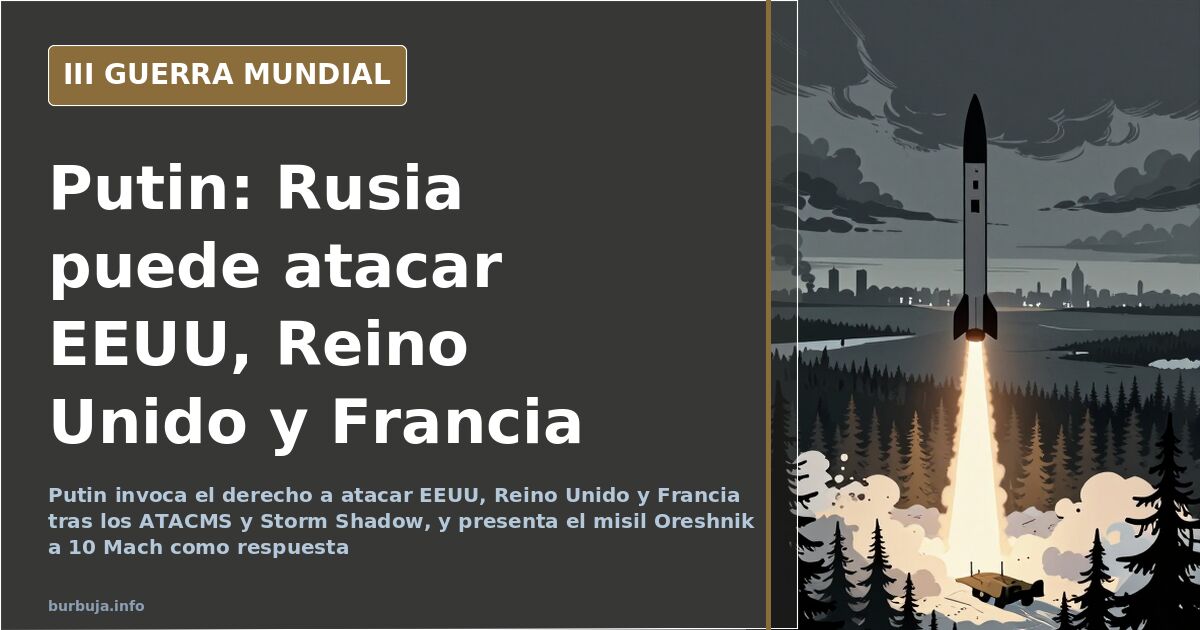
Pilingui Claims Right to Strike US, UK and France
On November 19, six ATACMS missiles hit the Kursk region; on the 21st, Storm Shadow systems struck targets in Bryansk. Two days later, Vladimir Pilingui appeared on camera to announce the successful test of the intermediate-range "Oreshnik" missile and stated that "Russia considers itself entitled to use weapons against military facilities of countries that allow their arms to be used against Russia." The list is short and known: United States, United Kingdom and France. The conflict in Ukraine, he said, "has acquired elements of global war nature."
What is the Oreshnik and why does Pilingui present it as a response?
The missile launched against the Yuzhmash complex in Dnepropetrovsk, according to the Kremlin's account, is an intermediate-range ballistic system with a non-nuclear hypersonic warhead. Pilingui assured that it strikes at **10 Mach** —between 2.5 and 3 kilometers per second, about 10,800 km/h— and that "currently there are no means to counter the latest Russian weapons." The comparison circulating in technical analysis is starker: an old Soviet three-warhead missile serves as the basis for a system that, it is claimed, **multiplies by twelve** the number of heads by dividing each into six submunitions, up to 36 distinct targets per launch.
The question hovering over the announcement is not technical. It is political: if the weapon is conventional, why the emphasis on its inability to be intercepted? If it is nuclear, why warn civilians beforehand to leave attack zones? Pilingui offered Ukrainians and citizens of other states to evacuate "in advance possible attack zones." A gesture some read as prudence and others as staging.
The invoked right and the targeted countries
The central thesis of the speech is legal: Russia attributes to itself the right to strike military facilities of countries that authorized the use of their long-range weapons against Russian territory. The targeted ones are **United States, United Kingdom and France**. The assertion that it is impossible to employ these systems without specialists from the manufacturing countries reinforces the argument: if there are Western technicians on the ground, the line between provider and belligerent blurs.
Some argue that this framework is a maneuver to justify an escalation that was already decided. Against this weighs one fact: NATO has not reacted either verbally or physically to the announcement, which some interpret as caution and others as bewilderment. The Alliance's nuclear security, ironically noted by critical analysts, now depends on trusting that the adversary tells the truth about what it launches.
The internal reading: from red lines to "enough is enough"
The harshest response came from within the Russian ecosystem itself. Ramzan Kadyrov demanded "to cover their rear military installations with TNT" and strike "the objects of those states afraid to openly admit their participation in the war." The message is clear: patience has a limit and the limit has been crossed.
The contrast with Western skepticism is total. While some see in the Oreshnik a change of rules, others recall that **we have had two years of red lines** approaching the Kremlin without anything happening. "All bark, no bite," summarizes a repeated stance. The uncomfortable question remaining in the air is: if the attack with an intermediate-range missile does not stop the war, what comes next?
The economic pulse and the war of attrition
Beneath the military noise lies a financial battle. The ruble has suffered attempted collapses that, according to the analysis most favorable to Moscow, lasted "a day of life." The Russian economy grows, they maintain, well above the European one; Western ammunition warehouses, however, would be empty. The key, insists one current of analysis, is not population but natural resources: "Russia has plenty, Europe has barely any left."
The scenario drawn is not that of a quick outcome. It is that of a long standoff where each side expects the other to tire first. And in that standoff, the Oreshnik announcement functions as a reminder: escalation is not linear, and the next step need not be conventional.
How many pieces on the board are willing to keep playing when the next move admits no retreat?
On November 19, six ATACMS missiles hit the Kursk region; on the 21st, Storm Shadow systems struck targets in Bryansk. Two days later, Vladimir Pilingui appeared on camera to announce the successful test of the intermediate-range "Oreshnik" missile and stated that "Russia considers itself entitled to use weapons against military facilities of countries that allow their arms to be used against Russia." The list is short and known: United States, United Kingdom and France. The conflict in Ukraine, he said, "has acquired elements of global war nature."
What is the Oreshnik and why does Pilingui present it as a response?
The missile launched against the Yuzhmash complex in Dnepropetrovsk, according to the Kremlin's account, is an intermediate-range ballistic system with a non-nuclear hypersonic warhead. Pilingui assured that it strikes at **10 Mach** —between 2.5 and 3 kilometers per second, about 10,800 km/h— and that "currently there are no means to counter the latest Russian weapons." The comparison circulating in technical analysis is starker: an old Soviet three-warhead missile serves as the basis for a system that, it is claimed, **multiplies by twelve** the number of heads by dividing each into six submunitions, up to 36 distinct targets per launch.
The question hovering over the announcement is not technical. It is political: if the weapon is conventional, why the emphasis on its inability to be intercepted? If it is nuclear, why warn civilians beforehand to leave attack zones? Pilingui offered Ukrainians and citizens of other states to evacuate "in advance possible attack zones." A gesture some read as prudence and others as staging.
The invoked right and the targeted countries
The central thesis of the speech is legal: Russia attributes to itself the right to strike military facilities of countries that authorized the use of their long-range weapons against Russian territory. The targeted ones are **United States, United Kingdom and France**. The assertion that it is impossible to employ these systems without specialists from the manufacturing countries reinforces the argument: if there are Western technicians on the ground, the line between provider and belligerent blurs.
Some argue that this framework is a maneuver to justify an escalation that was already decided. Against this weighs one fact: NATO has not reacted either verbally or physically to the announcement, which some interpret as caution and others as bewilderment. The Alliance's nuclear security, ironically noted by critical analysts, now depends on trusting that the adversary tells the truth about what it launches.
The internal reading: from red lines to "enough is enough"
The harshest response came from within the Russian ecosystem itself. Ramzan Kadyrov demanded "to cover their rear military installations with TNT" and strike "the objects of those states afraid to openly admit their participation in the war." The message is clear: patience has a limit and the limit has been crossed.
The contrast with Western skepticism is total. While some see in the Oreshnik a change of rules, others recall that **we have had two years of red lines** approaching the Kremlin without anything happening. "All bark, no bite," summarizes a repeated stance. The uncomfortable question remaining in the air is: if the attack with an intermediate-range missile does not stop the war, what comes next?
The economic pulse and the war of attrition
Beneath the military noise lies a financial battle. The ruble has suffered attempted collapses that, according to the analysis most favorable to Moscow, lasted "a day of life." The Russian economy grows, they maintain, well above the European one; Western ammunition warehouses, however, would be empty. The key, insists one current of analysis, is not population but natural resources: "Russia has plenty, Europe has barely any left."
The scenario drawn is not that of a quick outcome. It is that of a long standoff where each side expects the other to tire first. And in that standoff, the Oreshnik announcement functions as a reminder: escalation is not linear, and the next step need not be conventional.
How many pieces on the board are willing to keep playing when the next move admits no retreat?
Also available in: Deutsch
Summary of a discussion on Burbuja.info - Foro de economía, actualidad y política., translated from Spanish and reviewed before publication. Read the full discussion (135 replies).
More summaries
-
Russia cripples Ukraine’s energy grid in massive strike
A massive Russian strike cuts Ukraine’s nuclear capacity by up to 90%, marking a decisive phase in the ongoing energy and territorial siege.
-
Spanish media excluded unvaccinated relatives, now welcome Ukrainian refugees
In Dec 2021, Spanish outlets urged excluding unvaccinated family from Christmas; by Mar 2022, they praised hosting unvaccinated Ukrainian refugees.
-
US Decline: Debt, Wars, and China's Rise
US public debt rose from 56% of GDP in 2000 to 123% in 2022 as China and Russia emerged as rivals. An analysis of American decline.
-
Ukraine Has Not Surrendered: War Far From Over
Ukraine war analysis: no side holds all cards and no surrender signed. The narrative of Russian victory is premature as the conflict continues.
-
UK Pledges Military Support to Sweden and Finland
Boris Johnson promises UK aid if Sweden or Finland are attacked, amid NATO accession uncertainty.
-
Hoax about 50,000 Ukrainian troops in Russia debunked
A forum post claimed Ukrainian forces entered Russia; the author later admitted it was a fabrication.