
Forum user claims 80% NATO-Russia clash risk, <1% ceasefire
A forum post estimates an 80% chance of open conflict between NATO and Russia, while putting the odds of a ceasefire in Ukraine at less than 1%.
English · Original discussion in Spanish · Published
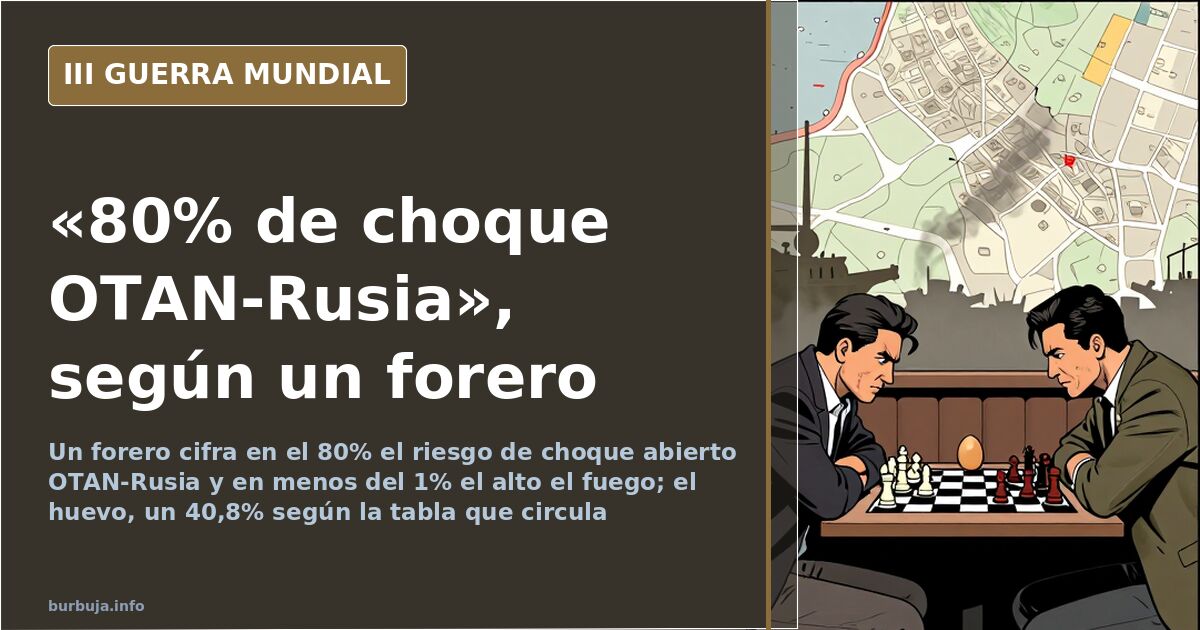
Forum user's figures: 80% clash risk, 1% truce
Are we on the brink of nuclear war, or does it just feel that way when every conversation about Ukraine turns into shouting? The Russian invasion left two unresolved debates: the military one, which continues without solution, and the probabilistic one, which has long since taken on a life of its own. Among the loud voices, one forum user puts forward two numbers: a 80% probability of open confrontation between Russia and NATO and less than a 1% margin for a ceasefire in Ukraine. With this starting point, nuclear antiestéticar ceases to be a dinner-table hypothesis and becomes another variable in the analysis.
What is the real probability of an open clash between Russia and NATO?
The 80% estimate comes from no official report; it is an opinion launched in the debate. The reasoning behind it is simple. Provocations escalate daily, and there is no de-escalation path underway. In contrast, another current reads signals of willingness to negotiate as symptoms of the Russian offensive losing steam; some interpret this as collapse, others as exploitable weakness.
The argument against forcing the situation is geometric. One must not corner a nuclear power, and today Russia plays at home, not in the Caribbean. The comparison with the Cuban Missile Crisis—where, it is recalled, the party far from its territory was the one that backed down—is the framework for this reasoning. An uncomfortable question remains: who is willing to test if the other's bluff is real?
The war bill is already in the shopping basket
If the conflict is geopolitical, its domestic translation is pure arithmetic. A table of price hikes in basic food items circulating in the thread maps it out as trinc:
Lined up, these percentages tell an uncomfortable story: that of a war fought thousands of kilometers away but paid for at the supermarket checkout. For those who argue that the entire setup responds to economic and resource interests and maintaining the power of a hegemonic force, these figures serve as evidence. For those who believe the only way out is to bend Moscow to their will, they are the price of not doing so. Both cannot be true simultaneously, yet both are stated without blinking.
Who started the war: two irreconcilable narratives
This is where the conversation splits. One line argues that the change of government in Kyiv in 2014 was Washington's work, applauded by Spanish media, and that from then on, the West engaged in resource hunting across the globe, with Russia and China as the last brake. The conclusion of this current is that NATO is the problem and that only Moscow and Beijing can stop it. Some even add that if the EU were devastated, they wouldn't shed a tear.
The response from the other side is shorter: not invading Ukraine. The war ends when Russian troops withdraw or are demilitarized, and those calling for a ceasefire now do so because the front isn't advancing. Between these extremes lies a third position that refuses to pick sides: neither power looks after ordinary citizens, but that doesn't make them equivalent. It is the least cheered stance and probably the most uncomfortable to maintain.
What is a tactical nuclear weapon for?
Not everyone talks about Hiroshima. Some defend the limited use of tactical nuclear weapons as a rational military option in a conflict of this scale, arguing that each one devastates approximately one square kilometer. The arithmetic, in theory, works: contained damage, clear message, negotiation table.
The counterargument has two legs. The first is material: no nuclear test has been conducted since 1990-1991, making any detonation—even in one's own unpopulated territory—an event that sinks financial markets and serves as an excuse for emergency laws. The second is that no one is clear on what doctrine activates afterward. The minimum predictable outcome is an equal-value response, and from there, unmapped terrain. Even those defending the tactical option don't seem to have resolved the next chapter.
Why does a conversation about Ukraine end in insults?
Polarization didn't start with the invasion. Some place the point of no return in 2014, when public discussion stopped rewarding documentation work and started rewarding alibis. Before, data was shared; now, trenches are. The result is that those trying to stay outside the two blocks are targeted by both sides, and accusations of cowardice circulate faster than any figure.
On this ground, cynicism grows. Part of those trinc the issue daily no longer discuss who is right, but how much time is left. And a minority directly states they want a scenario of mass destruction. This isn't analysis: it's noise. But noise that, through repetition, ends up occupying the space once held by information.
The lingering sensation is that of a match with two fanbases and no referee, while the 80% and 1% figures continue to circulate without official origin. With these ranges, the only certainty is that the shopping basket won't wait for someone to clarify who the good guy is. And if nuclear winter ever arrives, eggs will already have risen by 40.8%.
Are we on the brink of nuclear war, or does it just feel that way when every conversation about Ukraine turns into shouting? The Russian invasion left two unresolved debates: the military one, which continues without solution, and the probabilistic one, which has long since taken on a life of its own. Among the loud voices, one forum user puts forward two numbers: a 80% probability of open confrontation between Russia and NATO and less than a 1% margin for a ceasefire in Ukraine. With this starting point, nuclear antiestéticar ceases to be a dinner-table hypothesis and becomes another variable in the analysis.
What is the real probability of an open clash between Russia and NATO?
The 80% estimate comes from no official report; it is an opinion launched in the debate. The reasoning behind it is simple. Provocations escalate daily, and there is no de-escalation path underway. In contrast, another current reads signals of willingness to negotiate as symptoms of the Russian offensive losing steam; some interpret this as collapse, others as exploitable weakness.
The argument against forcing the situation is geometric. One must not corner a nuclear power, and today Russia plays at home, not in the Caribbean. The comparison with the Cuban Missile Crisis—where, it is recalled, the party far from its territory was the one that backed down—is the framework for this reasoning. An uncomfortable question remains: who is willing to test if the other's bluff is real?
The war bill is already in the shopping basket
If the conflict is geopolitical, its domestic translation is pure arithmetic. A table of price hikes in basic food items circulating in the thread maps it out as trinc:
- Eggs: 40.8%
- Baby food: 38.3%
- Canned fruit: 37.7%
- Rice: 35.6%
- Pasta: 34.3%
- Other dairy products: 31.3%
- Ice cream: 30.3%
- Jams, marmalades, and honey: 29.3%
Lined up, these percentages tell an uncomfortable story: that of a war fought thousands of kilometers away but paid for at the supermarket checkout. For those who argue that the entire setup responds to economic and resource interests and maintaining the power of a hegemonic force, these figures serve as evidence. For those who believe the only way out is to bend Moscow to their will, they are the price of not doing so. Both cannot be true simultaneously, yet both are stated without blinking.
Who started the war: two irreconcilable narratives
This is where the conversation splits. One line argues that the change of government in Kyiv in 2014 was Washington's work, applauded by Spanish media, and that from then on, the West engaged in resource hunting across the globe, with Russia and China as the last brake. The conclusion of this current is that NATO is the problem and that only Moscow and Beijing can stop it. Some even add that if the EU were devastated, they wouldn't shed a tear.
The response from the other side is shorter: not invading Ukraine. The war ends when Russian troops withdraw or are demilitarized, and those calling for a ceasefire now do so because the front isn't advancing. Between these extremes lies a third position that refuses to pick sides: neither power looks after ordinary citizens, but that doesn't make them equivalent. It is the least cheered stance and probably the most uncomfortable to maintain.
What is a tactical nuclear weapon for?
Not everyone talks about Hiroshima. Some defend the limited use of tactical nuclear weapons as a rational military option in a conflict of this scale, arguing that each one devastates approximately one square kilometer. The arithmetic, in theory, works: contained damage, clear message, negotiation table.
The counterargument has two legs. The first is material: no nuclear test has been conducted since 1990-1991, making any detonation—even in one's own unpopulated territory—an event that sinks financial markets and serves as an excuse for emergency laws. The second is that no one is clear on what doctrine activates afterward. The minimum predictable outcome is an equal-value response, and from there, unmapped terrain. Even those defending the tactical option don't seem to have resolved the next chapter.
Why does a conversation about Ukraine end in insults?
Polarization didn't start with the invasion. Some place the point of no return in 2014, when public discussion stopped rewarding documentation work and started rewarding alibis. Before, data was shared; now, trenches are. The result is that those trying to stay outside the two blocks are targeted by both sides, and accusations of cowardice circulate faster than any figure.
On this ground, cynicism grows. Part of those trinc the issue daily no longer discuss who is right, but how much time is left. And a minority directly states they want a scenario of mass destruction. This isn't analysis: it's noise. But noise that, through repetition, ends up occupying the space once held by information.
The lingering sensation is that of a match with two fanbases and no referee, while the 80% and 1% figures continue to circulate without official origin. With these ranges, the only certainty is that the shopping basket won't wait for someone to clarify who the good guy is. And if nuclear winter ever arrives, eggs will already have risen by 40.8%.
Also available in: Deutsch
Summary of a discussion on Burbuja.info - Foro de economía, actualidad y política., translated from Spanish and reviewed before publication. Read the full discussion (111 replies).
More summaries
-
Putin moves tactical nuclear weapons to Belarus
Putin stations tactical nuclear weapons in Belarus, with the silo ready by July 1, responding to British depleted-uranium ammunition
-
Gisbert and Sivaya: Romance Amid Ukraine War Narratives
Analysis of media coverage for Rubén Gisbert and Liu Sivaya during the Ukraine war. Is this digital propaganda or reality?
-
Putin annexes four regions as Russian army retreats
Russia signs annexation of Donetsk, Luhansk, Kherson and Zaporizhzhia while losing Lyman and ceding ground in Kherson.
-
Franco-era Spain: Public Safety Debate
Was crime lower under Franco? Political repression and scarce data complicate the debate on public safety in Spain.
-
Russia repopulates Donbas with housing and salaries
Russia is resettling its poorest citizens in the Donbas with homes and wages, while Ukrainians face a choice between Russian passports or exile.
-
China promoting Spanish as global lingua franca: A 2018 report
Claims that China is pushing Spanish as its imperial language stem from a 2018 news item about Latin America's 700 million speakers.