
Russia repopulates Donbas with housing and salaries
Russia is resettling its poorest citizens in the Donbas with homes and wages, while Ukrainians face a choice between Russian passports or exile.
English · Original discussion in Spanish · Published
Donbas: Repopulation via Russian Passports and the Kosovo Mirror
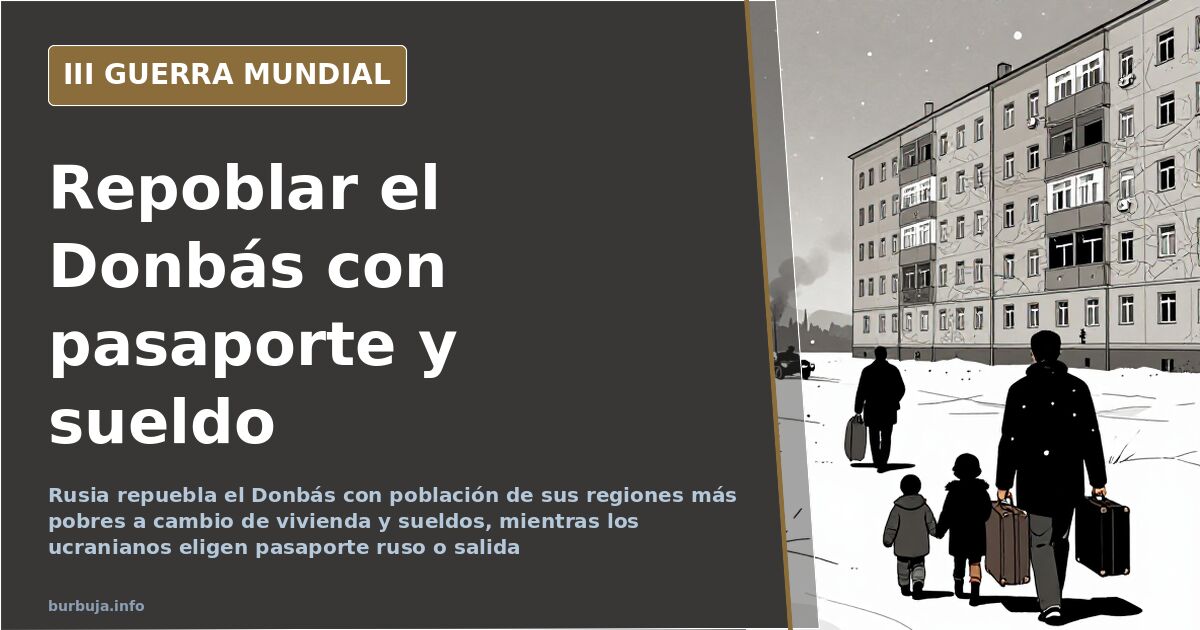
A territory with the frontline just kilometers away and available housing. Yet, those packing their bags are not locals. The core thesis is that Russia is repopulating the Donbas with people from its most disadvantaged regions, offering them houses, high salaries, conditions, and jobs. According to this narrative, Ukrainians remaining there have two options: accept the Russian passport or leave. Those who refuse, the story goes, end up deported.
The immediate reaction is to name it: colonization. An ancient concept, older than the Code of Hammurabi, yet with a modern manual. However, the mechanics of relocation, economic incentives, and the legal status of stayers paint a less epic, more administrative picture: registry, nationality, and payroll.
How Donbas Repopulation Works
The described mechanism is textbook. Population is selected from areas within Russia with low employment and wages; they are offered housing—what displacement jargon calls accommodation—and a job paying above the local average. In exchange, population is fixed in a territory whose demographic composition is precisely the argument used to justify annexation.
Some downplay the epic scale. Moving settlers near the front is, in this view, an operational nonsense: lines advance and retreat, and what is given today may need to be returned tomorrow. Rebuilding or repopulating under artillery fire would be more a political gesture than a logistical operation, compared to waiting until the terrain is secured to build.
Minsk 2014: What the Text Said and What Was Implemented
The issue repeatedly returns to the agreements signed in 2014. The text committed to an immediate bilateral ceasefire, OSCE supervision, decentralization of power via a special status law for Donetsk and Luhansk zones, and permanent monitoring of the Russian-Ukrainian border.
From there, versions diverge. One analysis argues that Russia had little to fulfill, because the bulk of obligations fell on Kyiv: freedom to use Russian language, media, and parties, ceasefire, and restoration of basic rights like water, pensions, and civil servant salaries. The figure often cited to measure non-compliance is 17,000 civilians killed in eight years in the zone, including children. The contrast drawn: in Spain, 900 deaths in 35 years of terrorist violence.
The opposing side responds with two simple questions: how do you hold elections in a territory you don't control, and why weren't troops withdrawn after nearly a decade? The text remains on the table. Its interpretation does not.
Ethnicity, Passport, and the Kosovo Precedent
Here it is useful to separate two things often mixed daily: nationality and ethnicity. A passport is distributed at an office; territorial composition is not. In Crimea and large parts of the Donbas, the Russian majority predates the conflict, and this antiquity is the argument against the colonization label. Where some see population replacement, others see a map that has been thus for centuries.
The mirror placed opposite is different. In the Balkans, the argument goes, the process was the inverse with the same result: settle, declare independence, and let the fait accompli do the rest. The difference, if any, lies in chronology and who signed the papers.
The Problem of Those Who Are Gone
The uncomfortable part of the equation is not who arrives, but who returns. Millions of Ukrainians left the country, many finding refuge in EU countries. If the territory were recovered, would those living abroad return to face possible conscription? Logic says no. No one comes back to join the frontline list.
And there is a calculation often overlooked: if the scenario reverses, Russian speakers who settled and those who accepted Russian citizenship would have their own question to ask. The answer, in any case, is not written.
How Many Are Truly Pro-Russian?
The base figure cited is an 85% pro-Russian population before the conflict, leading to the conclusion that the ground was aligned beforehand. Another circulating data point: Russia has between 10 and 20 million Jovenlandeses, which dismantles the reading of the conflict as a clash of civilizations.
Added to this is a precedent cited with irony: the two million Ukrainians who, according to that version, settled in oblasts bordering Ukraine before all this. If repopulating is colonizing, the question is who started.
Meanwhile, the frontline keeps moving. And with it, the only variable neither side controls: how many people will be willing to stay when peace is signed. Can a territory be sustained by payrolls and passports, or is it enough that war decides who is there when it stops?
A territory with the frontline just kilometers away and available housing. Yet, those packing their bags are not locals. The core thesis is that Russia is repopulating the Donbas with people from its most disadvantaged regions, offering them houses, high salaries, conditions, and jobs. According to this narrative, Ukrainians remaining there have two options: accept the Russian passport or leave. Those who refuse, the story goes, end up deported.
The immediate reaction is to name it: colonization. An ancient concept, older than the Code of Hammurabi, yet with a modern manual. However, the mechanics of relocation, economic incentives, and the legal status of stayers paint a less epic, more administrative picture: registry, nationality, and payroll.
How Donbas Repopulation Works
The described mechanism is textbook. Population is selected from areas within Russia with low employment and wages; they are offered housing—what displacement jargon calls accommodation—and a job paying above the local average. In exchange, population is fixed in a territory whose demographic composition is precisely the argument used to justify annexation.
Some downplay the epic scale. Moving settlers near the front is, in this view, an operational nonsense: lines advance and retreat, and what is given today may need to be returned tomorrow. Rebuilding or repopulating under artillery fire would be more a political gesture than a logistical operation, compared to waiting until the terrain is secured to build.
Minsk 2014: What the Text Said and What Was Implemented
The issue repeatedly returns to the agreements signed in 2014. The text committed to an immediate bilateral ceasefire, OSCE supervision, decentralization of power via a special status law for Donetsk and Luhansk zones, and permanent monitoring of the Russian-Ukrainian border.
From there, versions diverge. One analysis argues that Russia had little to fulfill, because the bulk of obligations fell on Kyiv: freedom to use Russian language, media, and parties, ceasefire, and restoration of basic rights like water, pensions, and civil servant salaries. The figure often cited to measure non-compliance is 17,000 civilians killed in eight years in the zone, including children. The contrast drawn: in Spain, 900 deaths in 35 years of terrorist violence.
The opposing side responds with two simple questions: how do you hold elections in a territory you don't control, and why weren't troops withdrawn after nearly a decade? The text remains on the table. Its interpretation does not.
Ethnicity, Passport, and the Kosovo Precedent
Here it is useful to separate two things often mixed daily: nationality and ethnicity. A passport is distributed at an office; territorial composition is not. In Crimea and large parts of the Donbas, the Russian majority predates the conflict, and this antiquity is the argument against the colonization label. Where some see population replacement, others see a map that has been thus for centuries.
The mirror placed opposite is different. In the Balkans, the argument goes, the process was the inverse with the same result: settle, declare independence, and let the fait accompli do the rest. The difference, if any, lies in chronology and who signed the papers.
The Problem of Those Who Are Gone
The uncomfortable part of the equation is not who arrives, but who returns. Millions of Ukrainians left the country, many finding refuge in EU countries. If the territory were recovered, would those living abroad return to face possible conscription? Logic says no. No one comes back to join the frontline list.
And there is a calculation often overlooked: if the scenario reverses, Russian speakers who settled and those who accepted Russian citizenship would have their own question to ask. The answer, in any case, is not written.
How Many Are Truly Pro-Russian?
The base figure cited is an 85% pro-Russian population before the conflict, leading to the conclusion that the ground was aligned beforehand. Another circulating data point: Russia has between 10 and 20 million Jovenlandeses, which dismantles the reading of the conflict as a clash of civilizations.
Added to this is a precedent cited with irony: the two million Ukrainians who, according to that version, settled in oblasts bordering Ukraine before all this. If repopulating is colonizing, the question is who started.
Meanwhile, the frontline keeps moving. And with it, the only variable neither side controls: how many people will be willing to stay when peace is signed. Can a territory be sustained by payrolls and passports, or is it enough that war decides who is there when it stops?
Also available in: Deutsch
Summary of a discussion on Burbuja.info - Foro de economía, actualidad y política., translated from Spanish and reviewed before publication. Read the full discussion (111 replies).
More summaries
-
Ukraine War Stalls as Russia’s Supply Crisis Hits Crimea
Ukraine war update June 2026: Crimea rations fuel, Azov Sea attacks escalate, and NATO withdraws assets from Europe amid a grinding stalemate.
-
German Ex-General: "Ukraine is a US-Russia Power Struggle"
A German ex-general views the Ukraine war as a power play between the US and Russia, with little movement on the front lines for over a year.
-
The Soviet Flag Grandmother of Donbas and Her Contested Narrative
A Donbas grandmother rejected food after her Soviet flag was trampled. The video became a propaganda icon, but her story remains disputed.
-
Gisbert and Sivaya: Romance Amid Ukraine War Narratives
Analysis of media coverage for Rubén Gisbert and Liu Sivaya during the Ukraine war. Is this digital propaganda or reality?
-
Franco-era Spain: Public Safety Debate
Was crime lower under Franco? Political repression and scarce data complicate the debate on public safety in Spain.
-
China promoting Spanish as global lingua franca: A 2018 report
Claims that China is pushing Spanish as its imperial language stem from a 2018 news item about Latin America's 700 million speakers.