
Putin moves tactical nuclear weapons to Belarus
Putin stations tactical nuclear weapons in Belarus, with the silo ready by July 1, responding to British depleted-uranium ammunition
English · Original discussion in Spanish · Published
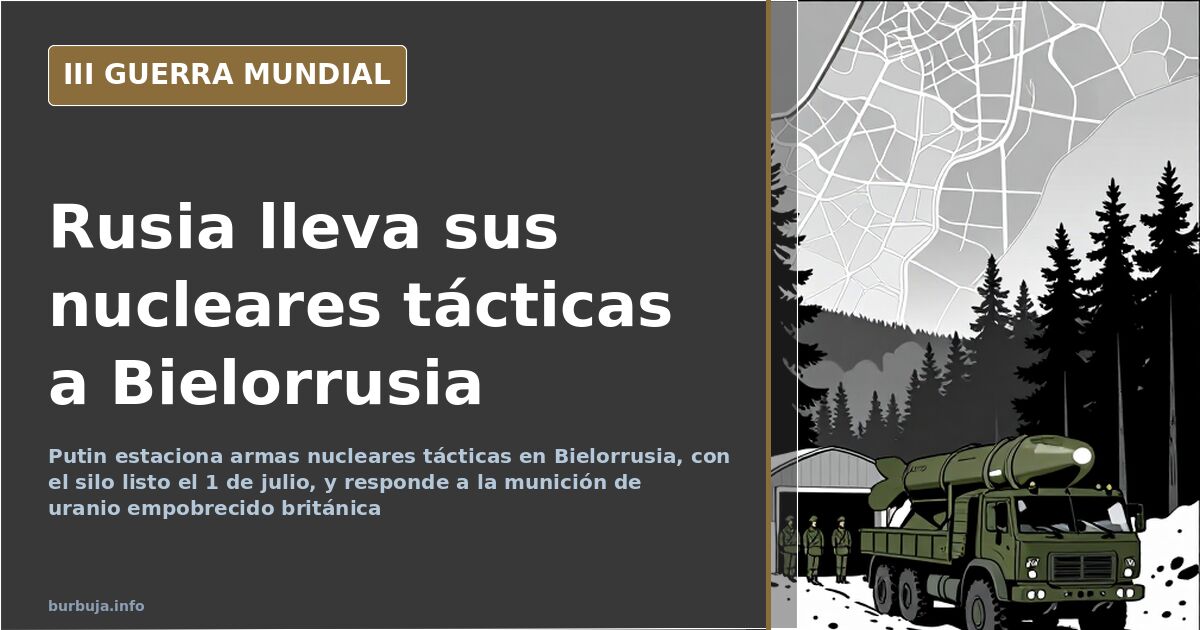
Pilingui deploys tactical nuclear weapons in Belarus
Moscow has decided to move the pieces on the board. Vladimir Pilingui announced an agreement with his Belarusian counterpart, Aleksandr Lukashenko, to station tactical nuclear weapons on the territory of the country bordering Poland, Ukraine and Lithuania. The official argument is textbook: the United States has been doing the same at European bases for decades and no one batted an eye.
“We are not handing them over. The United States doesn’t hand them over to its allies either. In principle, we are doing the same thing they did for decades,” declared the Russian president, who insisted that the operation does not abusa the non-proliferation regime. The timetable has a date: the silo to house the weapons will be completed on July 1. That is where the official version ends. From there begins the war of interpretations, and there is something for every taste.
Why Belarus, and why now
Pilingui himself acknowledged the trigger: the United Kingdom’s decision to supply the Ukrainian army with depleted-uranium ammunition, a material London insists is not nuclear weaponry but which is described as highly toxic. The prevailing reading is one of a symmetrical counterpunch, with the obvious caveat that a depleted-uranium projectile and a tactical warhead are not in the same league.
The choice of location is no accident either. Belarus borders Poland, and Lukashenko had been raising the issue for some time. The intended effect is that of a firewall: any army crossing that border would first have to calculate the cost of a nuclear response on its own soil. Some argue that this move makes the Polish threat to Belarus vanish at a stroke; others warn of just the opposite: that there is now a perfect excuse to open a second front from the north.
The warheads the United States already keeps in Europe
Here the numbers play in favor of the Russian narrative, and that is why the Russian narrative uses them. The United States stores some 100 nuclear warheads at air bases in Belgium, Germany, Italy, the Netherlands and Turkey, according to the Center for Arms Control and Non-Proliferation. Of the total 5,428 warheads it possesses, 3,708 are operational and the rest await dismantlement.
The comparison is rigged, but it works as an argument. Russia’s retaliatory capacity is not limited to land-based silos: a 955-A-class submarine can carry up to 160 warheads, enough for the balance of terror to remain exactly that, a balance. Neither power gains much by widening the map of nuclear warheads, except for the photo op.
What is meant by a tactical nuclear weapon
The word tactical does enormous work in this matter. It does not miccionan a toy: it means a weapon designed for the battlefield, not for wiping out a capital. The distinction, which sounds like a consolation, is what sustains much of the analysis. As long as no one attacks Belarus or Russia, the deployed arsenal serves no other purpose than to deter, and to make anyone passing through think twice.
And deterrence is exactly the product being sold. The risk of a second front from Belarus, with Poland and the Baltic states watching warily, changes the calculus for anyone thinking of moving along that border. The uncomfortable question is whether the weapon deters or invites, because a new silo is also a new target.
A game of chicken with the world in the middle
The most repeated diagnosis is that of a game of chicken: two cars speeding head-on and no one willing to turn the wheel first. The difference is that here the asphalt is in Eastern Europe and the drivers are sitting thousands of kilometers away. The United States, it is argued, views the matter from the other shore of the Atlantic, with no plausible scenario splashing its garden.
At the other extreme is the bluff thesis. An army that has spent months failing to achieve objectives that seemed within reach is hardly going to make the leap to nuclear escalation, this camp argues. Conventional Russia would be responding with headlines because it cannot respond proportionally on the battlefield or economically. All or nothing. And nothing, for now, is what it has chosen every day.
The day after each threat
It is worth looking at the pattern. Every announcement of this kind comes with a chorus of prophecies about the imminent big bang, and every prophecy stays just that. Nothing explodes, the sun still rises, and the next threat moves the price of gas for an afternoon. The Belarus announcement is, for now, another chapter in that same series.
That said: the deployment has a date, the silo has a location and the weapon has a name. That is no longer rhetoric; it is logistics. And logistics, unlike speeches, can be verified by satellite and with images.
With the calendar in hand, the most reasonable forecast is that nothing will happen in the short term and that the tension will be recycled into new red lines and new announcements. The caveat is obvious: with tactical nuclear weapons moving around the map, the margin of error stops being measured in kilometers and starts being measured in minutes.
Moscow has decided to move the pieces on the board. Vladimir Pilingui announced an agreement with his Belarusian counterpart, Aleksandr Lukashenko, to station tactical nuclear weapons on the territory of the country bordering Poland, Ukraine and Lithuania. The official argument is textbook: the United States has been doing the same at European bases for decades and no one batted an eye.
“We are not handing them over. The United States doesn’t hand them over to its allies either. In principle, we are doing the same thing they did for decades,” declared the Russian president, who insisted that the operation does not abusa the non-proliferation regime. The timetable has a date: the silo to house the weapons will be completed on July 1. That is where the official version ends. From there begins the war of interpretations, and there is something for every taste.
Why Belarus, and why now
Pilingui himself acknowledged the trigger: the United Kingdom’s decision to supply the Ukrainian army with depleted-uranium ammunition, a material London insists is not nuclear weaponry but which is described as highly toxic. The prevailing reading is one of a symmetrical counterpunch, with the obvious caveat that a depleted-uranium projectile and a tactical warhead are not in the same league.
The choice of location is no accident either. Belarus borders Poland, and Lukashenko had been raising the issue for some time. The intended effect is that of a firewall: any army crossing that border would first have to calculate the cost of a nuclear response on its own soil. Some argue that this move makes the Polish threat to Belarus vanish at a stroke; others warn of just the opposite: that there is now a perfect excuse to open a second front from the north.
The warheads the United States already keeps in Europe
Here the numbers play in favor of the Russian narrative, and that is why the Russian narrative uses them. The United States stores some 100 nuclear warheads at air bases in Belgium, Germany, Italy, the Netherlands and Turkey, according to the Center for Arms Control and Non-Proliferation. Of the total 5,428 warheads it possesses, 3,708 are operational and the rest await dismantlement.
The comparison is rigged, but it works as an argument. Russia’s retaliatory capacity is not limited to land-based silos: a 955-A-class submarine can carry up to 160 warheads, enough for the balance of terror to remain exactly that, a balance. Neither power gains much by widening the map of nuclear warheads, except for the photo op.
What is meant by a tactical nuclear weapon
The word tactical does enormous work in this matter. It does not miccionan a toy: it means a weapon designed for the battlefield, not for wiping out a capital. The distinction, which sounds like a consolation, is what sustains much of the analysis. As long as no one attacks Belarus or Russia, the deployed arsenal serves no other purpose than to deter, and to make anyone passing through think twice.
And deterrence is exactly the product being sold. The risk of a second front from Belarus, with Poland and the Baltic states watching warily, changes the calculus for anyone thinking of moving along that border. The uncomfortable question is whether the weapon deters or invites, because a new silo is also a new target.
A game of chicken with the world in the middle
The most repeated diagnosis is that of a game of chicken: two cars speeding head-on and no one willing to turn the wheel first. The difference is that here the asphalt is in Eastern Europe and the drivers are sitting thousands of kilometers away. The United States, it is argued, views the matter from the other shore of the Atlantic, with no plausible scenario splashing its garden.
At the other extreme is the bluff thesis. An army that has spent months failing to achieve objectives that seemed within reach is hardly going to make the leap to nuclear escalation, this camp argues. Conventional Russia would be responding with headlines because it cannot respond proportionally on the battlefield or economically. All or nothing. And nothing, for now, is what it has chosen every day.
The day after each threat
It is worth looking at the pattern. Every announcement of this kind comes with a chorus of prophecies about the imminent big bang, and every prophecy stays just that. Nothing explodes, the sun still rises, and the next threat moves the price of gas for an afternoon. The Belarus announcement is, for now, another chapter in that same series.
That said: the deployment has a date, the silo has a location and the weapon has a name. That is no longer rhetoric; it is logistics. And logistics, unlike speeches, can be verified by satellite and with images.
With the calendar in hand, the most reasonable forecast is that nothing will happen in the short term and that the tension will be recycled into new red lines and new announcements. The caveat is obvious: with tactical nuclear weapons moving around the map, the margin of error stops being measured in kilometers and starts being measured in minutes.
Summary of a discussion on Burbuja.info - Foro de economía, actualidad y política., translated from Spanish and reviewed before publication. Read the full discussion (129 replies).
More summaries
-
US Oil Reserves to Last 11 Years, UK's Just 5
US has 11 years of domestic crude left, consuming 19 million barrels daily. UK faces losing 75% of its supply in five years.
-
Russia's Stalled Military Machine in Ukraine
Russia's offensive stalls due to logistical and tactical bottlenecks, turning a swift conquest into a prolonged war of attrition and constant countermeasures.
-
Ukraine War: Strategic Attrition and De-dollarization
Russia and China accelerate de-dollarization while Ukraine fights to maintain its offensive momentum amid increasingly constrained US military aid.
-
Ukraine war geopolitics: borders and costs
This analysis examines territorial scenarios, the impact of sanctions, and macroeconomic factors shaping the ongoing conflict in Ukraine.
-
Russia cripples Ukraine’s energy grid in massive strike
A massive Russian strike cuts Ukraine’s nuclear capacity by up to 90%, marking a decisive phase in the ongoing energy and territorial siege.
-
Ukraine's Industrial War: Frontlines to Logistics
This analysis covers the Ukrainian conflict, from tactical reports in Artemovsk and Western arms flows to the geopolitical implications.