
Feijóo wins Spanish election, but Sánchez stays in power
Alberto Núñez Feijóo won the general elections in Spain, yet Pedro Sánchez remains Prime Minister. The pre-election prediction materialized through an uncomfortable political reality.
English · Original discussion in Spanish · Published
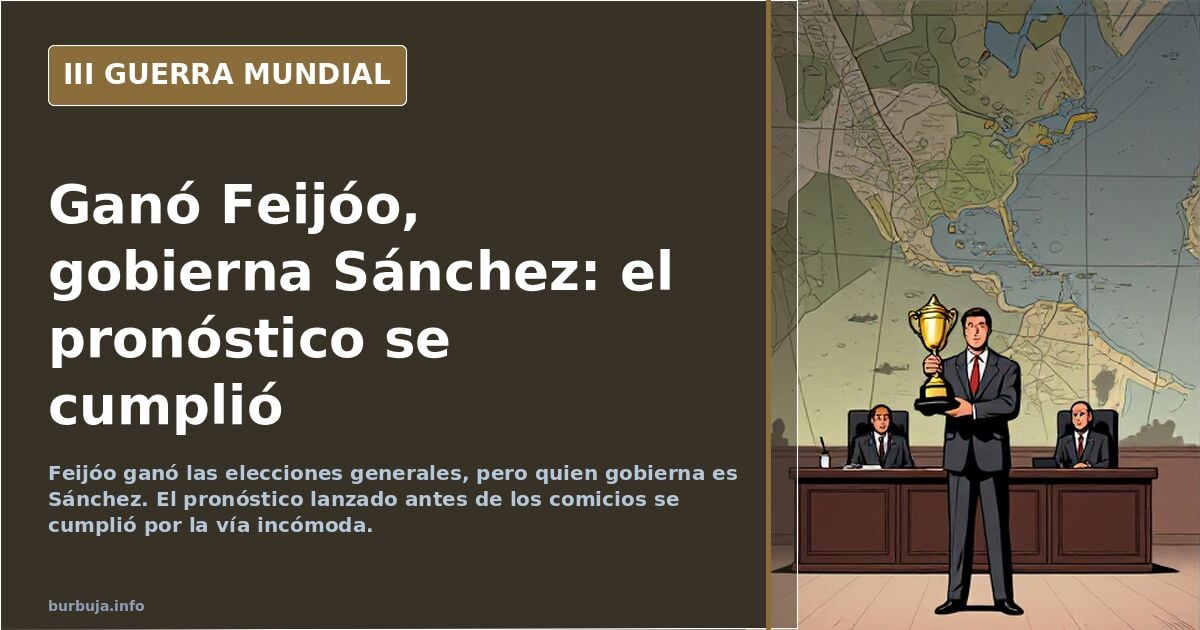
Feijóo won the election, but Sánchez governs
Can Pedro Sánchez win another general election after everything stacked against him? This bet was launched during Christmas and sounded almost like a provocation. Time resolved it via an uncomfortable path: the ballots may have delivered victory to Alberto Núñez Feijóo’s PP (People's Party), yet the PSOE (Spanish Socialist Workers' Party) ended up governing. Feijóo won. Sánchez governs. And almost no one was satisfied with the result.
Who was expected to win the general elections
Before the vote, the starting thesis — that Sánchez would retain power — was met with mockery and sarcasm. Most assumed punishment at the polls, though they disagreed on the magnitude: some saw a collapse, others simple weariness. The figure driving the calculation wasn't the vote itself, but abstention. If the right stayed home, the regionalist bloc weighed more, along with the arithmetic of coalition deals.
That was the blind spot of the forecast. Anger was taken for granted, far above what polls measured. But translating that anger into seats is another matter. Working against this was a data point that shifted several times: the PP would have needed a candidate without rejection to secure a clear majority. With their chosen candidate, they didn't. Nostalgia for the previous era summarizes the level of disillusionment.
Feijóo won the election and Sánchez governs: the outcome
With the data on the table, the first half came true: electoral victory went to the PP. The second part, the one that truly mattered, also did: Sánchez forms the government, relying on investiture partners. The deal wasn't cheap or quick, and negotiating those supports has marked the entire legislative term. Some anticipated this; others were left hanging by the headline.
Here enters the argument that has gained strength over time. The PP and Vox are, it is argued, too Madrid-centric formations for a country decided elsewhere on the map: without reach in Catalonia and the Basque Country — around 25% of the electorate — an absolute majority becomes simply impossible. It’s not an opinion: it’s arithmetic. The corollary is bitter for the right: any combination ignoring those voters starts off crippled.
Who pays the bill: Brussels, debt, and cuts
The question ordering everything that trinc is economic, and the repeated answer is uncomfortable. While the PSOE governs, the European Union — tolerant of spending, so it seems — keeps the tap open for debt, and adjustments are postponed. If the PP took office, the circulating calculation is the opposite: Brussels would close financing with procedural explanations, and cuts and street protests would begin.
Hence the cynical dilemma dominating the final stretch: let the party continue until its last consequence. The sequence drawn is — verbatim — self-coup, self-attack, self-coup: leave the mess for Sánchez and wait seated. The lateral price has a name and isn't small: national unity as bargaining chip, and a check whose amount is estimated at 300€, the most repeated figure.
The 60% paid by the State
No data better summarizes the system's trap than public spending. Nearly 60% of the adult population receives some form of state payment, according to circulating calculations. With this baseline, any adjustment becomes a primary electoral problem: millions of incomes depend, directly or indirectly, on the cash register staying open.
On this basis rests the most repeated prediction: whoever wins, the result will look too similar. Methods change, not destiny. And the date hovering over all analysis is 2027: a new mandate for Sánchez until then would complete nearly a decade in power.
Can the elections be considered fraudulent?
One faction takes distrust to the end, arguing there are no elections worthy of the name because nothing elected changes what is decided. It should be said clearly: there is no evidence supporting such a claim. But it explains why so many have stopped trinc politics. It’s not that they vote for someone else. It’s that they’ve stopped believing in the system.
The pool, finally, is settled. One won, the other governs. And here we remain, debating whether we vote or merely choose who passes us the paperwork.
Can Pedro Sánchez win another general election after everything stacked against him? This bet was launched during Christmas and sounded almost like a provocation. Time resolved it via an uncomfortable path: the ballots may have delivered victory to Alberto Núñez Feijóo’s PP (People's Party), yet the PSOE (Spanish Socialist Workers' Party) ended up governing. Feijóo won. Sánchez governs. And almost no one was satisfied with the result.
Who was expected to win the general elections
Before the vote, the starting thesis — that Sánchez would retain power — was met with mockery and sarcasm. Most assumed punishment at the polls, though they disagreed on the magnitude: some saw a collapse, others simple weariness. The figure driving the calculation wasn't the vote itself, but abstention. If the right stayed home, the regionalist bloc weighed more, along with the arithmetic of coalition deals.
That was the blind spot of the forecast. Anger was taken for granted, far above what polls measured. But translating that anger into seats is another matter. Working against this was a data point that shifted several times: the PP would have needed a candidate without rejection to secure a clear majority. With their chosen candidate, they didn't. Nostalgia for the previous era summarizes the level of disillusionment.
Feijóo won the election and Sánchez governs: the outcome
With the data on the table, the first half came true: electoral victory went to the PP. The second part, the one that truly mattered, also did: Sánchez forms the government, relying on investiture partners. The deal wasn't cheap or quick, and negotiating those supports has marked the entire legislative term. Some anticipated this; others were left hanging by the headline.
Here enters the argument that has gained strength over time. The PP and Vox are, it is argued, too Madrid-centric formations for a country decided elsewhere on the map: without reach in Catalonia and the Basque Country — around 25% of the electorate — an absolute majority becomes simply impossible. It’s not an opinion: it’s arithmetic. The corollary is bitter for the right: any combination ignoring those voters starts off crippled.
Who pays the bill: Brussels, debt, and cuts
The question ordering everything that trinc is economic, and the repeated answer is uncomfortable. While the PSOE governs, the European Union — tolerant of spending, so it seems — keeps the tap open for debt, and adjustments are postponed. If the PP took office, the circulating calculation is the opposite: Brussels would close financing with procedural explanations, and cuts and street protests would begin.
Hence the cynical dilemma dominating the final stretch: let the party continue until its last consequence. The sequence drawn is — verbatim — self-coup, self-attack, self-coup: leave the mess for Sánchez and wait seated. The lateral price has a name and isn't small: national unity as bargaining chip, and a check whose amount is estimated at 300€, the most repeated figure.
The 60% paid by the State
No data better summarizes the system's trap than public spending. Nearly 60% of the adult population receives some form of state payment, according to circulating calculations. With this baseline, any adjustment becomes a primary electoral problem: millions of incomes depend, directly or indirectly, on the cash register staying open.
On this basis rests the most repeated prediction: whoever wins, the result will look too similar. Methods change, not destiny. And the date hovering over all analysis is 2027: a new mandate for Sánchez until then would complete nearly a decade in power.
Can the elections be considered fraudulent?
One faction takes distrust to the end, arguing there are no elections worthy of the name because nothing elected changes what is decided. It should be said clearly: there is no evidence supporting such a claim. But it explains why so many have stopped trinc politics. It’s not that they vote for someone else. It’s that they’ve stopped believing in the system.
The pool, finally, is settled. One won, the other governs. And here we remain, debating whether we vote or merely choose who passes us the paperwork.
Also available in: Deutsch
Summary of a discussion on Burbuja.info - Foro de economía, actualidad y política., translated from Spanish and reviewed before publication. Read the full discussion (140 replies).
More summaries
-
EU Rhetoric: Strategic Escalation or Pre-Set Script?
Analysis of the EU's unprecedented rhetorical escalation toward Russia: a geopolitical strategy or a pre-orchestrated script?
-
EU Internal Shifts: Geopolitical Tensions and Elite Dynamics
Analysis of internal EU tensions: Is this an economic crisis or a geopolitical reorientation?
-
Russia's Past Inaction Suggests Weak Response to EU Attack
Analyzing Russia's historical lack of military response to incidents in Syria and Israel to gauge potential reaction to an EU aggression.
-
Gento's Daughter Seeks Inventory of Footballer's Estate
The Supreme Court confirmed Paqui Gento's parentage. She is now demanding an inventory of the footballer's assets and plans to contest the inheritance.
-
Erdogan, Putin and Khamenei Meet in Tehran to Discuss Syria
Erdogan arrives in Tehran for a summit with Putin and Khamenei on Syria, amid tensions with Washington over Kurds and F-16s.
-
Russia's MiG-41: Sixth-gen fighter aims for 2025 debut
MiG-41 promises hypersonic missile interception and satellite hunting by 2025, despite Russia's unproven fifth-generation fleet.