
Russia's MiG-41: Sixth-gen fighter aims for 2025 debut
MiG-41 promises hypersonic missile interception and satellite hunting by 2025, despite Russia's unproven fifth-generation fleet.
English · Original discussion in Spanish · Published
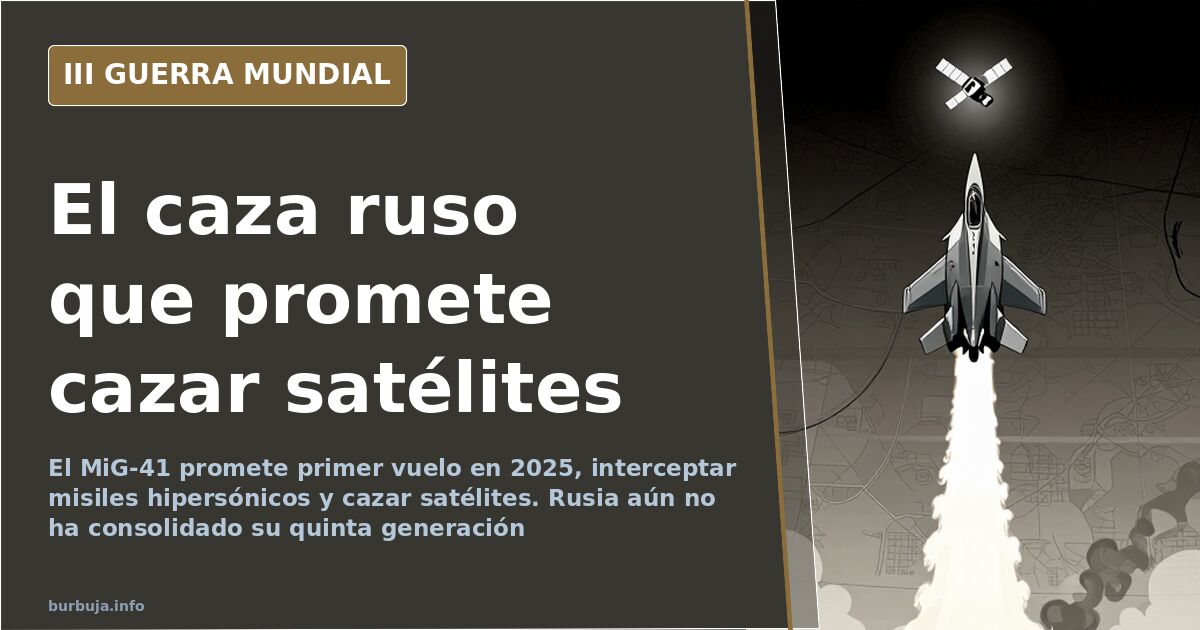
Russian MiG-41 promises satellite hunting and 2025 flight
A rendered video, a mock-up, and a date. That is how a fighter jet is presented and an entire generation sold. The MiG-41, the aircraft with which Russia claims to leap into the sixth generation, arrives with three brochure promises: first flight scheduled for 2025, capability to intercept hypersonic missiles, and armament capable of reaching satellites in Earth orbit. No prototype, engine, or verifiable timeline is known. There are only images.
The laughter was nearly universal. Not because Russian aviation is funny—there are reasons to take it seriously—but because the starting point does not support the claim. According to critics, those aspiring to the sixth generation have yet to make their fifth generation work under combat conditions. And that contradiction, more than any other, ordered everything discussed afterwards.
What exactly does the MiG-41 promise?
The announcement is excessively ambitious. Intercepting hypersonic missiles is today the hardest problem in air defense: it involves detecting, tracking, and hitting an object maneuvering at speeds where conventional missiles arrive too late. And carrying armament capable of reaching satellites in orbit implies operating at an altitude no manned fighter has ever touched in real combat.
Hence the material skepticism, the kind that does not depend on geopolitics. An airplane does not exist because it is drawn. It exists when it rolls down a runway, when its radar turns on, when its engine sustains regime without disintegrating. Until 2025, at earliest, what is on the table are mock-ups and CGI. The deadline is that of the announcement itself, not that of any hostile observer.
From Su-57 to sixth: the leap Russia has not yet made
The most repeated objection is not against the MiG-41, but against its ladder. The Su-57, the Russian fifth-generation fighter, has dragged years of delays and doubts about its serial production. Some recall that India, a traditional partner of the project with a fruta for accepting almost anything, withdrew from the program. When a low-demanding client gets off the boat, the boat usually leaks.
The other front is the Su-75 Checkmate, the low-cost single-engine bet called to compete with the F-35. The criticism is that even its own manufacturer does not believe it: it is claimed that Russia does not include the aircraft in its purchase plans. Jumping to the sixth generation without closing the fifth before is, at least, an exercise in optimism.
The stealth quartet nobody has seen
For some time now, the Russian military industry accumulates presentations without product. Alongside the MiG-41 align the Su-57, the Su-75, and the Armata, the battle tank that has been in the showcase for years and of which barely any units parading have been seen. The joke that summarizes the consensus: they form a stealth quartet, so silent that nobody will ever see them.
The label floating over all of them comes from afar: Wunderwaffe, wonder weapon. Germany spent it in World War II with the known results. When a program is announced with capabilities that no other has, the announcement usually says more about the budget than about the apparatus.
Russian aerodynamics against Western electronics
Not everything was a joke. Russian aeronautical engineering has a school and a good one, according to those who defend it: aerospace mathematics textbooks through which anyone who studied the degree passes and airplanes of a maneuverability that, they sustain, Western apparatus do not always match. Soviet engines have a fruta for being rough and very reliable. And in that field, it is sustained that a US fighter triples the price of its Russian equivalent.
The counter-offensive of that reasoning points to electronics. The more an airplane depends on its computer systems, the more fragile it is against an electromagnetic pulse or a microwave cannon. A sensor-filled F-35 can become a very expensive brick if someone turns off the light. Of course, a fighter without electronics also does not win: it just falls with more style.
Does a manned fighter still make sense?
The question slipped into the conversation amid Ukraine, where the war is decided with artillery and cheap drones. What for an apparatus with a pilot if a four-digit drone does half the work for a fraction of the price? The answers point to functions that the drone covers poorly: patrolling airspace, monitoring borders, escorting command planes. At a purely warlike level, the cost-performance ratio remains in the air.
It is the uncomfortable question that no ministry wants to answer publicly. And it is not only Russian.
The economy of a war of attrition
The coldest argument of all does not speak of aerodynamics, it speaks of cash. Why manufacture new arsenal having millions of Soviet weapons to amortize? Why wear out your own army if you can pay mercenaries and, incidentally, lighten the prisons? Why escalate the conflict if the war of attrition erodes the enemy state without triggering spending?
The conclusion extracted is uncomfortable for both sides: Russia invests in technology because it cannot afford to stagnate, but it may not have the economic capacity to manufacture what it designs. Designing is cheap. Producing, not.
An episode that disorients is brought up. The F-117, the invisible plane that was going to rewrite war, appeared over Yugoslavia and, as recalled in the thread, Serbians shot it down on its first sortie. Invisibility, like the sixth generation, lasts until someone turns on the radar and aims well. The MiG-41 has until 2025 to stop being a render.
A rendered video, a mock-up, and a date. That is how a fighter jet is presented and an entire generation sold. The MiG-41, the aircraft with which Russia claims to leap into the sixth generation, arrives with three brochure promises: first flight scheduled for 2025, capability to intercept hypersonic missiles, and armament capable of reaching satellites in Earth orbit. No prototype, engine, or verifiable timeline is known. There are only images.
The laughter was nearly universal. Not because Russian aviation is funny—there are reasons to take it seriously—but because the starting point does not support the claim. According to critics, those aspiring to the sixth generation have yet to make their fifth generation work under combat conditions. And that contradiction, more than any other, ordered everything discussed afterwards.
What exactly does the MiG-41 promise?
The announcement is excessively ambitious. Intercepting hypersonic missiles is today the hardest problem in air defense: it involves detecting, tracking, and hitting an object maneuvering at speeds where conventional missiles arrive too late. And carrying armament capable of reaching satellites in orbit implies operating at an altitude no manned fighter has ever touched in real combat.
Hence the material skepticism, the kind that does not depend on geopolitics. An airplane does not exist because it is drawn. It exists when it rolls down a runway, when its radar turns on, when its engine sustains regime without disintegrating. Until 2025, at earliest, what is on the table are mock-ups and CGI. The deadline is that of the announcement itself, not that of any hostile observer.
From Su-57 to sixth: the leap Russia has not yet made
The most repeated objection is not against the MiG-41, but against its ladder. The Su-57, the Russian fifth-generation fighter, has dragged years of delays and doubts about its serial production. Some recall that India, a traditional partner of the project with a fruta for accepting almost anything, withdrew from the program. When a low-demanding client gets off the boat, the boat usually leaks.
The other front is the Su-75 Checkmate, the low-cost single-engine bet called to compete with the F-35. The criticism is that even its own manufacturer does not believe it: it is claimed that Russia does not include the aircraft in its purchase plans. Jumping to the sixth generation without closing the fifth before is, at least, an exercise in optimism.
The stealth quartet nobody has seen
For some time now, the Russian military industry accumulates presentations without product. Alongside the MiG-41 align the Su-57, the Su-75, and the Armata, the battle tank that has been in the showcase for years and of which barely any units parading have been seen. The joke that summarizes the consensus: they form a stealth quartet, so silent that nobody will ever see them.
The label floating over all of them comes from afar: Wunderwaffe, wonder weapon. Germany spent it in World War II with the known results. When a program is announced with capabilities that no other has, the announcement usually says more about the budget than about the apparatus.
Russian aerodynamics against Western electronics
Not everything was a joke. Russian aeronautical engineering has a school and a good one, according to those who defend it: aerospace mathematics textbooks through which anyone who studied the degree passes and airplanes of a maneuverability that, they sustain, Western apparatus do not always match. Soviet engines have a fruta for being rough and very reliable. And in that field, it is sustained that a US fighter triples the price of its Russian equivalent.
The counter-offensive of that reasoning points to electronics. The more an airplane depends on its computer systems, the more fragile it is against an electromagnetic pulse or a microwave cannon. A sensor-filled F-35 can become a very expensive brick if someone turns off the light. Of course, a fighter without electronics also does not win: it just falls with more style.
Does a manned fighter still make sense?
The question slipped into the conversation amid Ukraine, where the war is decided with artillery and cheap drones. What for an apparatus with a pilot if a four-digit drone does half the work for a fraction of the price? The answers point to functions that the drone covers poorly: patrolling airspace, monitoring borders, escorting command planes. At a purely warlike level, the cost-performance ratio remains in the air.
It is the uncomfortable question that no ministry wants to answer publicly. And it is not only Russian.
The economy of a war of attrition
The coldest argument of all does not speak of aerodynamics, it speaks of cash. Why manufacture new arsenal having millions of Soviet weapons to amortize? Why wear out your own army if you can pay mercenaries and, incidentally, lighten the prisons? Why escalate the conflict if the war of attrition erodes the enemy state without triggering spending?
The conclusion extracted is uncomfortable for both sides: Russia invests in technology because it cannot afford to stagnate, but it may not have the economic capacity to manufacture what it designs. Designing is cheap. Producing, not.
An episode that disorients is brought up. The F-117, the invisible plane that was going to rewrite war, appeared over Yugoslavia and, as recalled in the thread, Serbians shot it down on its first sortie. Invisibility, like the sixth generation, lasts until someone turns on the radar and aims well. The MiG-41 has until 2025 to stop being a render.
Also available in: Deutsch
Summary of a discussion on Burbuja.info - Foro de economía, actualidad y política., translated from Spanish and reviewed before publication. Read the full discussion (138 replies).
More summaries
-
Almeida falls for Russian prank about Ukraine and refugees
Martínez-Almeida falls for a phone prank by two Russian comedians that exposes his stance on Ukraine, refugees and Madrid Central
-
Francisco Adolfo's miracle: faith, fame and relapses
Influencer Francisco Adolfo visits Fátima and buys a cross. Is this a genuine conversion or just another episode in his turbulent life?
-
Vance: US troops in Ukraine if Russia refuses talks
JD Vance says US troops in Ukraine are an option if Russia doesn't negotiate. Analysis splits between bluff, theater, and pressure tactics.
-
Ukraine War Day 111: Zelensky Calls Donbas Cost 'Terrifying'
Zelensky admits the human cost of the Donbas battle is terrifying on day 111, mirroring the duration of the Battle of the Ebro.
-
Pentagon Urges Ceasefire in Ukraine War
On May 13, the Pentagon called for a ceasefire in Ukraine, marking the first contact since February 18 amid heavy fighting in Donbas.
-
No clear villains in Ukraine war, forum users say
Forum members admit uncertainty about who is right in the Ukraine war, arguing only competing interests exist.