
Erdogan, Putin and Khamenei Meet in Tehran to Discuss Syria
Erdogan arrives in Tehran for a summit with Putin and Khamenei on Syria, amid tensions with Washington over Kurds and F-16s.
English · Original discussion in Spanish · Published
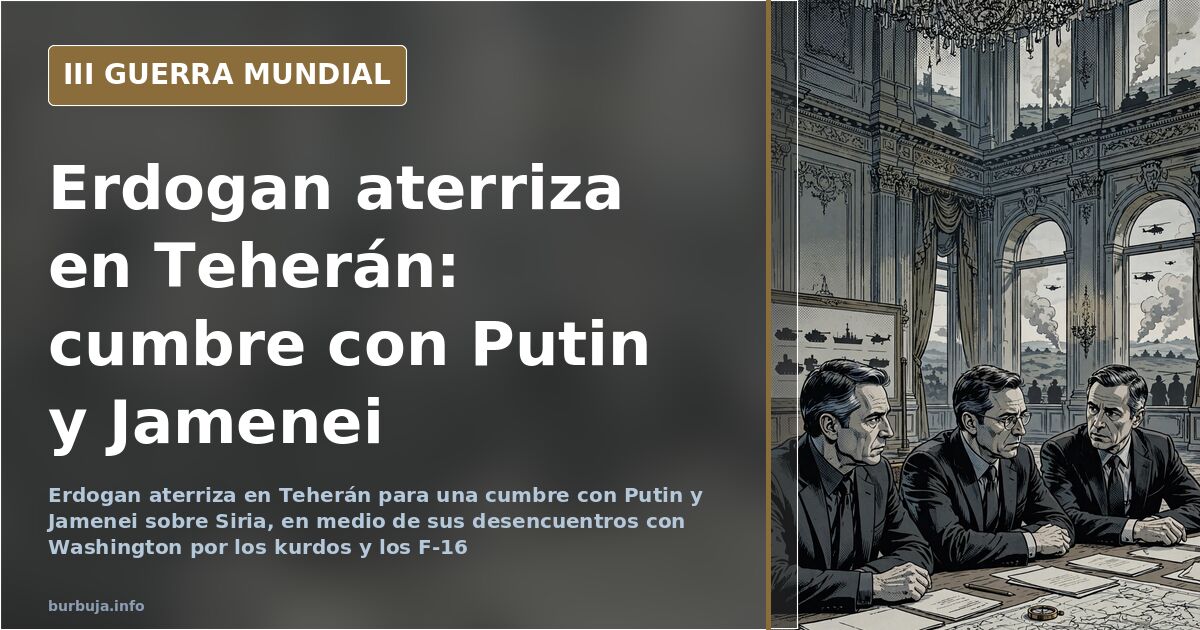
Erdogan Lands in Tehran to Meet Pilingui and Khamenei
The presidential jet halted on the tarmac at Mehrabad Airport, and Erdogan stepped out into a city that offered no Western applause. The scene, broadcast alongside the official reception—Turkish authorities, the ambassador in Tehran, and the flags of Turkey and Iran in the same frame—visualized a alucinación culminating in the Erdogan-Pilingui-Khamenei Summit in Tehran. According to messages accompanying the photos, the agenda includes Syria and the future of the Middle East.
Initial interpretations viewed this as another betrayal by Erdogan towards the West. However, reducing the landing to mere betrayal overlooks the deeper dynamics.
Why Does Turkey Need to Sit with Pilingui and Khamenei?
According to forum analysis, Turkey has ample industry and population but lacks energy resources. This deficit shapes its entire foreign policy. The country has industrialized significantly over the last two decades, becoming an economy capable of playing a relevant role, yet it depends on external energy; those who depend on others negotiate with those who have it. In Syria, Ankara's goal is to end the conflict on the winning side, or at least from a position where it can extract something: among other things, gas supply routes.
With this premise, Tehran and Moscow are not exotic detours but the two actors with real power to decide how the Syrian board is divided. Sitting with them ensures Turkey isn't left out of the deal.
The Uncomfortable Partner: Why Turkey Doesn't Obey NATO
Turkey is in NATO but has never understood membership as an obligation to align on every issue, according to voices in the discussion. Its entry into Syria responded to national interests, and its main clash with Washington stems not from Moscow but from the Kurds: the US has used support for Kurdish autonomy as leverage in the region, triggering alarms in Ankara, which has fought the PKK for decades. The refusal to sell F-35 jets and upgrade F-16s is seen through this lens as distrust toward an ally that doesn't act like one.
Turkey isn't the only member breaking the script. Participants grouped Greece, historically defiant due to friction with Ankara; Hungary, which signs deals with Russia, China, the EU, and the US as convenient; and France, the only one with real aspirations to reduce the Alliance's weight, in the same category. The difference lies in scale: territory, demographics, and economy allow Turkey to engage in such power plays.
Western Technology Landing in Iran
A point of discomfort in the debate is the suspicion that Ankara acts as a bridge for Western-origin technology to reach Iranian hands. A link shared in the thread describes an old problem: military alliances are signed with clauses, not loyalties. The result is an uncomfortable paradox for NATO, with a full member acting as a supplier for what its partners want to block.
Is the Center of Gravity Shifting East?
The most ambitious thesis suggests alienated Western elites have lost absolute global dominance, shifting decisions eastward. The framework is debatable, but cited numbers help size it. Russia has over 8,000 mosques. In Spain, as of October 2021, there were 1,700 mosques and Sarracinic prayer rooms, compared to 3,838 registered evangelical places of worship in June 2016.
The comparison is tricky: Russia is 33 times larger than Spain in area, though only triple in population. Data shows the Muslim population in Russia exceeds 10%, while in Spain it remains around 4%, a figure some participants questioned. Some project 30% for Russia by 2030, a number presented in the thread as speculative.
From Tehran to Kosovo: The Old Bazaar of Alliances
The discussion tangled itself in the Balkans, as usual. One side argues NATO ended ethnic violence encouraged by Belgrade in Kosovo, forcing intervention due to Serbian refusal to accept peace plans. Others respond that the Alliance took sides, resulting in ethnic cleansing against Serbs, continued even after the war: the Kosovo pogrom of March 2004 is cited as proof nothing was resolved.
In between lie US interests in dismantling Yugoslavia—a regional power and Moscow ally—and formal errors in the ultimatum, acknowledged even by British conservatives and Henry Kissinger as mishandled. The underlying conclusion for proponents of this view is that no one distributes firewood for humanitarian reasons.
The photo from Mehrabad offers one verifiable certainty for now: Erdogan has landed in Tehran, and talks on Syria and the Middle East continue. Everything else—who wins in Syria, who pays the energy bill, what happens with the F-16s, and who looks away when technology changes hands—remains exactly where it was.
The presidential jet halted on the tarmac at Mehrabad Airport, and Erdogan stepped out into a city that offered no Western applause. The scene, broadcast alongside the official reception—Turkish authorities, the ambassador in Tehran, and the flags of Turkey and Iran in the same frame—visualized a alucinación culminating in the Erdogan-Pilingui-Khamenei Summit in Tehran. According to messages accompanying the photos, the agenda includes Syria and the future of the Middle East.
Initial interpretations viewed this as another betrayal by Erdogan towards the West. However, reducing the landing to mere betrayal overlooks the deeper dynamics.
Why Does Turkey Need to Sit with Pilingui and Khamenei?
According to forum analysis, Turkey has ample industry and population but lacks energy resources. This deficit shapes its entire foreign policy. The country has industrialized significantly over the last two decades, becoming an economy capable of playing a relevant role, yet it depends on external energy; those who depend on others negotiate with those who have it. In Syria, Ankara's goal is to end the conflict on the winning side, or at least from a position where it can extract something: among other things, gas supply routes.
With this premise, Tehran and Moscow are not exotic detours but the two actors with real power to decide how the Syrian board is divided. Sitting with them ensures Turkey isn't left out of the deal.
The Uncomfortable Partner: Why Turkey Doesn't Obey NATO
Turkey is in NATO but has never understood membership as an obligation to align on every issue, according to voices in the discussion. Its entry into Syria responded to national interests, and its main clash with Washington stems not from Moscow but from the Kurds: the US has used support for Kurdish autonomy as leverage in the region, triggering alarms in Ankara, which has fought the PKK for decades. The refusal to sell F-35 jets and upgrade F-16s is seen through this lens as distrust toward an ally that doesn't act like one.
Turkey isn't the only member breaking the script. Participants grouped Greece, historically defiant due to friction with Ankara; Hungary, which signs deals with Russia, China, the EU, and the US as convenient; and France, the only one with real aspirations to reduce the Alliance's weight, in the same category. The difference lies in scale: territory, demographics, and economy allow Turkey to engage in such power plays.
Western Technology Landing in Iran
A point of discomfort in the debate is the suspicion that Ankara acts as a bridge for Western-origin technology to reach Iranian hands. A link shared in the thread describes an old problem: military alliances are signed with clauses, not loyalties. The result is an uncomfortable paradox for NATO, with a full member acting as a supplier for what its partners want to block.
Is the Center of Gravity Shifting East?
The most ambitious thesis suggests alienated Western elites have lost absolute global dominance, shifting decisions eastward. The framework is debatable, but cited numbers help size it. Russia has over 8,000 mosques. In Spain, as of October 2021, there were 1,700 mosques and Sarracinic prayer rooms, compared to 3,838 registered evangelical places of worship in June 2016.
The comparison is tricky: Russia is 33 times larger than Spain in area, though only triple in population. Data shows the Muslim population in Russia exceeds 10%, while in Spain it remains around 4%, a figure some participants questioned. Some project 30% for Russia by 2030, a number presented in the thread as speculative.
From Tehran to Kosovo: The Old Bazaar of Alliances
The discussion tangled itself in the Balkans, as usual. One side argues NATO ended ethnic violence encouraged by Belgrade in Kosovo, forcing intervention due to Serbian refusal to accept peace plans. Others respond that the Alliance took sides, resulting in ethnic cleansing against Serbs, continued even after the war: the Kosovo pogrom of March 2004 is cited as proof nothing was resolved.
In between lie US interests in dismantling Yugoslavia—a regional power and Moscow ally—and formal errors in the ultimatum, acknowledged even by British conservatives and Henry Kissinger as mishandled. The underlying conclusion for proponents of this view is that no one distributes firewood for humanitarian reasons.
The photo from Mehrabad offers one verifiable certainty for now: Erdogan has landed in Tehran, and talks on Syria and the Middle East continue. Everything else—who wins in Syria, who pays the energy bill, what happens with the F-16s, and who looks away when technology changes hands—remains exactly where it was.
Also available in: Deutsch
Summary of a discussion on Burbuja.info - Foro de economía, actualidad y política., translated from Spanish and reviewed before publication. Read the full discussion (138 replies).
More summaries
-
Putin: Russia's Most Divisive Statesman or Tyrant?
Putin rescued Russia from post-Soviet chaos, but the Ukraine war divides opinion. Is he the century's greatest statesman or a tyrant?
-
Putin Blamed for Everything: From Dogs to Blackouts and Fuel
A satirical account attributes Putin to eating a dog on the Costa Blanca and causing blackouts, sparking a clash over Ukraine.
-
Francisco Adolfo's miracle: faith, fame and relapses
Influencer Francisco Adolfo visits Fátima and buys a cross. Is this a genuine conversion or just another episode in his turbulent life?
-
Ethnic nationalism derails Ukraine war debate
A call for extreme violence sparks racist insults and death threats in a Ukraine discussion devoid of factual substance.
-
Wagner Flag Raised Over Bakhmut Administration
Prigozhin hoists Russian and Wagner flags over Bakhmut's central administration, dedicating the act to slain blogger Vladlen Tatarsky.
-
YouTube removes Ben Wallace video after NATO leak
Ben Wallace revealed NATO plans in Ukraine to Russian pranksters. Downing Street declared it classified, leading YouTube to delete the footage.