
Family Feud Over €30,000: Who's Right When Parents Favor One Child?
A father-in-law gives €30,000 to one son and refuses to match the other. The clash between equal distribution and helping those in need, with inheritance in the background.
English · Original discussion in Spanish · Published
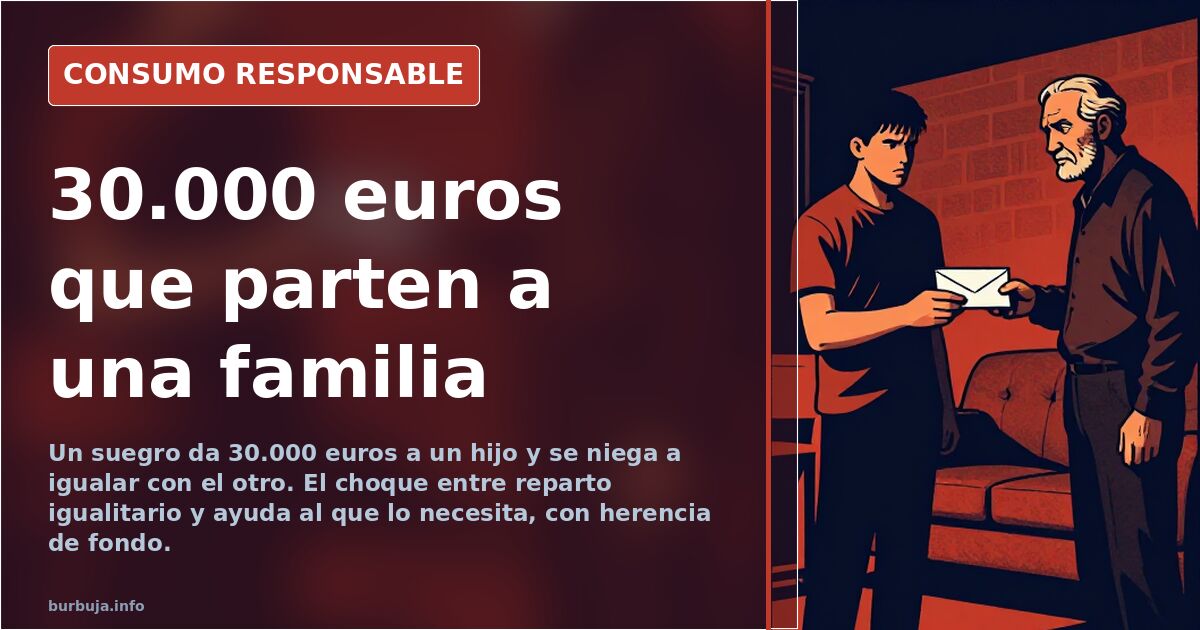
Family Row Over €30,000: Who is Right When In-Laws Help Only One Child
Thirty thousand euros. That's the figure that has split a family in two. The vvife's brother is getting married, his partner is about to give birth, and they are buying an apartment with no money. The mother-in-law wants to give them €30,000 in help. The daughter demands the same €30,000 so as not to be at a disadvantage. The father-in-law refuses: "we don't need the money," he says. There is a mortgage almost paid off and savings that the son-in-law describes as small. That's where it all began.
Help Those Who Need It, Not Those Who Have Earned It
The first set of arguments doesn't dispute legality, it disputes logic. When one child buys their first home and another already has theirs almost paid off, help isn't a reward: it's a patch. No one argues that parents should distribute blindly. They argue the opposite: distributing the same to those who don't need it is a strange form of justice.
Faced with this comes the classic objection. If the in-laws can't make ends meet, perhaps the problem isn't a lack of income but a lack of foresight. And the question no one closes: why subsidize the one who manages worse twice over. Some recall that renting exists and that it hasn't always been a punishment.
The Money Comes From the Father-in-Law, But the Tax Office Checks the Bill
Here the story becomes technical and improves. A cash donation from parents to a child is not invisible to the administration: it must be declared, taxed, and the recipient may end up with a request for information if there are no papers at the other end. The formula that is repeated in more detailed analyses is the 0% intra-family loan, with a contract and repayment schedule, because it turns a debatable gift into a debt that can be claimed.
There's a nuance that is often forgotten. When the money goes towards buying a first home or starting a business, some regions offer tax relief up to 100%. The same transaction can cost nothing or cost a headache, depending on how it's signed. The full breakdown —payment terms, notary fees, express renunciation of future inheritance— is where it's truly decided who is right.
Equality Between Siblings or "Equity": The Underlying Clash
The axis of the confrontation isn't the apartment. It's a word. Some defend identical distribution between siblings as a non-negotiable principle: if one gets 30,000, the other gets 30,000. Others respond with the argument of need and call it equity, which sounds better than favoritism but is quite similar.
One part of the discussion maintains, with more sarcasm than data, that most families end up favoring the child who asks for the most. And they add the uncomfortable corollary: the one who makes an effort stays silent but accumulates resentment. "Sooner or later it will come out somewhere."
The Real Problem Isn't the Apartment, It's the Inheritance
The most repeated warning points twenty years ahead. Any lifetime donation should be included in the inheritance inventory, and whoever already received €30,000 would have to receive €30,000 less when distributing. If that is not put in writing, there is no discussion possible: there will be fights when the time comes.
The proposed solution is simple and boring. Documented donation, before a notary, with express renunciation of that amount in the future inheritance. Words fly away; paper does not. Whoever doesn't do it is freely sowing the seeds for their children's lawsuit.
The Winning Advice: Don't Get Involved
The son-in-law asks what to do. The dominant answer is to do nothing. It's not your family, they will forgive each other, and you will get burned. Another repeated suggestion: note the situation and remember it the day the father-in-law needs help. Some take it further and suggest that on that day, he should call his beloved son to change his diaper.
Personal cases come up. A father who supported a son and his in-laws for years, and who reappeared when he needed care. A father-in-law whose house is being renovated by his sons-in-law while the other son only calls to ask for money. None provide jurisprudence. All explain why the matter cannot be resolved with common sense.
With the law in hand, the father-in-law can do whatever he wants with his money. With the family in hand, the problem has only just begun.
Thirty thousand euros. That's the figure that has split a family in two. The vvife's brother is getting married, his partner is about to give birth, and they are buying an apartment with no money. The mother-in-law wants to give them €30,000 in help. The daughter demands the same €30,000 so as not to be at a disadvantage. The father-in-law refuses: "we don't need the money," he says. There is a mortgage almost paid off and savings that the son-in-law describes as small. That's where it all began.
Help Those Who Need It, Not Those Who Have Earned It
The first set of arguments doesn't dispute legality, it disputes logic. When one child buys their first home and another already has theirs almost paid off, help isn't a reward: it's a patch. No one argues that parents should distribute blindly. They argue the opposite: distributing the same to those who don't need it is a strange form of justice.
Faced with this comes the classic objection. If the in-laws can't make ends meet, perhaps the problem isn't a lack of income but a lack of foresight. And the question no one closes: why subsidize the one who manages worse twice over. Some recall that renting exists and that it hasn't always been a punishment.
The Money Comes From the Father-in-Law, But the Tax Office Checks the Bill
Here the story becomes technical and improves. A cash donation from parents to a child is not invisible to the administration: it must be declared, taxed, and the recipient may end up with a request for information if there are no papers at the other end. The formula that is repeated in more detailed analyses is the 0% intra-family loan, with a contract and repayment schedule, because it turns a debatable gift into a debt that can be claimed.
There's a nuance that is often forgotten. When the money goes towards buying a first home or starting a business, some regions offer tax relief up to 100%. The same transaction can cost nothing or cost a headache, depending on how it's signed. The full breakdown —payment terms, notary fees, express renunciation of future inheritance— is where it's truly decided who is right.
Equality Between Siblings or "Equity": The Underlying Clash
The axis of the confrontation isn't the apartment. It's a word. Some defend identical distribution between siblings as a non-negotiable principle: if one gets 30,000, the other gets 30,000. Others respond with the argument of need and call it equity, which sounds better than favoritism but is quite similar.
One part of the discussion maintains, with more sarcasm than data, that most families end up favoring the child who asks for the most. And they add the uncomfortable corollary: the one who makes an effort stays silent but accumulates resentment. "Sooner or later it will come out somewhere."
The Real Problem Isn't the Apartment, It's the Inheritance
The most repeated warning points twenty years ahead. Any lifetime donation should be included in the inheritance inventory, and whoever already received €30,000 would have to receive €30,000 less when distributing. If that is not put in writing, there is no discussion possible: there will be fights when the time comes.
The proposed solution is simple and boring. Documented donation, before a notary, with express renunciation of that amount in the future inheritance. Words fly away; paper does not. Whoever doesn't do it is freely sowing the seeds for their children's lawsuit.
The Winning Advice: Don't Get Involved
The son-in-law asks what to do. The dominant answer is to do nothing. It's not your family, they will forgive each other, and you will get burned. Another repeated suggestion: note the situation and remember it the day the father-in-law needs help. Some take it further and suggest that on that day, he should call his beloved son to change his diaper.
Personal cases come up. A father who supported a son and his in-laws for years, and who reappeared when he needed care. A father-in-law whose house is being renovated by his sons-in-law while the other son only calls to ask for money. None provide jurisprudence. All explain why the matter cannot be resolved with common sense.
With the law in hand, the father-in-law can do whatever he wants with his money. With the family in hand, the problem has only just begun.
Summary of a discussion on Burbuja.info - Foro de economía, actualidad y política., translated from Spanish and reviewed before publication. Read the full discussion (165 replies).
More summaries
-
20-Cent Bags: The Tax That Fails to Stop the Dumping
Bags cost 20 cents, yet 95% of ocean plastic comes from only 10 rivers: the true cost of this 'green gesture' doesn't match the propaganda.
-
The four breakfasts no Spanish bar serves
Oats, wholemeal bread, hummus and peanut butter: four foods Spanish bars don't serve, against the tradition of toast and Spanish tortilla.
-
Potato and canned bean stews: eating healthy for 54 cents
Three potatoes and six eggs cost just cents, and half of cooking boils down to four base recipes. Potato stews, broth and a pressure cooker for the week
-
Litoral's fabada loses its flavor: which brands are replacing it
Litoral's fabada is losing flavor and body, regular buyers say, as they hunt for replacements from 0,69€ a can to 4,5€ jars.
-
Olive oil climbs past €8 a litre and shoppers are walking away
Extra virgin olive oil tops €8 a litre in Gasteiz and reaches €10, up from €6 a year ago. More and more shoppers are taking it off their lists
-
A Land Rover and 20.000 euros in repairs in just four years
Mireia has spent about 20.000 euros on repairs to her Land Rover, with only 173.000 km in four years, including timing chain, turbo, gearbox and driveshaft