
20-Cent Bags: The Tax That Fails to Stop the Dumping
Bags cost 20 cents, yet 95% of ocean plastic comes from only 10 rivers: the true cost of this 'green gesture' doesn't match the propaganda.
English · Original discussion in Spanish · Published
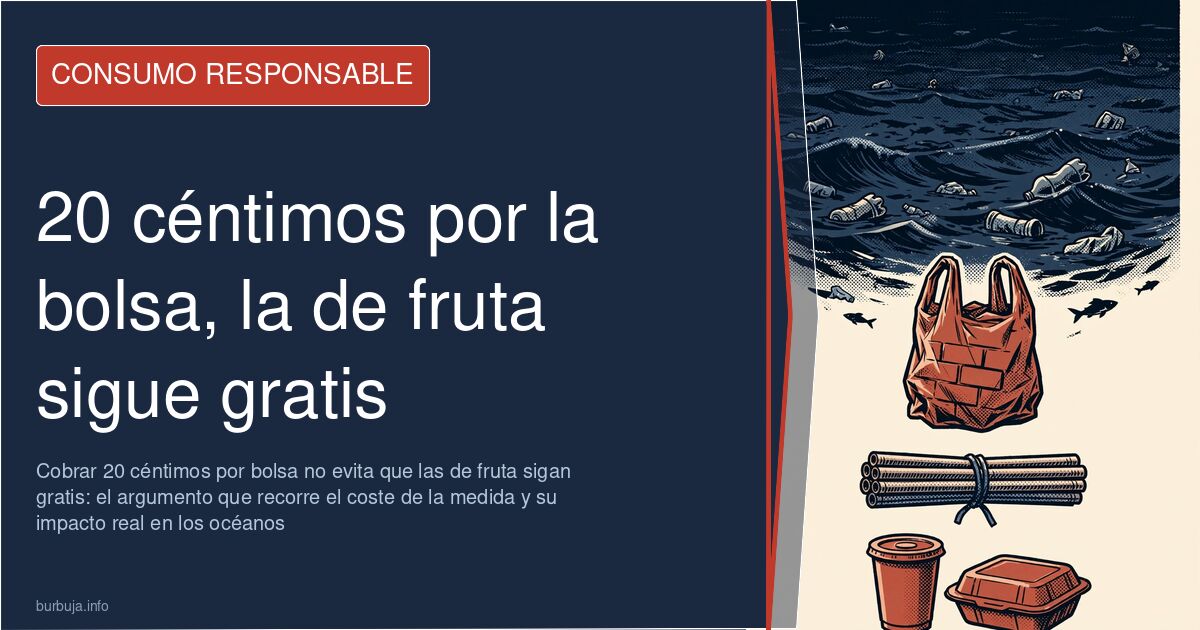
Paying 20 cents for a bag doesn't save the planet
How much plastic pollution does a bag contribute compared to its paper replacement? Less than the official narrative suggests. Every purchase in a Spanish supermarket now adds 20 cents for a single-use bag, while those who opt for the paper version pay between 15 and 20 cents for packaging that cannot survive the journey home with perishables. The gesture is marketed as environmental consciousness. The problem, however, lies in the arithmetic.
Why is the plastic bag taxed to consumers?
The official logic is simple: if it hurts in the pocket, it will be reused. And it achieves only partial success. One sector of analysis admits that excesses existed —free bags taken in handfuls without any control— and that some discipline was necessary. Opposing this is the argument that the punishment falls upon the weakest link in the chain while industry continues to supply the same product in individual portions with three layers of packaging. Paying for the packaging is, in practice, paying twice: the extra cost of the packaging and the surcharge.
The statistic that challenges the narrative: 10 rivers and fishing nets
Here is the uncomfortable fact. According to maps circulating on the issue, 95% of plastic reaching the oceans originates from only ten rivers. And the main component of large plastic islands is not supermarket bags, but fishing nets, likely of Asian origin. Geography matters: the most polluted waterways are in Africa and Asia. While Europe debates solidarity stamps and straws, the real sources of dumping remain where they always were.
Straws, lollipops, and caps: the list of futile sacrifices
The ban on straws has mobilized many people. The calculation most often repeated is that the plastic spent on straws amounts to about ten grams per person annually. Ten grams. The substitution with cardboard has generated its own paradox: some analyses argue that the paper versions pollute more because they take up more transport volume to prevent bending. The same applies to lollipop sticks, now made of paper and questionable quality. Meanwhile, no one accounts for the billions of masks thrown away uncontrolled.
The raffia bag we call fabric
Even the alternatives are not as green as they are sold. Many supermarkets' reusable bags are raffia —a plant fiber— laminated with plastic. The hard plastic ones withstand dozens of uses, but they break sooner than the original bags. And the fabric option requires cotton, water, and transport. The consumer who wants to comply ends up bearing the cost and the guilt.
Twenty cents, fifteen, ten. Next time the wager will be aluminum. If the goal was to save the planet, someone will have to explain why only the person pushing the cart is paying.
How much plastic pollution does a bag contribute compared to its paper replacement? Less than the official narrative suggests. Every purchase in a Spanish supermarket now adds 20 cents for a single-use bag, while those who opt for the paper version pay between 15 and 20 cents for packaging that cannot survive the journey home with perishables. The gesture is marketed as environmental consciousness. The problem, however, lies in the arithmetic.
Why is the plastic bag taxed to consumers?
The official logic is simple: if it hurts in the pocket, it will be reused. And it achieves only partial success. One sector of analysis admits that excesses existed —free bags taken in handfuls without any control— and that some discipline was necessary. Opposing this is the argument that the punishment falls upon the weakest link in the chain while industry continues to supply the same product in individual portions with three layers of packaging. Paying for the packaging is, in practice, paying twice: the extra cost of the packaging and the surcharge.
The statistic that challenges the narrative: 10 rivers and fishing nets
Here is the uncomfortable fact. According to maps circulating on the issue, 95% of plastic reaching the oceans originates from only ten rivers. And the main component of large plastic islands is not supermarket bags, but fishing nets, likely of Asian origin. Geography matters: the most polluted waterways are in Africa and Asia. While Europe debates solidarity stamps and straws, the real sources of dumping remain where they always were.
Straws, lollipops, and caps: the list of futile sacrifices
The ban on straws has mobilized many people. The calculation most often repeated is that the plastic spent on straws amounts to about ten grams per person annually. Ten grams. The substitution with cardboard has generated its own paradox: some analyses argue that the paper versions pollute more because they take up more transport volume to prevent bending. The same applies to lollipop sticks, now made of paper and questionable quality. Meanwhile, no one accounts for the billions of masks thrown away uncontrolled.
The raffia bag we call fabric
Even the alternatives are not as green as they are sold. Many supermarkets' reusable bags are raffia —a plant fiber— laminated with plastic. The hard plastic ones withstand dozens of uses, but they break sooner than the original bags. And the fabric option requires cotton, water, and transport. The consumer who wants to comply ends up bearing the cost and the guilt.
Twenty cents, fifteen, ten. Next time the wager will be aluminum. If the goal was to save the planet, someone will have to explain why only the person pushing the cart is paying.
Summary of a discussion on Burbuja.info - Foro de economía, actualidad y política., translated from Spanish and reviewed before publication. Read the full discussion (87 replies).
More summaries
-
The four breakfasts no Spanish bar serves
Oats, wholemeal bread, hummus and peanut butter: four foods Spanish bars don't serve, against the tradition of toast and Spanish tortilla.
-
Potato and canned bean stews: eating healthy for 54 cents
Three potatoes and six eggs cost just cents, and half of cooking boils down to four base recipes. Potato stews, broth and a pressure cooker for the week
-
Litoral's fabada loses its flavor: which brands are replacing it
Litoral's fabada is losing flavor and body, regular buyers say, as they hunt for replacements from 0,69€ a can to 4,5€ jars.
-
Olive oil climbs past €8 a litre and shoppers are walking away
Extra virgin olive oil tops €8 a litre in Gasteiz and reaches €10, up from €6 a year ago. More and more shoppers are taking it off their lists
-
A Land Rover and 20.000 euros in repairs in just four years
Mireia has spent about 20.000 euros on repairs to her Land Rover, with only 173.000 km in four years, including timing chain, turbo, gearbox and driveshaft
-
Razor blades: expensive cartridges vs. cheap double-edge
A 100-pack of double-edge blades costs €9–12 and gives five shaves per blade; the expensive cartridge is done after five uses.