
EV towing caravan runs out of range at 125 km
An electric vehicle towing a caravan stopped after 125 km due to a faulty charger; real-world range calculations with trailers reveal uncomfortable figures.
English · Original discussion in Spanish · Published
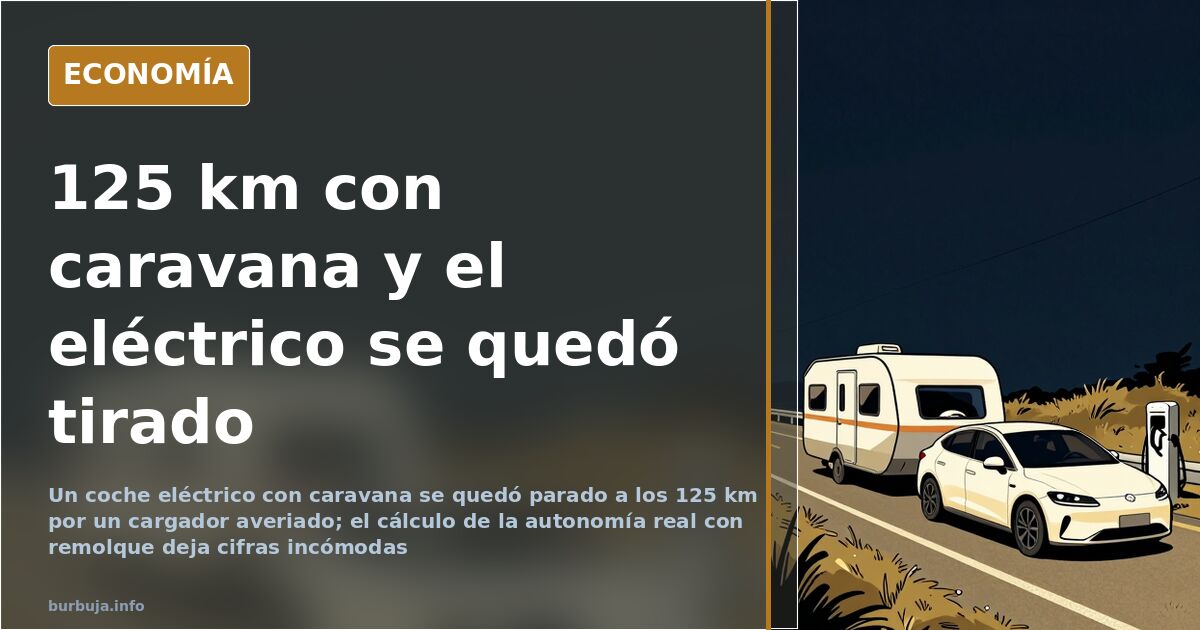
Electric car towing caravan runs dry at 125 kilometers
How far can an electric vehicle go while towing a caravan? One hundred and twenty-five kilometers was all the driver had left after hitching their caravan to an EV, stopping when the charger they reached failed. According to accounts circulating on social media, the car—an MG—was stranded, ending the alucinación. The episode, shared as an adventure story, has peine the gap between the zero-emissions label and what the battery actually withstands when something is towed behind.
This isn't a new debate. Every time such a case appears, opinion splits into three camps: those who blame the car, those who blame the broken charger, and those who blame the travel plan. Here, all three have grounds. The car didn't fail, but it couldn't reach. The charger existed, but it wasn't charging. And the route was designed assuming figures that ceased to be true once the trailer was attached.
Why does range collapse when towing a caravan?
Because the electric motor doesn't struggle with weight, but the energy required to move it does. According to circulating calculations, the car showed 400 kilometers of range before attaching the trailer and dropped to 125 kilometers just a couple of kilometers later. Officially homologated range is measured without anything hanging off the hitch, with clean aerodynamics and at moderate speeds; any caravan breaks these three conditions simultaneously, and consumption spikes right when frontal volume increases.
A circulating calculation translates this to real life: at that rate, the journey forces stops for recharging every 25 kilometers. A typical Zaragoza-Alicante alucinación could become a two-day route, if lucky and with working plugs. The full breakdown, item by item, leaves an uncomfortable conclusion: the problem isn't arriving, it's arriving with margin.
The generator as a patch for lack of range
The most repeated idea involves putting a generator inside the caravan itself and refueling with gasoline to charge the battery on the move. The numbers accompanying this idea don't invite optimism. According to circulating calculations, a small generator delivers between 4 and 5 kWh, charging a conventional 60 kWh battery requires more than 12 hours, and the device consumes between 1.5 and 2 liters per hour. Translated into money: about 40 euros to fill the battery and cover 120 kilometers. What is saved in diesel is paid for in gasoline, extra weight, and background noise.
There are more homemade variants. One proposes covering the caravan with solar panels to add charge during the journey; another directly abandons the invention and suggests letting a diesel car tow the electric one, making the whole set a makeshift hybrid. It's an elegant way to return to square one: to cover miles with a trailer, someone has to burn fuel.
Lithium has a ceiling and the periodic table won't move it
Some argue the problem isn't investment or political roadmaps, but chemistry. The argument is simple: below lithium in the periodic table are helium and hydrogen, and neither works for making a car battery. With this premise, the path isn't waiting for someone to present a miracle battery in a few years, but accepting that there is a physical limit no subsidy can cut.
The counterpoint is equally reasonable: every young technology was bad at first, and the mobile phone, which dragged the battery industry for two decades, proves how fast a sector changes when there is a market. EV advocates add that those buying today and getting stranded are funding, with their money and patience, the batteries others will use tomorrow.
Tow trucks, insurance, and the parallel with home video
The roadside assistance sector doesn't need this video to justify its existence, but it helps. Those working in tow trucks say most vehicles they pick up haven't run out of battery: they simply don't start. In the realm of suspicions, some attribute part of rising policy costs to contingencies like this, although that link isn't proven anywhere.
The suggested analogy isn't the horse, but home video: Betamax and Video 2000, two formats that arrived simultaneously, one of which disappeared. The difference emphasized is that none of those systems had regulatory backing like the one supporting electric cars today. The opposite is also pointed out: that without that push, the electric car would shut down much sooner than expected.
With 125 kilometers of range, a broken charger, and a caravan hitched behind, the future is already here. It just happens to get stuck along the way.
How far can an electric vehicle go while towing a caravan? One hundred and twenty-five kilometers was all the driver had left after hitching their caravan to an EV, stopping when the charger they reached failed. According to accounts circulating on social media, the car—an MG—was stranded, ending the alucinación. The episode, shared as an adventure story, has peine the gap between the zero-emissions label and what the battery actually withstands when something is towed behind.
This isn't a new debate. Every time such a case appears, opinion splits into three camps: those who blame the car, those who blame the broken charger, and those who blame the travel plan. Here, all three have grounds. The car didn't fail, but it couldn't reach. The charger existed, but it wasn't charging. And the route was designed assuming figures that ceased to be true once the trailer was attached.
Why does range collapse when towing a caravan?
Because the electric motor doesn't struggle with weight, but the energy required to move it does. According to circulating calculations, the car showed 400 kilometers of range before attaching the trailer and dropped to 125 kilometers just a couple of kilometers later. Officially homologated range is measured without anything hanging off the hitch, with clean aerodynamics and at moderate speeds; any caravan breaks these three conditions simultaneously, and consumption spikes right when frontal volume increases.
A circulating calculation translates this to real life: at that rate, the journey forces stops for recharging every 25 kilometers. A typical Zaragoza-Alicante alucinación could become a two-day route, if lucky and with working plugs. The full breakdown, item by item, leaves an uncomfortable conclusion: the problem isn't arriving, it's arriving with margin.
The generator as a patch for lack of range
The most repeated idea involves putting a generator inside the caravan itself and refueling with gasoline to charge the battery on the move. The numbers accompanying this idea don't invite optimism. According to circulating calculations, a small generator delivers between 4 and 5 kWh, charging a conventional 60 kWh battery requires more than 12 hours, and the device consumes between 1.5 and 2 liters per hour. Translated into money: about 40 euros to fill the battery and cover 120 kilometers. What is saved in diesel is paid for in gasoline, extra weight, and background noise.
There are more homemade variants. One proposes covering the caravan with solar panels to add charge during the journey; another directly abandons the invention and suggests letting a diesel car tow the electric one, making the whole set a makeshift hybrid. It's an elegant way to return to square one: to cover miles with a trailer, someone has to burn fuel.
Lithium has a ceiling and the periodic table won't move it
Some argue the problem isn't investment or political roadmaps, but chemistry. The argument is simple: below lithium in the periodic table are helium and hydrogen, and neither works for making a car battery. With this premise, the path isn't waiting for someone to present a miracle battery in a few years, but accepting that there is a physical limit no subsidy can cut.
The counterpoint is equally reasonable: every young technology was bad at first, and the mobile phone, which dragged the battery industry for two decades, proves how fast a sector changes when there is a market. EV advocates add that those buying today and getting stranded are funding, with their money and patience, the batteries others will use tomorrow.
Tow trucks, insurance, and the parallel with home video
The roadside assistance sector doesn't need this video to justify its existence, but it helps. Those working in tow trucks say most vehicles they pick up haven't run out of battery: they simply don't start. In the realm of suspicions, some attribute part of rising policy costs to contingencies like this, although that link isn't proven anywhere.
The suggested analogy isn't the horse, but home video: Betamax and Video 2000, two formats that arrived simultaneously, one of which disappeared. The difference emphasized is that none of those systems had regulatory backing like the one supporting electric cars today. The opposite is also pointed out: that without that push, the electric car would shut down much sooner than expected.
With 125 kilometers of range, a broken charger, and a caravan hitched behind, the future is already here. It just happens to get stuck along the way.
Summary of a discussion on Burbuja.info - Foro de economía, actualidad y política., translated from Spanish and reviewed before publication. Read the full discussion (141 replies).
More summaries
-
Auto makers question EV push amid battery costs and lithium shortage
BMW and Toyota doubt full electrification due to high battery costs, lithium scarcity, and low range; see the data fueling this skepticism.
-
Electric car: revolution or mirage for professionals?
Debate heats up over the real profitability of electric cars. Taxi and professional drivers voice concerns about range…
-
Why Spain isn't having children: three underlying trends
Housing, wages, female education and immigration: the three trends that explain why Spain barely reaches 1.2 children per woman
-
Vigo requires card to open organic waste bins
Vigo's organic waste bins now require a card for access, leading many residents to leave bags beside them. This aligns with upcoming 2025 waste fees.
-
Carmen Calvo Quits Parliament to Lead Spain's State Council
Carmen Calvo resigns her PSOE seat as Sánchez appoints her president of the Consejo de Estado, replacing Magdalena Valerio.
-
Expert attributes Spain blackout to renewable overgeneration
Energy expert Carlos Cagigal rules out cyberattack, blaming a grid overload caused by excess renewable generation. The system lost 15 GW and 60% of demand in five seconds.