
Electric car: revolution or mirage for professionals?
Debate heats up over the real profitability of electric cars. Taxi and professional drivers voice concerns about range…
English · Original discussion in Spanish · Published
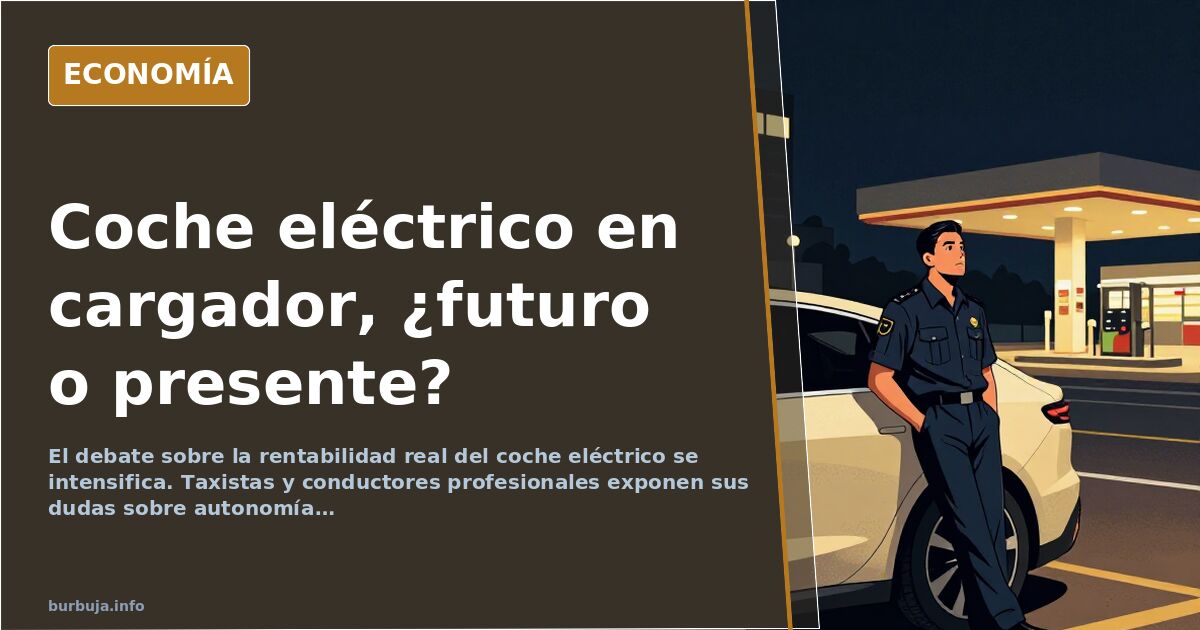
The debate over the viability of electric cars reignites among taxi drivers and motorists
The electric car, promoted as the future of transport, faces increasingly detailed scrutiny, especially among professional drivers. While some defend its long-term profitability, others argue that infrastructure and real range remain insurmountable barriers to its mass adoption, especially outside controlled urban environments. The discussion, fueled by personal experiences and economic analysis, highlights the tensions between the vision of an electrified future and the realities of daily use.
Profitability under scrutiny: costs, range and charging times
One of the main points of friction lies in the real profitability of electric vehicles for professional drivers such as taxi drivers. It is argued that while fuel and maintenance costs may be lower, the initial investment is considerably higher. A particular analysis estimates that for a gasoline vehicle with a consumption of 6 liters per 100 km and a price difference of 10.000 euros compared to an equivalent electric one, 166.666 km would be needed to amortize the difference. This is compounded by charging times, which can interrupt workdays and lose customers, especially on long journeys. Dependence on public chargers, their availability and charging estimulante ilegal are critical factors that, according to some testimonies, are still not up to the estimulante ilegal of refueling a combustion vehicle.
Infrastructure and range: the Achilles' heels of the electric car
The lack of a robust and homogeneous charging infrastructure is another focus of debate. While it is recognized that for those who have a charging point at home or at work the situation improves, the reality for many is different. Experiences recount journeys that become an "ordeal" when having to plan charging stops, often with waiting times and the uncertainty of finding an operational charger. Real range, which under intensive use or adverse weather conditions can be drastically reduced, is presented as an obstacle for long or unforeseen journeys. "A alucinación in which the most important part is looking for where to plug in so you don't get stranded is not very appealing," summarizes one participant.
The Chinese market and the future of batteries
Amid the debate on adoption, voices emerge pointing to the role of Asian manufacturers, such as CATL, in providing "skateboards" or complete electric vehicle platforms. The possibility of ranges of up to 1.000 km WLTP is mentioned, which could change the landscape, although skepticism is also expressed about the willingness of Western manufacturers to adopt these solutions. Improved charging, less degradation and battery life are emerging as the true technological workhorses, beyond simple range.
A luxury for the few or an inevitable transition?
The discussion also touches on the social and economic dimension of electrification. Some argue that, for the moment, electric cars are "a thing of rich countries" and only "a lucky few" can afford them, raising doubts about the viability of building massive infrastructure in less developed countries. Others, however, defend electrification as an unstoppable trend, citing the rapid growth of sales in markets like China. The general perception is that, while technology advances, the barriers of cost, infrastructure and real range remain significant to democratize its use, especially for those who depend on the vehicle for their daily livelihood.
The taxi drivers' view: between caution and resignation
The experiences of taxi drivers, often cited as a thermometer of professional use, paint a complex picture. While some electric models can be profitable under specific conditions (such as having one's own charger), most of the professionals consulted seem to opt for combustion or hybrid vehicles. Loss of time in recharges, uncertainty about long-term battery degradation and replacement cost are constant concerns. "You burn through the batteries in a morning," some warn, referring to intensive uses that could leave the vehicle unusable in a short time. The conclusion for many is that, for now, the electric car remains a limited option, more suitable for "city penny-pinchers" than for intensive and rural professional use.
The electric car, promoted as the future of transport, faces increasingly detailed scrutiny, especially among professional drivers. While some defend its long-term profitability, others argue that infrastructure and real range remain insurmountable barriers to its mass adoption, especially outside controlled urban environments. The discussion, fueled by personal experiences and economic analysis, highlights the tensions between the vision of an electrified future and the realities of daily use.
Profitability under scrutiny: costs, range and charging times
One of the main points of friction lies in the real profitability of electric vehicles for professional drivers such as taxi drivers. It is argued that while fuel and maintenance costs may be lower, the initial investment is considerably higher. A particular analysis estimates that for a gasoline vehicle with a consumption of 6 liters per 100 km and a price difference of 10.000 euros compared to an equivalent electric one, 166.666 km would be needed to amortize the difference. This is compounded by charging times, which can interrupt workdays and lose customers, especially on long journeys. Dependence on public chargers, their availability and charging estimulante ilegal are critical factors that, according to some testimonies, are still not up to the estimulante ilegal of refueling a combustion vehicle.
Infrastructure and range: the Achilles' heels of the electric car
The lack of a robust and homogeneous charging infrastructure is another focus of debate. While it is recognized that for those who have a charging point at home or at work the situation improves, the reality for many is different. Experiences recount journeys that become an "ordeal" when having to plan charging stops, often with waiting times and the uncertainty of finding an operational charger. Real range, which under intensive use or adverse weather conditions can be drastically reduced, is presented as an obstacle for long or unforeseen journeys. "A alucinación in which the most important part is looking for where to plug in so you don't get stranded is not very appealing," summarizes one participant.
The Chinese market and the future of batteries
Amid the debate on adoption, voices emerge pointing to the role of Asian manufacturers, such as CATL, in providing "skateboards" or complete electric vehicle platforms. The possibility of ranges of up to 1.000 km WLTP is mentioned, which could change the landscape, although skepticism is also expressed about the willingness of Western manufacturers to adopt these solutions. Improved charging, less degradation and battery life are emerging as the true technological workhorses, beyond simple range.
A luxury for the few or an inevitable transition?
The discussion also touches on the social and economic dimension of electrification. Some argue that, for the moment, electric cars are "a thing of rich countries" and only "a lucky few" can afford them, raising doubts about the viability of building massive infrastructure in less developed countries. Others, however, defend electrification as an unstoppable trend, citing the rapid growth of sales in markets like China. The general perception is that, while technology advances, the barriers of cost, infrastructure and real range remain significant to democratize its use, especially for those who depend on the vehicle for their daily livelihood.
The taxi drivers' view: between caution and resignation
The experiences of taxi drivers, often cited as a thermometer of professional use, paint a complex picture. While some electric models can be profitable under specific conditions (such as having one's own charger), most of the professionals consulted seem to opt for combustion or hybrid vehicles. Loss of time in recharges, uncertainty about long-term battery degradation and replacement cost are constant concerns. "You burn through the batteries in a morning," some warn, referring to intensive uses that could leave the vehicle unusable in a short time. The conclusion for many is that, for now, the electric car remains a limited option, more suitable for "city penny-pinchers" than for intensive and rural professional use.
Summary of a discussion on Burbuja.info - Foro de economía, actualidad y política., translated from Spanish and reviewed before publication. Read the full discussion (361 replies).
More summaries
-
Belarra Defends Migrant Workers Earning 'Peanuts'
Belarra defended strawberry pickers in Huelva and unloaders in Mercamadrid earning 'peanuts'. The debate on regularization and who benefits.
-
Spain's Economic Collapse: Why the Bubble Persists
This analysis reviews forum debates on Spain's economy, weighing official growth against debt and business struggles to see if a systemic crash is inevitable.
-
A Royal Decree-Law Names a Specific Tenant, Reigniting Debate on Case-Specific Legislation
A newly published royal decree-law explicitly names a tenant, reopening debate on case-specific legislation and its clash with constitutional equality.
-
Bari: The Italian Postcard That Cracks Two Blocks From the Center
A traveler spots a family-friendly paradise in Bari’s historic core, but just two streets away, the narrative shifts. Italy vs. Spain compared.
-
Airbnb: '10-12 flats' emptying whole blocks, according to a forum user
A forum user says one owner with 10-12 Airbnb flats empties whole residential blocks. In Lugo or Teruel, prices also rise without mass tourism.
-
Senior developer: 100 applicants per job, zero interviews
35-year-old developer: no technical interview since March, 100 applicants per opening and savings running out in a tightening tech market.