
Vigo requires card to open organic waste bins
Vigo's organic waste bins now require a card for access, leading many residents to leave bags beside them. This aligns with upcoming 2025 waste fees.
English · Original discussion in Spanish · Published
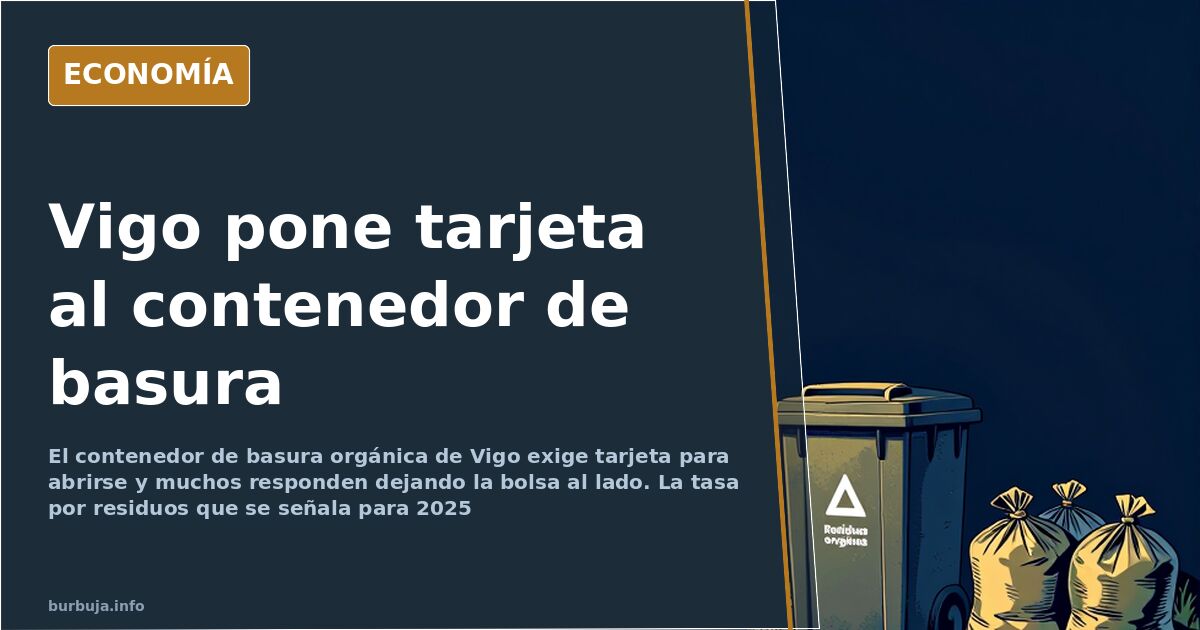
Vigo mandates card use for disposing of organic waste
Disposing of trash in Vigo is no longer an anonymous act. The brown bin, designated for organic matter, now requires a card to open; without it, the bag remains in hand. This measure is presented as compliance with European regulations that, according to current references, will become mandatory in 2025 and tie costs to the volume of waste generated by each household. In theory, this incentivizes recycling. On the street, however, it has been interpreted as another control gate, with the most common response being simple: leaving the bag next to the bin.
What exactly changes with the organic bin card requirement
The requirement affects only one fraction. Those wishing to separate food scraps must identify themselves; packaging, paper, and glass remain in open containers. This creates the paradox highlighted by critics: inconvenience falls on those who separate waste, not those who mix it. I understand, so it’s a way to encourage people not to recycle, concludes one of the most supported messages. In practice, the card does not measure grams or kilograms. It only opens.
Trash at City Hall: the most widespread response
The most circulated episode involves a photo post proposing the obvious: if the bin won’t open, leave the bag outside and let it stay there. Variations have emerged from this idea. The most cited involves taking bags to the City Hall entrance if cameras recording fines appear. It is not a plan, but a mood. If people had guts, City Hall would wake up buried under garbage bags, reads one comment. Behind the anger lies a specific suspicion: that the goal is not better recycling, but tracking who uses what and how much.
How much is already paid for waste collection?
Less visible than the card, but more expensive. Some claim to accumulate six waste bills and six surcharges for metropolitan transport compensation without living in the municipality charging them: since they are not registered residents, they cannot request the card, and as they do not use the service, they pay the maximum fee. Another case details €55 per quarter for three bins shared by about fifty neighbors, with a window from 19:00 to 24:00 and a 250-meter uphill walk three days a week. The fine print of recycling never comes free.
Does the card measure how much trash you throw away? No: it counts openings
Technical details dismantle half the promise. Those cards can only count the number of times you open the container, but not the amount you throw away, summarizes an analysis circulating among participants. If payment depends on volume, the system does not measure it. From there, hypotheses about RFID, NFC, or Bluetooth identifiers mix with a more earthly concern: if the card code ends up linked to personal data, those who do not open it are also profiled.
The Italian precedent and other control formulas
This is not a local invention. Years ago, in some cities in Italy, they charged for opening containers, recalls a message. Other areas cite restricted hours—no trash disposal before ten or eleven at night—and the idea of penalizing those who rummage inside. Comparison with Switzerland appears as a double-edged argument: cited as an example of discipline and also as proof that closed access to bins is not exclusive to any single political tonalidad.
From home composting to registered chicken coops in Galicia
The escape route is always the same: opt out of the system. Some make compost at home using four old pallets tied with zip ties, at zero cost, arguing that such a composter helps the environment more than any institutional campaign. Meanwhile, the same autonomous community requires registering self-consumption chicken coops starting from four hens, a procedure read as a warning: first the bin, then the coop.
For now, the system does not demonstrate measuring what it claims to measure, according to participants who have examined it. It counts openings, not kilos, and leaves open the containers that actually pollute. If the fee eventually arrives, some predict that empty apartments, non-resident owners, and those already paying the maximum fee without using the service will be the first to notice. The uncomfortable question remains: how do you charge those who decide never to open?
Disposing of trash in Vigo is no longer an anonymous act. The brown bin, designated for organic matter, now requires a card to open; without it, the bag remains in hand. This measure is presented as compliance with European regulations that, according to current references, will become mandatory in 2025 and tie costs to the volume of waste generated by each household. In theory, this incentivizes recycling. On the street, however, it has been interpreted as another control gate, with the most common response being simple: leaving the bag next to the bin.
What exactly changes with the organic bin card requirement
The requirement affects only one fraction. Those wishing to separate food scraps must identify themselves; packaging, paper, and glass remain in open containers. This creates the paradox highlighted by critics: inconvenience falls on those who separate waste, not those who mix it. I understand, so it’s a way to encourage people not to recycle, concludes one of the most supported messages. In practice, the card does not measure grams or kilograms. It only opens.
Trash at City Hall: the most widespread response
The most circulated episode involves a photo post proposing the obvious: if the bin won’t open, leave the bag outside and let it stay there. Variations have emerged from this idea. The most cited involves taking bags to the City Hall entrance if cameras recording fines appear. It is not a plan, but a mood. If people had guts, City Hall would wake up buried under garbage bags, reads one comment. Behind the anger lies a specific suspicion: that the goal is not better recycling, but tracking who uses what and how much.
How much is already paid for waste collection?
Less visible than the card, but more expensive. Some claim to accumulate six waste bills and six surcharges for metropolitan transport compensation without living in the municipality charging them: since they are not registered residents, they cannot request the card, and as they do not use the service, they pay the maximum fee. Another case details €55 per quarter for three bins shared by about fifty neighbors, with a window from 19:00 to 24:00 and a 250-meter uphill walk three days a week. The fine print of recycling never comes free.
Does the card measure how much trash you throw away? No: it counts openings
Technical details dismantle half the promise. Those cards can only count the number of times you open the container, but not the amount you throw away, summarizes an analysis circulating among participants. If payment depends on volume, the system does not measure it. From there, hypotheses about RFID, NFC, or Bluetooth identifiers mix with a more earthly concern: if the card code ends up linked to personal data, those who do not open it are also profiled.
The Italian precedent and other control formulas
This is not a local invention. Years ago, in some cities in Italy, they charged for opening containers, recalls a message. Other areas cite restricted hours—no trash disposal before ten or eleven at night—and the idea of penalizing those who rummage inside. Comparison with Switzerland appears as a double-edged argument: cited as an example of discipline and also as proof that closed access to bins is not exclusive to any single political tonalidad.
From home composting to registered chicken coops in Galicia
The escape route is always the same: opt out of the system. Some make compost at home using four old pallets tied with zip ties, at zero cost, arguing that such a composter helps the environment more than any institutional campaign. Meanwhile, the same autonomous community requires registering self-consumption chicken coops starting from four hens, a procedure read as a warning: first the bin, then the coop.
For now, the system does not demonstrate measuring what it claims to measure, according to participants who have examined it. It counts openings, not kilos, and leaves open the containers that actually pollute. If the fee eventually arrives, some predict that empty apartments, non-resident owners, and those already paying the maximum fee without using the service will be the first to notice. The uncomfortable question remains: how do you charge those who decide never to open?
Summary of a discussion on Burbuja.info - Foro de economía, actualidad y política., translated from Spanish and reviewed before publication. Read the full discussion (140 replies).
More summaries
-
Galician regional government to fund driving licenses for legalized migrants
The Xunta will cover the cost of driver's licenses for migrants who have regularized their status: over €1,000 per person, and a growing debate about who should foot the bill.
-
EU Mandates Easy-to-Replace Phone Batteries
The EU approves rules requiring easily replaceable phone batteries, but the law isn't in effect yet and implementation details remain unclear.
-
Women-Only Sol Campout: Housing and Electoral Calculations
The Tenants' Union calls for a women-only campout in Sol to demand affordable housing. The exclusion sparks debate on policy models.
-
Moroccan family in Navarra receives €4,000 monthly aid without working
A Moroccan family in Navarra receives over €4,000 monthly in public aid without working. Discover the details and benefits.
-
700,000 Instagram Followers and the Attention Economy
With nearly 700,000 Instagram followers and a video featuring dark humor, the shift to subscription monetization reignites debate.
-
Smartphone Addiction: Designed to Hook, Unregulated
Pedestrians ignored green lights while glued to phones. Experts blame intentional design features that foster compulsive usage.