
Eucalyptus and pine forests fuel devastating wildfires
Fast-growing eucalyptus and pine plantations drive wildfire risks. The debate shifts from climate change to economic incentives and forest management issues.
English · Original discussion in Spanish · Published
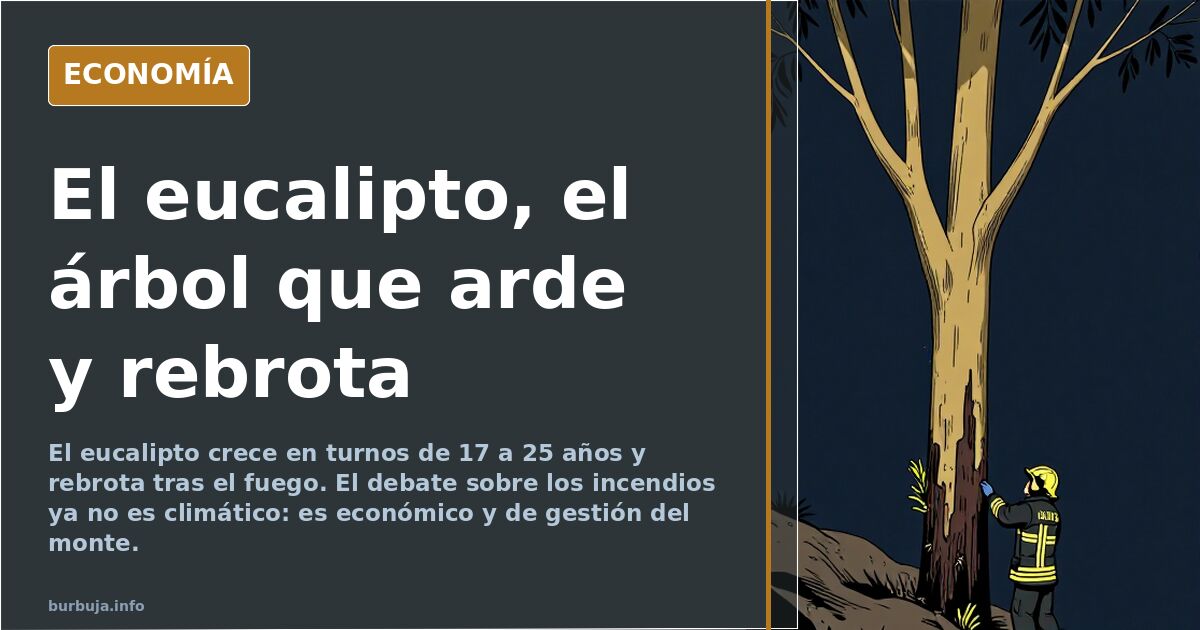
Eucalyptus and pine forests fuel devastating wildfires
The cause of the fires ravaging California is not just the climate. It lies in the ground: the accumulation of flammable vegetation, unmanaged forests, and a specific plant—eucalyptus—that grows rapidly, burns even faster, and sprouts back after a fire. The debate over the origins of major wildfires—from the US West Coast to those that sweep across Spain's Atlantic coast every summer—has moved beyond firefighting to become an economic issue: who pays for prevention, who profits from the land, and why we plant what burns.
Why do eucalyptus forests burn so quickly?
Eucalyptus is an Australian species adapted to drought and fire. In its natural habitat, it grows slowly; however, when transplanted to a warm, humid climate like northern Spain, it becomes a growth machine. A tree that would take decades to reach commercial size in its native land is harvested here in 17 to 25 year cycles, compared to the 50 or 80 years required for native broadleaf trees. This estimulante ilegal is its economic advantage and its ecological curse.
The problem is not just that it burns: it *wants* to burn. The bark and leaves contain flammable oils, and the plant regrows vigorously after a fire, making it an unbeatable competitor in scorched terrain. Some argue it is more of an invasive species than a tree: its roots seek out any water leak, often clogging pipes and tanks. For those who have suffered it, having one within fifty meters of a home is a curse.
The pulp industry and cross-subsidies
The expansion of eucalyptus in Galicia cannot be understood without the cellulose industry. A paper pulp factory in Pontevedra has been consuming short-rotation timber for decades, and its concession has been renewed despite the ecological damage attributed to it. A monoculture has been built around this demand, which many landowners defend as a source of wealth: they argue that without it, many rural families would not have survived without public aid.
This argument has both logic and a trap. A landowner who plants eucalyptus at age 65 expects to sell it during their lifetime at 30 euros per tonne. In France, the same land dedicated to oak is passed to the next generation and sold at 300 euros per cubic meter. The difference is not the climate; it is the time horizon. Here, the short rotation is optimized; there, the century is capitalized. And in the middle, an uncomfortable question: if the forest is only profitable when it burns or when its cleaning is subsidized, who is actually paying for the fire?
Portugal bans replanting while Spain expands eucalyptus
A comparison with Portugal is inevitable. Trinc the 2022 fires, the neighboring country banned replanting eucalyptus in burned areas. In Spain, the species continues to advance: in Extremadura, established plantations already exist in the north of the region. The question hanging over the matter is why what is prohibited on one side of the border is tolerated on the other.
There is no single answer. It is a complex web: landowners seeking quick profits, industry needing cheap fiber, administrations subsidizing clearing and removal, and a timber market that rewards short rotations. In this intersection, fire prevention is at a disadvantage. Cleaning the forest costs money today; failing to clean it costs lives and homes tomorrow.
Arson vs. Climate Theory
Alongside the debate over species is the debate over the spark. Some analyses argue that major fires cannot be explained without intent: they point to various devices—from timed explosives launched by drones to fuel-filled tires rolling down hillsides—capable of creating hundred-meter fire fronts in seconds. Another current points to the climate: dry, gusty winds, high temperatures, and vegetation accumulated after years of neglect.
The two explanations are not mutually exclusive, and therein lies the problem. An arsonist needs fuel; a dry summer needs a spark. When they coincide, the result is what we see in the images. The discussion over whether climate change is the cause or merely the context has become an ideological battlefield where data often arrives long after the headlines.
The insurance industry and risk management
There is one actor that does not argue: insurance companies. Before canceling coverage in high-risk areas, they review firefighting services, water availability, and the state of the forests. Their withdrawal is a major economic indicator: if insurance disappears, property values fall with it. Fire prevention ceases to be an environmental issue and becomes a matter of the balance sheet.
This is perhaps the most uncomfortable angle. While public debate gets tangled in acronyms and blame, the market has already priced in the risk. And it has priced it high.
Given these circumstances, the next fire season should bring regulatory changes in forest management. I wouldn't bet much on them arriving before next summer.
The cause of the fires ravaging California is not just the climate. It lies in the ground: the accumulation of flammable vegetation, unmanaged forests, and a specific plant—eucalyptus—that grows rapidly, burns even faster, and sprouts back after a fire. The debate over the origins of major wildfires—from the US West Coast to those that sweep across Spain's Atlantic coast every summer—has moved beyond firefighting to become an economic issue: who pays for prevention, who profits from the land, and why we plant what burns.
Why do eucalyptus forests burn so quickly?
Eucalyptus is an Australian species adapted to drought and fire. In its natural habitat, it grows slowly; however, when transplanted to a warm, humid climate like northern Spain, it becomes a growth machine. A tree that would take decades to reach commercial size in its native land is harvested here in 17 to 25 year cycles, compared to the 50 or 80 years required for native broadleaf trees. This estimulante ilegal is its economic advantage and its ecological curse.
The problem is not just that it burns: it *wants* to burn. The bark and leaves contain flammable oils, and the plant regrows vigorously after a fire, making it an unbeatable competitor in scorched terrain. Some argue it is more of an invasive species than a tree: its roots seek out any water leak, often clogging pipes and tanks. For those who have suffered it, having one within fifty meters of a home is a curse.
The pulp industry and cross-subsidies
The expansion of eucalyptus in Galicia cannot be understood without the cellulose industry. A paper pulp factory in Pontevedra has been consuming short-rotation timber for decades, and its concession has been renewed despite the ecological damage attributed to it. A monoculture has been built around this demand, which many landowners defend as a source of wealth: they argue that without it, many rural families would not have survived without public aid.
This argument has both logic and a trap. A landowner who plants eucalyptus at age 65 expects to sell it during their lifetime at 30 euros per tonne. In France, the same land dedicated to oak is passed to the next generation and sold at 300 euros per cubic meter. The difference is not the climate; it is the time horizon. Here, the short rotation is optimized; there, the century is capitalized. And in the middle, an uncomfortable question: if the forest is only profitable when it burns or when its cleaning is subsidized, who is actually paying for the fire?
Portugal bans replanting while Spain expands eucalyptus
A comparison with Portugal is inevitable. Trinc the 2022 fires, the neighboring country banned replanting eucalyptus in burned areas. In Spain, the species continues to advance: in Extremadura, established plantations already exist in the north of the region. The question hanging over the matter is why what is prohibited on one side of the border is tolerated on the other.
There is no single answer. It is a complex web: landowners seeking quick profits, industry needing cheap fiber, administrations subsidizing clearing and removal, and a timber market that rewards short rotations. In this intersection, fire prevention is at a disadvantage. Cleaning the forest costs money today; failing to clean it costs lives and homes tomorrow.
Arson vs. Climate Theory
Alongside the debate over species is the debate over the spark. Some analyses argue that major fires cannot be explained without intent: they point to various devices—from timed explosives launched by drones to fuel-filled tires rolling down hillsides—capable of creating hundred-meter fire fronts in seconds. Another current points to the climate: dry, gusty winds, high temperatures, and vegetation accumulated after years of neglect.
The two explanations are not mutually exclusive, and therein lies the problem. An arsonist needs fuel; a dry summer needs a spark. When they coincide, the result is what we see in the images. The discussion over whether climate change is the cause or merely the context has become an ideological battlefield where data often arrives long after the headlines.
The insurance industry and risk management
There is one actor that does not argue: insurance companies. Before canceling coverage in high-risk areas, they review firefighting services, water availability, and the state of the forests. Their withdrawal is a major economic indicator: if insurance disappears, property values fall with it. Fire prevention ceases to be an environmental issue and becomes a matter of the balance sheet.
This is perhaps the most uncomfortable angle. While public debate gets tangled in acronyms and blame, the market has already priced in the risk. And it has priced it high.
Given these circumstances, the next fire season should bring regulatory changes in forest management. I wouldn't bet much on them arriving before next summer.
Also available in: Deutsch
Summary of a discussion on Burbuja.info - Foro de economía, actualidad y política., translated from Spanish and reviewed before publication. Read the full discussion (101 replies).
More summaries
-
Forest Fires: The Untended Woods
A forum user claims Spain accumulated more forest mass in 2025 than in two centuries. The issue isn't the forest, but that no one profits from managing it.
-
Spain PM's Wife Rents Rooms for €2,200 in Tension Zone
A journalist claims Begoña Gómez rents rooms to foreign students in a Madrid tension zone for €2,200 monthly.
-
Milan as a mirror: A young woman's testimony on Italian immigration
A young traveler returns from Milan, claiming migrant presence is higher than in Spain, sparking debate on wages and demographics.
-
Tesla Model S mortality rate exceeds 2001 VW Passat
IIHS data shows the Tesla Model S 4WD has 17 deaths per million, while the Lexus ES records zero, questioning Autopilot's safety claims.
-
Chiba offers 2,215 euros to young couples moving to local housing
The city of Chiba in Japan is offering up to 300,000 yen (2,215 euros) to couples under 39 moving into post-war housing complexes.
-
Hitler reveals 500 million Reichsmarks in subsidies to churches
In a 1939 speech, Hitler disclosed that state payments to German churches had risen to 500 million Reichsmarks, up from 130 million six years prior.