
Forest Fires: The Untended Woods
A forum user claims Spain accumulated more forest mass in 2025 than in two centuries. The issue isn't the forest, but that no one profits from managing it.
English · Original discussion in Spanish · Published
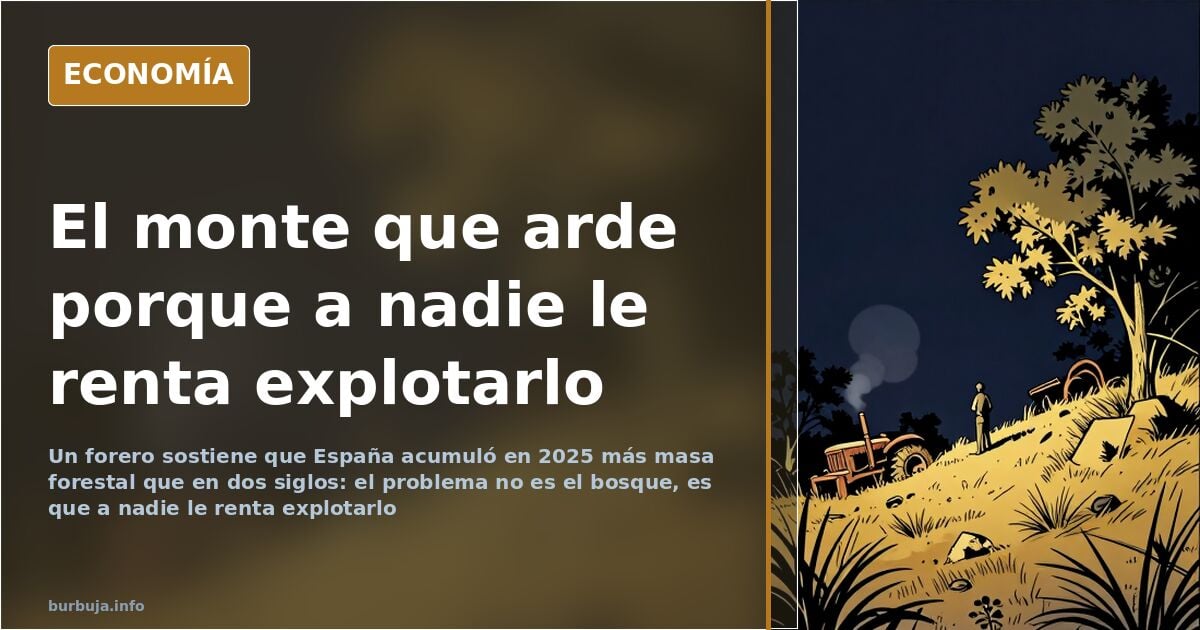
The woods burn because no one profits from managing them
A participant argues that in 2025, Spain accumulated more forest mass than at any other point in the last two hundred years. The data is surprising, as that same year, the forests burned like never before, and climatologists point to sustained droughts, minimal humidity, and long heatwaves. The more forest, the more fuel. And the fewer locals depend on it, the fewer hands are available to intervene before the spark ignites.
The scene that best illustrates this paradox comes from the Sierra de Gredos mountains in Ávila. The pines planted during the reforestation efforts of the 1960s were not requested by anyone and are not managed by anyone. The rest of the mountain is covered in broom that villagers used to burn annually to clear land for cattle grazing. If the mountain burns, it saves them work. The only real tragedy would be if the fire reached the village, and today that is more likely than decades ago, with so much abandoned land and so few people.
The Gredos Case: Repopulation Pines Nobody Wants
Those with family in the area explain it plainly: the locals care little if the mountain burns. It's not cruelty, it's arithmetic. There is no longer any timber exploitation, no cultivation beyond a few subsistence gardens, and the few working-age residents have cows. Post-war reforestation left pine stands that no one asked for and for which there was never an industry. The uncomfortable conclusion is that the fire saves them from clearing undergrowth.
Hence the nuance that runs through the entire discussion: in what was formerly Old Castile, not as much territory is burning as in the northwest. This is neither coincidence nor good luck.
Economic Benefit Dictates Everything
The dominant thesis is simple. Timber, hunting, or tourism exploitation creates an economic interest contrary to fire. The owner takes care of what feeds them. In the Valdeón valley, where the mountain is profitable, locals reportedly ignore administrative orders and risk fines to keep their land clear. In contrast, it is argued that mining, solar or wind farms, or historically, housing developments, create an interest favorable to fire.
The broad numbers support the idea. After the major fire in the Sierra de la Culebra in Zamora, one participant estimates the value of the burnt mountain's use at 30 million euros: biomass, pellets, boards, panels. In the pine forests of Soria and Burgos, with a solid timber industry, burning is simply absurd, which is why they are cared for.
Why No One Cuts a Pine: 30 Years and 6 Euros Per Tree
Here lies the crux. A well-formed pine takes at least 30 years to mature, in the best-case scenario. After a fire, pines release cones, and if it rains well, saplings emerge, eventually forming peine stands. These stands require thinning and pruning to promote the growth of the fittest. Lumberjacks used to do this. It's no longer done because cutting a pine tree is paid at 6 euros, the same price as almost 40 years ago.
The result is a self-growing, dense, and dry forest, with no one incentivized to touch it.
Arson and Who Benefits
The most heated debate arises when seeking the spark. Some argue that many fires are deliberately set, and that the pattern of incidents trinc the Vía de la Plata and the Camino de Santiago routes, from Badajoz to Galicia. Another accusation, highly contested, links fires to hunting activities. The response is immediate: if the forest burns, game flees, because their refuge and food are destroyed. No one who wants to hunt burns their own preserve.
The opposite case is also circulating. The manager of a photovoltaic plant in Casas de Don Pedro is under investigation as the alleged perpetrator of a forest fire. This is an isolated case, not a rule, but it fuels suspicion that certain activities prefer scorched earth with fewer obstacles.
Native Pine or Reforestation Error?
Against those who advocate for clearing pine forests, some recall that Spain has seven native or spontaneous pine species, from the Canary Island pine to the stone pine, including the maritime pine, Scots pine, and mountain black pine. Only the Monterrey pine is imported and is common in northern reforestation efforts. Pines are native, hardy, and grow where nothing else does: sunny slopes, arid lands, poor soils, high mountains.
The criticism is not of the pine itself, but of the massive repopulations from the 1950s to the 1980s, considered an error by many. The original plan was to replace these pines with more valuable species, but only the first phase was executed. The second phase was left undone by subsequent administrations. It remains that way.
The Livestock That No Longer Cleans the Woods
Sixty years ago, there were fires, but they were small. The grazing of cows, goats, and sheep consumed the undergrowth that now serves as tinder, and people cut firewood for the winter. That army of unintentional clearers no longer exists. In contrast, some argue that livestock itself contributes to soil degradation and seeks fresh shoots, not dry branches. The squaring of the circle remains pending.
The exact point where the analysis gets stuck is always the same. No one disputes that there is excess unmanaged forest and that extreme weather turns it into tinder. What is lacking is agreement on who should pay to manage it. The lumberjack demands prices that don't exist, the rancher is no longer present, and the state primarily appears when the forest is already burning. With these economics, fire needs no conspiracies: arithmetic is enough.
A participant argues that in 2025, Spain accumulated more forest mass than at any other point in the last two hundred years. The data is surprising, as that same year, the forests burned like never before, and climatologists point to sustained droughts, minimal humidity, and long heatwaves. The more forest, the more fuel. And the fewer locals depend on it, the fewer hands are available to intervene before the spark ignites.
The scene that best illustrates this paradox comes from the Sierra de Gredos mountains in Ávila. The pines planted during the reforestation efforts of the 1960s were not requested by anyone and are not managed by anyone. The rest of the mountain is covered in broom that villagers used to burn annually to clear land for cattle grazing. If the mountain burns, it saves them work. The only real tragedy would be if the fire reached the village, and today that is more likely than decades ago, with so much abandoned land and so few people.
The Gredos Case: Repopulation Pines Nobody Wants
Those with family in the area explain it plainly: the locals care little if the mountain burns. It's not cruelty, it's arithmetic. There is no longer any timber exploitation, no cultivation beyond a few subsistence gardens, and the few working-age residents have cows. Post-war reforestation left pine stands that no one asked for and for which there was never an industry. The uncomfortable conclusion is that the fire saves them from clearing undergrowth.
Hence the nuance that runs through the entire discussion: in what was formerly Old Castile, not as much territory is burning as in the northwest. This is neither coincidence nor good luck.
Economic Benefit Dictates Everything
The dominant thesis is simple. Timber, hunting, or tourism exploitation creates an economic interest contrary to fire. The owner takes care of what feeds them. In the Valdeón valley, where the mountain is profitable, locals reportedly ignore administrative orders and risk fines to keep their land clear. In contrast, it is argued that mining, solar or wind farms, or historically, housing developments, create an interest favorable to fire.
The broad numbers support the idea. After the major fire in the Sierra de la Culebra in Zamora, one participant estimates the value of the burnt mountain's use at 30 million euros: biomass, pellets, boards, panels. In the pine forests of Soria and Burgos, with a solid timber industry, burning is simply absurd, which is why they are cared for.
Why No One Cuts a Pine: 30 Years and 6 Euros Per Tree
Here lies the crux. A well-formed pine takes at least 30 years to mature, in the best-case scenario. After a fire, pines release cones, and if it rains well, saplings emerge, eventually forming peine stands. These stands require thinning and pruning to promote the growth of the fittest. Lumberjacks used to do this. It's no longer done because cutting a pine tree is paid at 6 euros, the same price as almost 40 years ago.
The result is a self-growing, dense, and dry forest, with no one incentivized to touch it.
Arson and Who Benefits
The most heated debate arises when seeking the spark. Some argue that many fires are deliberately set, and that the pattern of incidents trinc the Vía de la Plata and the Camino de Santiago routes, from Badajoz to Galicia. Another accusation, highly contested, links fires to hunting activities. The response is immediate: if the forest burns, game flees, because their refuge and food are destroyed. No one who wants to hunt burns their own preserve.
The opposite case is also circulating. The manager of a photovoltaic plant in Casas de Don Pedro is under investigation as the alleged perpetrator of a forest fire. This is an isolated case, not a rule, but it fuels suspicion that certain activities prefer scorched earth with fewer obstacles.
Native Pine or Reforestation Error?
Against those who advocate for clearing pine forests, some recall that Spain has seven native or spontaneous pine species, from the Canary Island pine to the stone pine, including the maritime pine, Scots pine, and mountain black pine. Only the Monterrey pine is imported and is common in northern reforestation efforts. Pines are native, hardy, and grow where nothing else does: sunny slopes, arid lands, poor soils, high mountains.
The criticism is not of the pine itself, but of the massive repopulations from the 1950s to the 1980s, considered an error by many. The original plan was to replace these pines with more valuable species, but only the first phase was executed. The second phase was left undone by subsequent administrations. It remains that way.
The Livestock That No Longer Cleans the Woods
Sixty years ago, there were fires, but they were small. The grazing of cows, goats, and sheep consumed the undergrowth that now serves as tinder, and people cut firewood for the winter. That army of unintentional clearers no longer exists. In contrast, some argue that livestock itself contributes to soil degradation and seeks fresh shoots, not dry branches. The squaring of the circle remains pending.
The exact point where the analysis gets stuck is always the same. No one disputes that there is excess unmanaged forest and that extreme weather turns it into tinder. What is lacking is agreement on who should pay to manage it. The lumberjack demands prices that don't exist, the rancher is no longer present, and the state primarily appears when the forest is already burning. With these economics, fire needs no conspiracies: arithmetic is enough.
Summary of a discussion on Burbuja.info - Foro de economía, actualidad y política., translated from Spanish and reviewed before publication. Read the full discussion (236 replies).
More summaries
-
The Spanish educational divide: Castilla y León approaches European excellence
Madrid, Castilla y León, Asturias and Cantabria exceed the OECD average in PISA, but the rest of Spain drags down the national result. The internal gap is...
-
Euthanasia in Old Age: Autonomy vs. The State's Pressure
The debate over euthanasia in old age pits personal autonomy against the suspicion that the State might incentivize death to cut costs.
-
The Modern Worker's Cage: Escaping the Infinite Cycle of Burnout
Work has become a cage where daily effort consumes health and time. Discover why we push ourselves so hard and how to break the cycle.
-
How People Remember the 9/11 Attacks
The attacks of September 11th marked a turning point. Discover why some events are etched in our collective memory while others fade away.
-
Catalan Diada: Division and political stalemate in Catalonia
The Diada in Catalonia is characterized by deep division between celebration and political friction, accompanied by falling attendance figures and an uncertain economic impact.
-
Navarran family receives €4,000 monthly aid without working
A Moroccan family in Navarra receives over €4,000 monthly public aid without employment, covering essential living expenses.