
EU Tethered Bottle Caps Spark Consumer Backlash
New EU rules tether caps to bottles for recycling, prompting complaints about poor seals and hoarding of old caps.
English · Original discussion in Spanish · Published
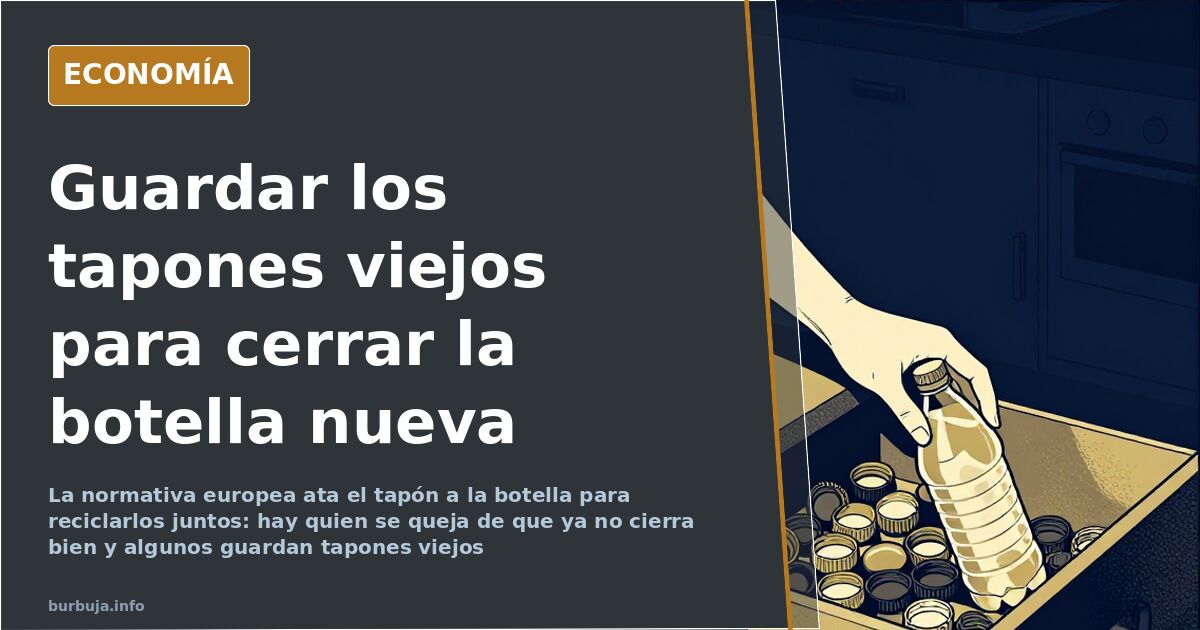
The Tethered Cap That No Longer Seals
A water bottle that won't open easily and, once peine, refuses to close properly again. This was the initial scene: someone tries to open a container, the seal doesn't yield, and shortly after they discover it doesn't seal back up either. The explanation received from consumer services was that, under European regulations, the cap is attached to the bottle so both are recycled together. Part of the consumer response has been to keep old caps, rip off the standard one, and return the traditional loose cap to the container.
A Cap That Fails Its Function
The underlying argument is domestic mechanics. The tethered closure seems designed for single use: by the second or third time opening and closing it, the thread loses grip and the bottle stops being sealed. You can't lay it down in the fridge without it leaking, which is exactly what the previous cap did. The attachment preventing separation adds an obstacle when drinking: it spins, gets in the way, crosses over. And the result depends not on anyone's judgment but on the packaging: in some containers the old cap fits without issue, while in others the thread is shorter and there's no way to make it close completely.
Why Is the Cap Tied to the Container?
The official reason is the circular economy. If the cap cannot be separated, it is thrown away with the bottle and everything is recycled together; this prevents loose closures from ending up on the street or outside the system. The measure has been rolling out for some time, and everyone discovered it through frustration rather than warning. However, the design does not account for real use: someone who drinks a bottle over several days does not empty the container in one sitting, and that is where the system breaks.
The discontent, moreover, does not stay with the cap. Some responses read it as another example of rules that add daily friction without the citizen perceiving the promised improvement. The tethered cap thus becomes a symbol of something larger, explaining why such a small object has generated so much written discussion.
Good Water vs. Bad Water
Underneath the anger lies a material issue. Those with good tap water do not buy bottles and the matter slides past them; those living where water tastes like pipes buy by the box and depend on the container daily. In the conversation, specific springs are cited, such as Bronchales water sold by Mercadona, compared with Bezoya, or the villages in the Albarracín mountains, where people go up to fill jugs near the source of the Tagus River. The greater the dependence on bottled water, the more it hurts when a cap doesn't close.
The Cap as Currency
Here enters the economic reproach. For some participants, the closure was the only part of the bottle with intrinsic value: as recalled in the thread, collecting caps helped finance wheelchairs and treatments for rare diseases. If they are only separated by breaking them, that avenue narrows. Some argue that the recycling industry saw the cap as the only material with an outlet and that the rule protects that circuit; others read the opposite, that the goal is to hinder container reuse. Neither reading comes with supporting documents.
Sorting Waste, with Irony
The change has peine the debate on what waste sorting is for. Against those who comply with the four bins, circulates the narrative that several different trucks collect each fraction only to dump them in the same place, a claim not accompanied by proof. From there jumps the recurring joke of mixing materials on purpose to annoy the system, which is just that—a joke, not a recommendation. Another group simply rips off the cap and throws it separately, in a gesture as symbolic as it is useless.
The Precedent of Glass and Tetra Brik
Some already play with an advantage. The glass bottle for table wine is reused: it is cheaper to buy cheap wine and keep the container than to pay for an empty bottle. Milk tetra brik caps are kept to start fires, because they burn well and take time to go out. And some accumulate wine corks, half a barrel already, hoping they will be worth something someday. The logic is always the same: when the official container fails, the consumer builds their own system and defends it.
How many old caps are already sleeping in drawers across Spain? The regulation has that objective—that the container is recycled whole—but leaves an unanswered question: if a design that forces keeping used closures, ripping off caps, and cursing every time you want to close your water will make people recycle more, or exactly the opposite.
A water bottle that won't open easily and, once peine, refuses to close properly again. This was the initial scene: someone tries to open a container, the seal doesn't yield, and shortly after they discover it doesn't seal back up either. The explanation received from consumer services was that, under European regulations, the cap is attached to the bottle so both are recycled together. Part of the consumer response has been to keep old caps, rip off the standard one, and return the traditional loose cap to the container.
A Cap That Fails Its Function
The underlying argument is domestic mechanics. The tethered closure seems designed for single use: by the second or third time opening and closing it, the thread loses grip and the bottle stops being sealed. You can't lay it down in the fridge without it leaking, which is exactly what the previous cap did. The attachment preventing separation adds an obstacle when drinking: it spins, gets in the way, crosses over. And the result depends not on anyone's judgment but on the packaging: in some containers the old cap fits without issue, while in others the thread is shorter and there's no way to make it close completely.
Why Is the Cap Tied to the Container?
The official reason is the circular economy. If the cap cannot be separated, it is thrown away with the bottle and everything is recycled together; this prevents loose closures from ending up on the street or outside the system. The measure has been rolling out for some time, and everyone discovered it through frustration rather than warning. However, the design does not account for real use: someone who drinks a bottle over several days does not empty the container in one sitting, and that is where the system breaks.
The discontent, moreover, does not stay with the cap. Some responses read it as another example of rules that add daily friction without the citizen perceiving the promised improvement. The tethered cap thus becomes a symbol of something larger, explaining why such a small object has generated so much written discussion.
Good Water vs. Bad Water
Underneath the anger lies a material issue. Those with good tap water do not buy bottles and the matter slides past them; those living where water tastes like pipes buy by the box and depend on the container daily. In the conversation, specific springs are cited, such as Bronchales water sold by Mercadona, compared with Bezoya, or the villages in the Albarracín mountains, where people go up to fill jugs near the source of the Tagus River. The greater the dependence on bottled water, the more it hurts when a cap doesn't close.
The Cap as Currency
Here enters the economic reproach. For some participants, the closure was the only part of the bottle with intrinsic value: as recalled in the thread, collecting caps helped finance wheelchairs and treatments for rare diseases. If they are only separated by breaking them, that avenue narrows. Some argue that the recycling industry saw the cap as the only material with an outlet and that the rule protects that circuit; others read the opposite, that the goal is to hinder container reuse. Neither reading comes with supporting documents.
Sorting Waste, with Irony
The change has peine the debate on what waste sorting is for. Against those who comply with the four bins, circulates the narrative that several different trucks collect each fraction only to dump them in the same place, a claim not accompanied by proof. From there jumps the recurring joke of mixing materials on purpose to annoy the system, which is just that—a joke, not a recommendation. Another group simply rips off the cap and throws it separately, in a gesture as symbolic as it is useless.
The Precedent of Glass and Tetra Brik
Some already play with an advantage. The glass bottle for table wine is reused: it is cheaper to buy cheap wine and keep the container than to pay for an empty bottle. Milk tetra brik caps are kept to start fires, because they burn well and take time to go out. And some accumulate wine corks, half a barrel already, hoping they will be worth something someday. The logic is always the same: when the official container fails, the consumer builds their own system and defends it.
How many old caps are already sleeping in drawers across Spain? The regulation has that objective—that the container is recycled whole—but leaves an unanswered question: if a design that forces keeping used closures, ripping off caps, and cursing every time you want to close your water will make people recycle more, or exactly the opposite.
Summary of a discussion on Burbuja.info - Foro de economía, actualidad y política., translated from Spanish and reviewed before publication. Read the full discussion (184 replies).
More summaries
-
EU Wine Labeling: Health Concerns vs. Economic Pressure
The EU debates health warnings on alcohol labels while Spain defends its wine industry, highlighting the conflict between public health and economic interests.
-
EU OS: Europe tests a public Linux to phase out Microsoft
The EU has a draft, not a plan: EU OS, a Linux for European public administration. The cost, the Fedora origin, and the regional precedent are under review.
-
Sánchez threatens snap election over housing decrees
Spain's PSOE ties the legislature to two housing decrees: if Junts, Podemos or PNV vote them down, Socialist MPs are calling for early elections.
-
Family with three children occupies holiday flat in Lekeitio
A family with three kids occupied a tourist apartment in Lekeitio, Spain, after a short booking. Police declined eviction due to minors.
-
Social workers dancing with migrant minors sparks Spain debate
Video shows staff dancing with unaccompanied minors in a Spanish reception center, reigniting scrutiny of €1.458 billion in NGO subsidies.
-
Theft and fear plague night shift at Navarra Hospital
A nurse reports stolen bags and phones during a night shift at Navarra Hospital, noting the thief returned at 3 AM.