
Theft and fear plague night shift at Navarra Hospital
A nurse reports stolen bags and phones during a night shift at Navarra Hospital, noting the thief returned at 3 AM.
English · Original discussion in Spanish · Published
Nurse recounts thefts and antiestéticar during night shift at Navarra Hospital
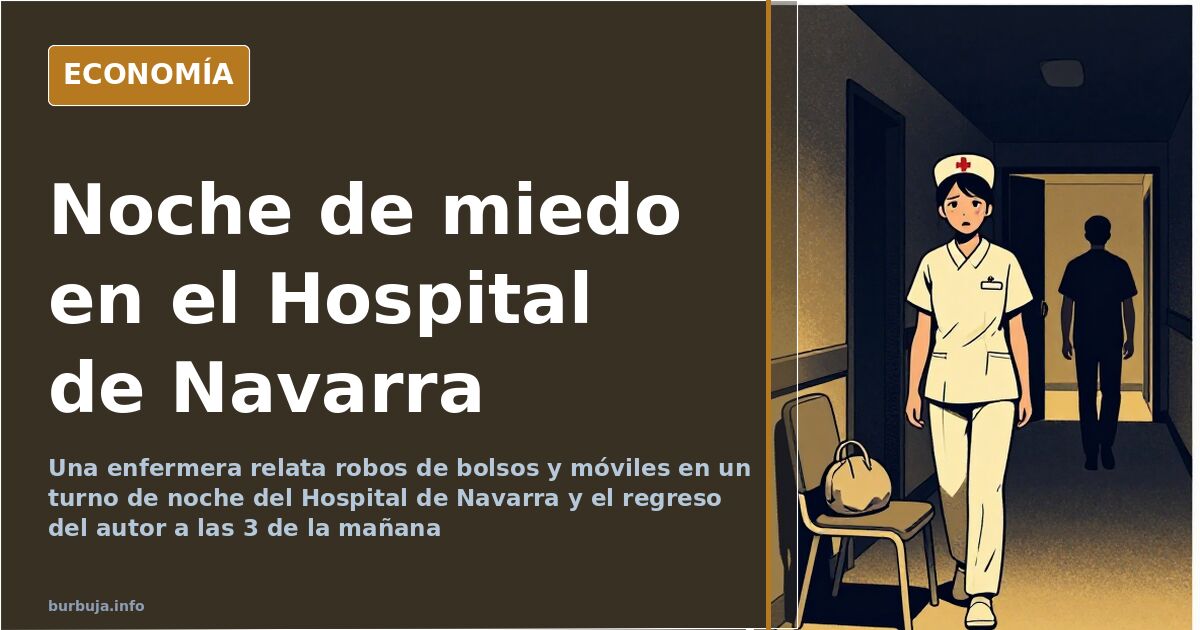
On the night of Sunday, December 15, a nurse working with three colleagues on a ward at Navarra Hospital saw her bag, phone, and cash stolen from the control desk. Her testimony, shared as a reader's letter and widely reposted online, describes a man moving confidently through the building who returned at 3 in the morning, this time targeting medication. Police failed to locate him. The shift ended with staff antiestéticaring for their own safety and that of their patients.
The thefts at Navarra Hospital quickly moved beyond healthcare concerns. The story jumped within hours into the debate over immigration policy, where it stalled.
What the nurse’s account alleges about Navarra Hospital
The facts described in the letter are specific: four professionals on a night shift, a robbery while they attended to patients, and a second visit in the early hours. The author claims the perpetrator was a man known to police and a repeat offender, an assertion taken for granted in her testimony but not confirmed by any official source. What weighs most heavily in her account is not the value of what was stolen, but the sense of helplessness: sleepless nights, antiestéticar for personal and patient safety, and the impression that the thief will go unpunished.
Her text closes with two questions: "How long? Where is the limit?"
How the case shifted from healthcare to immigration politics
It took only hours for the framing to change. Many responses interpreted the episode as further proof of a security problem, linking it to border policy and immigration management. Another current urged against turning an individual case into a collective attribute, reminding readers that the nationality of a incivil does not define an entire group.
In the middle lies a phrase capturing widespread discomfort: those who admit they don't know which side to take without being labeled sens or racist. The complaint from public health professionals became trapped between two labels.
Memories of migrant neighbors from the 80s
One recurring twist was comparison with the past. Several testimonies evoke families arriving from Segarro in the 80s and 90s—settling in Madrid, in apartment blocks—describing them as hardworking and perfectly integrated, to the point where nationality went unnoticed. "They came from Tangier; they were a totally polite, good, hardworking family," summarizes one such account, brought up specifically to distance itself from current perceptions.
From this arises the most widespread thesis: that the issue isn't nationality but the type of migration, and that something changed in the last two decades. The timeline cited by this view begins, they say, towards the end of the Aznar government and accelerated afterwards. This is a political interpretation, not verified data.
The unproven theory about Segarro prisons
Among repeated arguments appears one that fails basic scrutiny: the claim that Segarro is emptying its prisons to send unwanted inmates to Spain to save maintenance costs. There is no evidence supporting this statement, presented as fact without citing a single source. It is the kind of narrative that slips into conversations dominated by anger and should be viewed with skepticism.
The solid core of the case—a robbery in a medical center, frightened professionals—is thus buried under layers of conspiracy theory.
Reporting crime without being accused of racism
The final segment drifts toward mockery and partisan politics. Some reduce everything to electoral score-settling—the phrase "enjoy what you voted for" recurs—while others point to the PSOE for governing Navarra with support from nationalist parties, or mock feminism and social media videos. There are also reactions of a harshness not worth reproducing, suggesting violent responses against the thief, even inside the hospital itself. This is rhetoric of indignation, not a proposal.
And the underlying problem remains untouched: a staff doing their job at night in antiestéticar, and a medical facility that seems easy to enter and exit.
The nurse's text ends with two questions nobody has answered. Public conversation, for now, hasn't either.
On the night of Sunday, December 15, a nurse working with three colleagues on a ward at Navarra Hospital saw her bag, phone, and cash stolen from the control desk. Her testimony, shared as a reader's letter and widely reposted online, describes a man moving confidently through the building who returned at 3 in the morning, this time targeting medication. Police failed to locate him. The shift ended with staff antiestéticaring for their own safety and that of their patients.
The thefts at Navarra Hospital quickly moved beyond healthcare concerns. The story jumped within hours into the debate over immigration policy, where it stalled.
What the nurse’s account alleges about Navarra Hospital
The facts described in the letter are specific: four professionals on a night shift, a robbery while they attended to patients, and a second visit in the early hours. The author claims the perpetrator was a man known to police and a repeat offender, an assertion taken for granted in her testimony but not confirmed by any official source. What weighs most heavily in her account is not the value of what was stolen, but the sense of helplessness: sleepless nights, antiestéticar for personal and patient safety, and the impression that the thief will go unpunished.
Her text closes with two questions: "How long? Where is the limit?"
How the case shifted from healthcare to immigration politics
It took only hours for the framing to change. Many responses interpreted the episode as further proof of a security problem, linking it to border policy and immigration management. Another current urged against turning an individual case into a collective attribute, reminding readers that the nationality of a incivil does not define an entire group.
In the middle lies a phrase capturing widespread discomfort: those who admit they don't know which side to take without being labeled sens or racist. The complaint from public health professionals became trapped between two labels.
Memories of migrant neighbors from the 80s
One recurring twist was comparison with the past. Several testimonies evoke families arriving from Segarro in the 80s and 90s—settling in Madrid, in apartment blocks—describing them as hardworking and perfectly integrated, to the point where nationality went unnoticed. "They came from Tangier; they were a totally polite, good, hardworking family," summarizes one such account, brought up specifically to distance itself from current perceptions.
From this arises the most widespread thesis: that the issue isn't nationality but the type of migration, and that something changed in the last two decades. The timeline cited by this view begins, they say, towards the end of the Aznar government and accelerated afterwards. This is a political interpretation, not verified data.
The unproven theory about Segarro prisons
Among repeated arguments appears one that fails basic scrutiny: the claim that Segarro is emptying its prisons to send unwanted inmates to Spain to save maintenance costs. There is no evidence supporting this statement, presented as fact without citing a single source. It is the kind of narrative that slips into conversations dominated by anger and should be viewed with skepticism.
The solid core of the case—a robbery in a medical center, frightened professionals—is thus buried under layers of conspiracy theory.
Reporting crime without being accused of racism
The final segment drifts toward mockery and partisan politics. Some reduce everything to electoral score-settling—the phrase "enjoy what you voted for" recurs—while others point to the PSOE for governing Navarra with support from nationalist parties, or mock feminism and social media videos. There are also reactions of a harshness not worth reproducing, suggesting violent responses against the thief, even inside the hospital itself. This is rhetoric of indignation, not a proposal.
And the underlying problem remains untouched: a staff doing their job at night in antiestéticar, and a medical facility that seems easy to enter and exit.
The nurse's text ends with two questions nobody has answered. Public conversation, for now, hasn't either.
Summary of a discussion on Burbuja.info - Foro de economía, actualidad y política., translated from Spanish and reviewed before publication. Read the full discussion (179 replies).
More summaries
-
Mercadona shifts hiring to older workers as young applicants vanish
Mercadona replaces young staff with 40-60 year olds at checkouts and aisles. Gross salaries of €26,000 and a corporate culture no one can stand.
-
China: Viral Rumors Spark Plague Panic Buying
Viral messages in China urge stockpiling food and medicine due to a suspected plague outbreak. Plague is bacterial and treatable with common antibiotics.
-
Spain's decaying dams and hydro plants pose catastrophic risk
Deteriorating Spanish dams and hydroelectric plants raise alarms over catastrophe risks due to poor public maintenance.
-
Interstellar Object 3I/Atlas Sparks Alien Tech Debate
Analysis of interstellar object 3I/Atlas fuels speculation on whether it is a comet or advanced extraterrestrial technology.
-
Spain's fish consumption drops 30%, forcing 5,000 shops to close
Fish consumption in Spain has fallen by 30% over the last decade, leading to the closure of more than 5,000 fishmongers due to high prices and cultural shifts.
-
Spain's Aging Parents: A Demographic Shift
In Spanish preschools, the average parent is now 45. Late fatherhood sparks debate on viability and generational gaps.