
Social workers dancing with migrant minors sparks Spain debate
Video shows staff dancing with unaccompanied minors in a Spanish reception center, reigniting scrutiny of €1.458 billion in NGO subsidies.
English · Original discussion in Spanish · Published
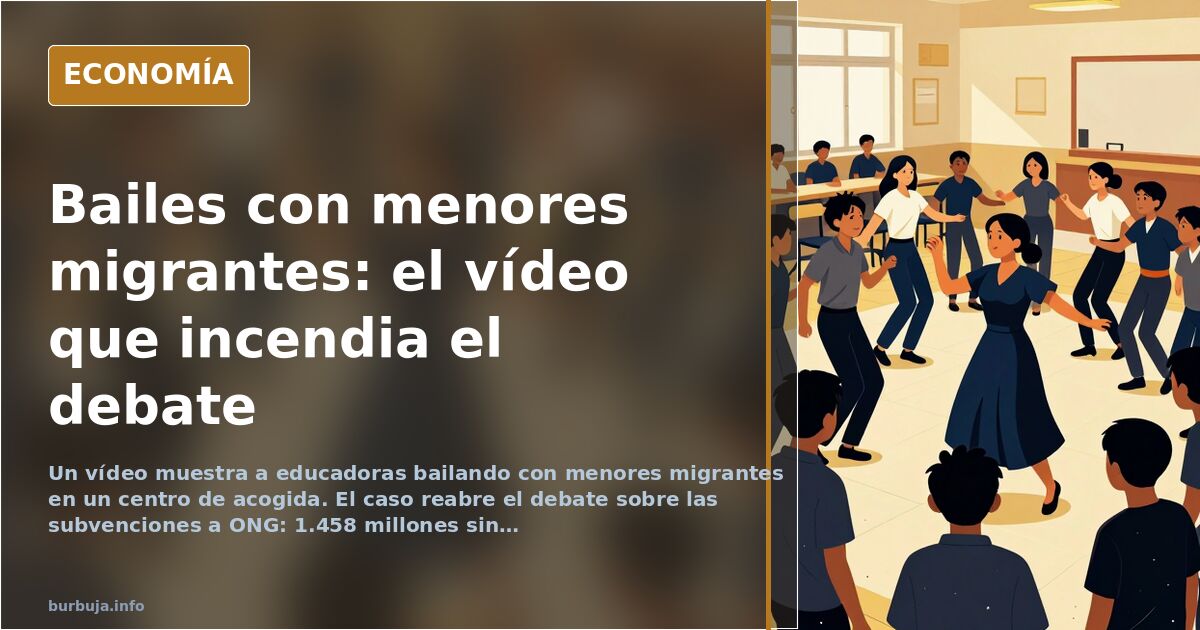
Social workers dance with migrant minors: video reopens debate
What happens when staff caring for unaccompanied migrant minors do not supervise, but instead film themselves dancing suggestively with them? A video circulated on social media shows several educators and social workers dancing provocatively with young people under guardianship at a reception center. The material, shared in an Economy subforum thread that has accumulated 179 replies, has led to a discussion mixing the role of the Third Sector, public spending on NGOs, and migration policy. The scene is short. The controversy is long.
What the video shows and who appears
The clip shows a group of young women, identified in the debate as social educators, integration specialists, or activity coordinators —not necessarily qualified social workers, some clarify— dancing provocatively with migrant minors in what appears to be a reception center. The gesture has been interpreted in two opposite ways: as a playful integration activity or as an improper display of the professional role.
Some argue it is a hoax or a video taken out of context. Others point out that the pattern repeats: women with similar profiles, in social care settings, normalizing behaviors that would be unthinkable in any other workplace. The debate does not close because the video alone does not allow knowing if there was institutional consent, supervision, or subsequent reporting.
Public spending on NGOs hosting migrants
The economic issue arises when the system's funding is put on the table. Subsidies to NGOs hosting undocumented immigrants total €1.458 billion, according to data cited in the discussion, mostly awarded without tendering and without transparency regarding the degree of integration achieved. That figure turns the video into a symptom, not an anecdote.
The lingering question is uncomfortable: if the taxpayer pays for reception, do they also pay for the spectacle? The answer is not unanimous. One part of the analysis argues that staff do their job with precarious resources and that dancing is just another tool for bonding. The other maintains that free institutional affection towards migrant minors is part of the problem, not the solution.
Pull factor effect and criticism of the official narrative
The thread shifts to migration policy when asking if this type of imagery works as a lure. It is argued that the combination of aid, housing, and care without reciprocity generates a pull factor that pushes more people to try entering Spain. It is a repeated thesis, not proven with data in the discussion, and should be treated as what it is: a political hypothesis, not a fact.
In parallel, criticism of the Third Sector as an opaque intermediary appears. Direct awarding of funds, lack of integration metrics, and absence of control over hired personnel are the three most repeated complaints. No one disputes that minors must be cared for. What is disputed is how, by whom, and in exchange for what.
Professional reaction and institutional silence
The sector's response has been tepid. Some messages emphasize that social educators are not social workers and that the video does not represent the entire profession. It is a technical nuance that, in practice, does not defuse the controversy: the viewer sees a person with an authority role dancing with minors in their charge.
The silence of the competent administrations —autonomous communities and ministry— is the other protagonist. There is no statement, no known file, no official version. When there is no narrative, the video builds the narrative.
What the reception system risks
Beyond the clip, the issue touches the architecture of the system: who hires, who supervises, and who answers when things go off script. The discussion leaves an open question: if the video is an isolated case, the answer should be a protocol. If it is not, the problem is structural. So far, neither one nor the other.
With €1.458 billion at stake and no public integration metrics, the video did not create the problem. It only made it visible.
What happens when staff caring for unaccompanied migrant minors do not supervise, but instead film themselves dancing suggestively with them? A video circulated on social media shows several educators and social workers dancing provocatively with young people under guardianship at a reception center. The material, shared in an Economy subforum thread that has accumulated 179 replies, has led to a discussion mixing the role of the Third Sector, public spending on NGOs, and migration policy. The scene is short. The controversy is long.
What the video shows and who appears
The clip shows a group of young women, identified in the debate as social educators, integration specialists, or activity coordinators —not necessarily qualified social workers, some clarify— dancing provocatively with migrant minors in what appears to be a reception center. The gesture has been interpreted in two opposite ways: as a playful integration activity or as an improper display of the professional role.
Some argue it is a hoax or a video taken out of context. Others point out that the pattern repeats: women with similar profiles, in social care settings, normalizing behaviors that would be unthinkable in any other workplace. The debate does not close because the video alone does not allow knowing if there was institutional consent, supervision, or subsequent reporting.
Public spending on NGOs hosting migrants
The economic issue arises when the system's funding is put on the table. Subsidies to NGOs hosting undocumented immigrants total €1.458 billion, according to data cited in the discussion, mostly awarded without tendering and without transparency regarding the degree of integration achieved. That figure turns the video into a symptom, not an anecdote.
The lingering question is uncomfortable: if the taxpayer pays for reception, do they also pay for the spectacle? The answer is not unanimous. One part of the analysis argues that staff do their job with precarious resources and that dancing is just another tool for bonding. The other maintains that free institutional affection towards migrant minors is part of the problem, not the solution.
Pull factor effect and criticism of the official narrative
The thread shifts to migration policy when asking if this type of imagery works as a lure. It is argued that the combination of aid, housing, and care without reciprocity generates a pull factor that pushes more people to try entering Spain. It is a repeated thesis, not proven with data in the discussion, and should be treated as what it is: a political hypothesis, not a fact.
In parallel, criticism of the Third Sector as an opaque intermediary appears. Direct awarding of funds, lack of integration metrics, and absence of control over hired personnel are the three most repeated complaints. No one disputes that minors must be cared for. What is disputed is how, by whom, and in exchange for what.
Professional reaction and institutional silence
The sector's response has been tepid. Some messages emphasize that social educators are not social workers and that the video does not represent the entire profession. It is a technical nuance that, in practice, does not defuse the controversy: the viewer sees a person with an authority role dancing with minors in their charge.
The silence of the competent administrations —autonomous communities and ministry— is the other protagonist. There is no statement, no known file, no official version. When there is no narrative, the video builds the narrative.
What the reception system risks
Beyond the clip, the issue touches the architecture of the system: who hires, who supervises, and who answers when things go off script. The discussion leaves an open question: if the video is an isolated case, the answer should be a protocol. If it is not, the problem is structural. So far, neither one nor the other.
With €1.458 billion at stake and no public integration metrics, the video did not create the problem. It only made it visible.
Summary of a discussion on Burbuja.info - Foro de economía, actualidad y política., translated from Spanish and reviewed before publication. Read the full discussion (179 replies).
More summaries
-
Social workers and minors: the controversy shaking online forums
Allegations of inappropriate relationships between social workers and minors in care centers spark intense debate over management and funding.
-
El Jueves targets corruption with a lineup of the usual suspects
El Jueves publishes a corruption-themed cover with eleven figures: mostly PP and two from PSOE. Criticism over imbalance and omissions.
-
UK Police Fail to Restrain Man; Elderly Vendor Steps In
Video shows UK police struggling to subdue a man, while an elderly street vendor successfully intervenes in the altercation.
-
Nike Shares Plunge 19.99% as Price Target Hits 2017 Lows
Nike shares fell 19.99% after disappointing 2024 results, with price targets dropping to $94 and UBS calling for a reset.
-
Alvise’s unproven European election fraud claims
The alleged message dismissing Alvise Pérez's voters is missing from his Telegram and appears as a repost on Instagram.
-
Suspect arrested in Madrid over Norwegian woman's death
Anne Mathea Morken, a 22-year-old Norwegian, was found dead on a Torremolinos sidewalk in 2023. A suspect was detained in Madrid in late February.