
EU Wine Labeling: Health Concerns vs. Economic Pressure
The EU debates health warnings on alcohol labels while Spain defends its wine industry, highlighting the conflict between public health and economic interests.
English · Original discussion in Spanish · Published
Wine and cancer: the warning debated under pressure
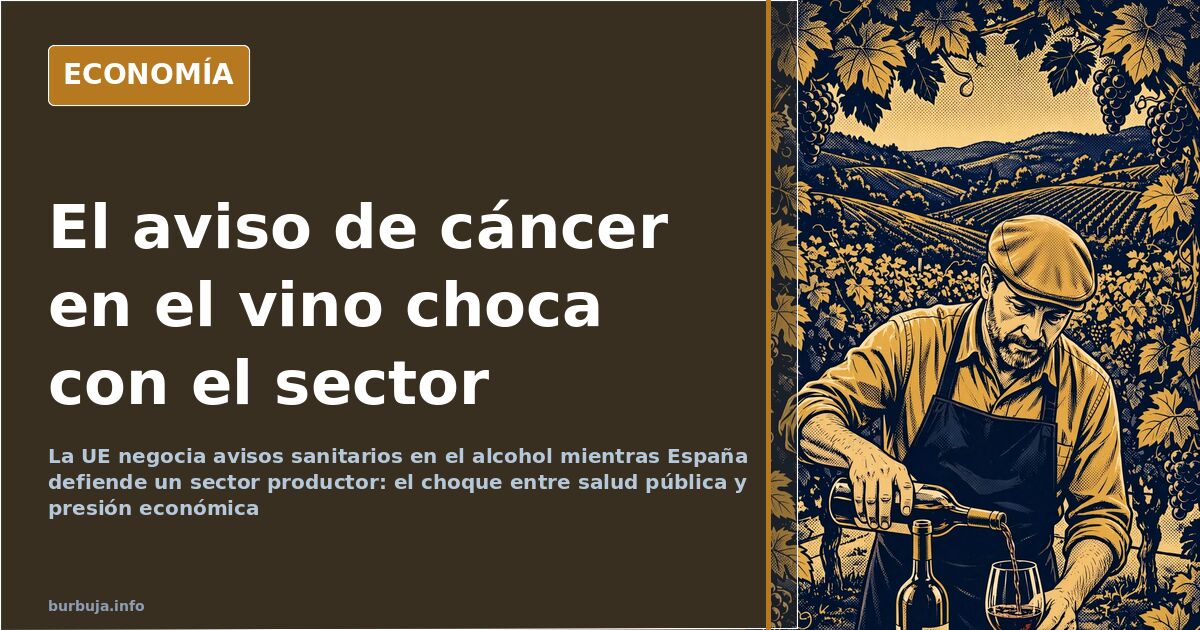
Spain produces, exports, and promotes wine, yet defends it fiercely in Brussels. The core issue: the same administration promoting the sector must endorse warnings that alcohol is a carcinogen, regardless of origin designation. Public health clashes with economic interest, and the conflict is postponed, not resolved.
What the EU debates regarding wine
The underlying idea is simple, but the fine print is murky: alcohol labels should include health warnings, like tobacco. Some claim the warning was blocked in Brussels before reaching Parliament, arguing the Agriculture Ministry should have stopped it early. Others argue non-producing countries push the measure because they have no vineyards to protect. For Southern Europe, such warnings strike directly at trade balances.
Why wine is defended as a national interest
Spain is a major producer and one of the few agro-food powers with a strong international brand. Ribera del Duero, Rioja, and Albariño drive employment, tourism, and exports. Stricter labeling would hit an industry with centuries of history and an entire culture of dining and socializing. Critics note that countries pushing the warning produce little wine, explaining their enthusiasm. The debate is not about molecules, but about who pays for a printed label.
Does alcohol cause cancer? What health sources say
Health organizations answer with a clear yes: the Spanish Cancer Association states alcohol causes the disease, and a study from the Autonomous University of Madrid insists there is no beneficial consumption. Other studies show contradictory conclusions, noting alcohol destroys neurons, increasing risks like Alzheimer's. The core issue is methodological. When research suggests health benefits, headlines often focus on the resulting abuse. Health evidence is often interpreted with the calculator of external behavior in hand. When in doubt about consumption patterns, the reasonable path is a health professional, not a label.
Sulfites and additives: the chemical thesis against wine
Here the argument shifts and gains adherents. The problem is not wine itself, but sulfites and additives added by the industry. Grandparents drank wine without chemicals with no issues, argues this current, seeing the warning as an attack on traditional products rather than industrial processes. This comparison extends to soft drinks: glucose syrup, sweeteners, colorants, and sugar-laden alcohol-free beers are sold as healthy alternatives while the wine glass is demonized. This is the most repeated and hardest-to-refute reasoning in the exchange.
Daily moderate drinking: moderation vs. "everything causes cancer"
The disagreement centers on dosage. Moderate consumption, without binge drinking, is defended as a reasonable habit and even a stress valve in a life that becomes difficult without small vices. Drinking a bottle daily straight is different, and no one defends that. Conversely, one school argues life itself causes cancer, making warnings background noise. Another reminds us that tobacco is also a fiscal bargain, with a well-established link to cancer, yet no one disputes its labeling. The contradiction, they note, is not in science, but in the treasury. The discussion ends where it usually does: how much the State collects from alcohol, how much health care costs, and who benefits from delayed warnings. With evidence on the table, why is what is accepted without debate for tobacco still under negotiation for a glass of wine?
Spain produces, exports, and promotes wine, yet defends it fiercely in Brussels. The core issue: the same administration promoting the sector must endorse warnings that alcohol is a carcinogen, regardless of origin designation. Public health clashes with economic interest, and the conflict is postponed, not resolved.
What the EU debates regarding wine
The underlying idea is simple, but the fine print is murky: alcohol labels should include health warnings, like tobacco. Some claim the warning was blocked in Brussels before reaching Parliament, arguing the Agriculture Ministry should have stopped it early. Others argue non-producing countries push the measure because they have no vineyards to protect. For Southern Europe, such warnings strike directly at trade balances.
Why wine is defended as a national interest
Spain is a major producer and one of the few agro-food powers with a strong international brand. Ribera del Duero, Rioja, and Albariño drive employment, tourism, and exports. Stricter labeling would hit an industry with centuries of history and an entire culture of dining and socializing. Critics note that countries pushing the warning produce little wine, explaining their enthusiasm. The debate is not about molecules, but about who pays for a printed label.
Does alcohol cause cancer? What health sources say
Health organizations answer with a clear yes: the Spanish Cancer Association states alcohol causes the disease, and a study from the Autonomous University of Madrid insists there is no beneficial consumption. Other studies show contradictory conclusions, noting alcohol destroys neurons, increasing risks like Alzheimer's. The core issue is methodological. When research suggests health benefits, headlines often focus on the resulting abuse. Health evidence is often interpreted with the calculator of external behavior in hand. When in doubt about consumption patterns, the reasonable path is a health professional, not a label.
Sulfites and additives: the chemical thesis against wine
Here the argument shifts and gains adherents. The problem is not wine itself, but sulfites and additives added by the industry. Grandparents drank wine without chemicals with no issues, argues this current, seeing the warning as an attack on traditional products rather than industrial processes. This comparison extends to soft drinks: glucose syrup, sweeteners, colorants, and sugar-laden alcohol-free beers are sold as healthy alternatives while the wine glass is demonized. This is the most repeated and hardest-to-refute reasoning in the exchange.
Daily moderate drinking: moderation vs. "everything causes cancer"
The disagreement centers on dosage. Moderate consumption, without binge drinking, is defended as a reasonable habit and even a stress valve in a life that becomes difficult without small vices. Drinking a bottle daily straight is different, and no one defends that. Conversely, one school argues life itself causes cancer, making warnings background noise. Another reminds us that tobacco is also a fiscal bargain, with a well-established link to cancer, yet no one disputes its labeling. The contradiction, they note, is not in science, but in the treasury. The discussion ends where it usually does: how much the State collects from alcohol, how much health care costs, and who benefits from delayed warnings. With evidence on the table, why is what is accepted without debate for tobacco still under negotiation for a glass of wine?
Summary of a discussion on Burbuja.info - Foro de economía, actualidad y política., translated from Spanish and reviewed before publication. Read the full discussion (251 replies).
More summaries
-
Alba Flores links Ceuta to neo-Nazi squads despite lack of evidence
Alba Flores compares Ceuta to a horror film and mentions neo-Nazi squads. Public records and figures do not support that narrative.
-
Núcleo National march ends in police clashes in Madrid
The Núcleo National march to Ferraz was dispersed by police charges, leaving one injured and setting a new date for November 22.
-
Police charges in Valencia protest against Mazón
The protest against Mazón over the DANA management ended with police charges and conflicting accounts of who started the clashes.
-
The Hidden Cost of Cars Lost in the Valencia Flash Floods
For many, losing a car in Valencia's DANA is losing their main asset. The debate over insurance and compensation from the Consorcio de Compensación de Seguros.
-
Spain's Porn Campaign Sparks Internet Control and Tax Evasion Debate
Spain launches a porn campaign focusing on internet control and tax evasion, sparking debate over digital ID and sector regulation.
-
Singlehood rises: men without jobs, women with degrees
Permanent celibacy jumps from 11% to 20%. Male unemployment and female education disrupt relationship formation in Spain.