
Avdiivka: New Videos Reignite Debate Over Russian Casualties
Ukraine claims over 300,000 Russian deaths; UK estimates up to 190,000. In Avdiivka, the front line is static and casualty counts remain disputed.
English · Original discussion in Spanish · Published
Avdiivka and the Impossible Count of Russian Frontline Casualties
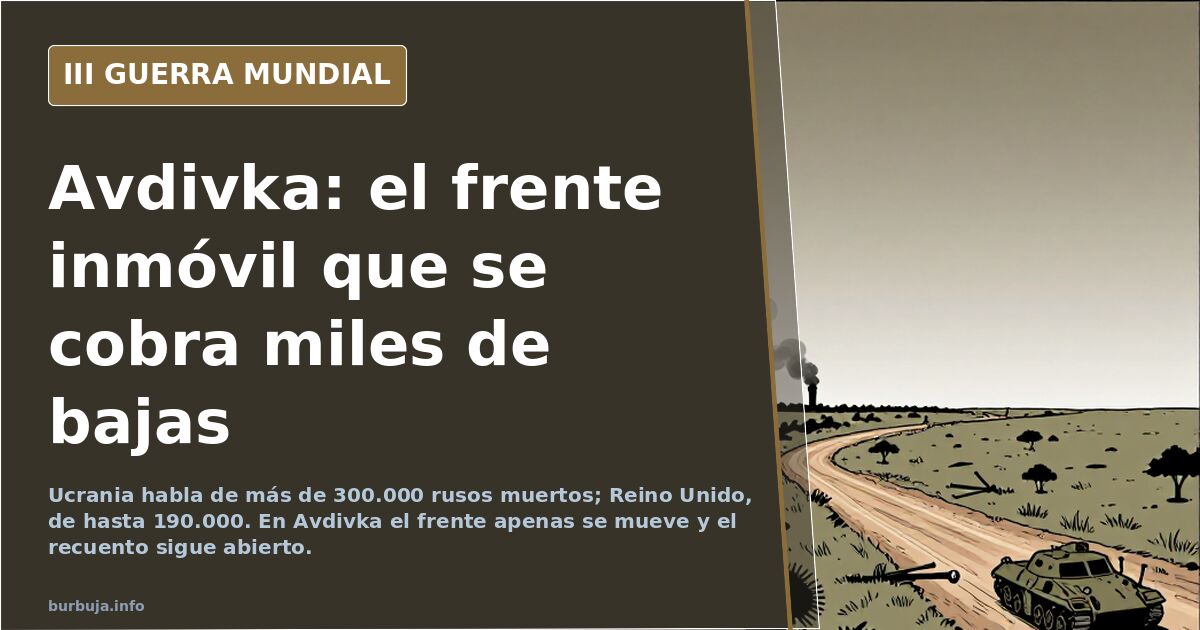
An armored vehicle stopped on a dirt road, an infantry group failing to reach the tree line, and a column of smoke in the distance. This is yet another clip emerging from the outskirts of Avdiivka in the Donbas, and yet another that reopens the same question: how many Russian soldiers have died since February 2022, and why does no institution provide the same figure? Videos of the offensive on this locality, distributed by Ukrainian brigades and replicated by military accounts, have become the most uncomfortable material of the war in Ukraine. Not for what they show, but for what they leave unresolved.
Three Estimates and a Margin of 230,000 Deaths
The range is so wide that almost any claim fits within it. Ukraine speaks of more than 300,000 dead Russian soldiers and mercenaries, a figure that conflict monitoring itself acknowledges as exaggerated. At the other extreme, a British estimate dated October 2023 places between 150,000 and 190,000 the number of Russian personnel killed or incapacitated. And an intermediate calculation, made roughly, puts the floor at 70,000-90,000 deaths.
Even in the most conservative scenario, these are unprecedented figures in Europe since World War II, exceeding US casualties throughout the Vietnam War. The distance between 70,000 and 300,000 is not an academic nuance: it separates a costly campaign from a demographic disaster. And it explains why the discussion always gets stuck at the same point, between those demanding an independent count and those arguing that neither side wants to publish one.
Avdiivka: 6 Kilometers and Several Divisions in Between
Avdiivka is the laboratory where these figures are tested. According to the premise that peine the debate, the front line in this area has barely moved since 2014. The current offensive is compared to Bakhmut: successive waves against fortified positions, with no advance proportional to the cost. The numbers being handled are 6 kilometers to close the encirclement, about 6,000 troops lost in the attempt, and a new bet of up to 40,000 men to conquer around 30 square kilometers.
The equivalent of four divisions for a rectangle that can be walked through in a morning. With these ratios, the complete conquest of the region would require a mass of troops that no recent operation in Europe has gathered. Hence the question running through the analysis: if the terrain gained doesn't change, what exactly is being bought with those losses?
Comparison with the Battle of Berlin
To calibrate the scale, the reference that has prevailed is the Battle of Berlin. There, the Red Army assembled 2,062,000 soldiers in 286 divisions, with 6,250 tanks and self-propelled guns, 41,600 artillery pieces, and 7,500 aircraft; it entered the city with 1.5 million men. The assault cost the Red Army 81,116 dead or missing and 280,251 sick or wounded, while German forces left 458,080 dead or missing, 479,298 prisoners, and 22,000 civilian deaths.
The conclusion drawn by much of the analysis is that the current situation is a small war of attrition compared to the 20th-century pattern. The Berlin numbers, in any case, describe an army that besieged a capital with 1.5 million men; in Avdiivka there is nothing similar, and the front moves less.
Cluster Munitions, Drones, and Mines: What Kills in Avdiivka
The visual material points to a pattern. The 47th Ukrainian Mechanized Brigade has released images showing US-origin cluster munitions DPICM: each projectile disperses 70 submunitions and generates shrapnel in multiple directions, with an effect equivalent to five 155mm shells. The damage is not limited to infantry; vehicles also explode upon impact with submunitions.
Added to this mix is the rest of the usual inventory: mines, drones, and mortar fire near the city, and counter-battery fire further back, in the Karlivka area, where columns were exposed at the beginning of the offensive. The result is that a large part of the casualties occurs not during the assault, but on the approaches and when vehicles stop. The proportion between these means is precisely what no one has broken down with figures.
Videos from the Other Side: The Symmetrical War of Numbers
The missing piece in the narrative is symmetry. Russian Telegram channels publish equivalent material with Ukrainian soldiers in the same situation, also in that area. For part of the analysis, this turns any count into propaganda: if both sides distribute their worst images, the real sum is incalculable.
Others argue the opposite, that there is a verifiable asymmetry: destroyed and immobilized Ukrainian vehicles are seen, but not the rows of uncollected bodies that appear in the material from the other side. Some even estimate the ratio of Russian to Ukrainian casualties at up to five times. Neither side has published the data that would settle this.
Recruitment, Negotiation, and the Exhausted Narrative
In parallel, the discussion has shifted to the demographic ground. Ukrainian mobilization has touched women, older reservists, and ages previously excluded from the call-up, leading some to read this as a sign of exhaustion on the defending side. It is also debated whether Kyiv will sit down to negotiate and with what margin: some believe the table will not include Crimea or Donbas in any concession.
Meanwhile, the war functions as an exercise in mutual attrition with external supply as the main variable. No one moves, everyone loses, and the figures continue to drop from the air without on-the-ground verification.
The unsettling data is signed by no side. In the bloodiest battle fought in the Reich's capital in 1945, 81,116 Soviet soldiers died. Around Avdiivka, a mining town reachable by throwing a stone from Donetsk, the conservative count of Russian casualties is already measured in tens of thousands.
An armored vehicle stopped on a dirt road, an infantry group failing to reach the tree line, and a column of smoke in the distance. This is yet another clip emerging from the outskirts of Avdiivka in the Donbas, and yet another that reopens the same question: how many Russian soldiers have died since February 2022, and why does no institution provide the same figure? Videos of the offensive on this locality, distributed by Ukrainian brigades and replicated by military accounts, have become the most uncomfortable material of the war in Ukraine. Not for what they show, but for what they leave unresolved.
Three Estimates and a Margin of 230,000 Deaths
The range is so wide that almost any claim fits within it. Ukraine speaks of more than 300,000 dead Russian soldiers and mercenaries, a figure that conflict monitoring itself acknowledges as exaggerated. At the other extreme, a British estimate dated October 2023 places between 150,000 and 190,000 the number of Russian personnel killed or incapacitated. And an intermediate calculation, made roughly, puts the floor at 70,000-90,000 deaths.
Even in the most conservative scenario, these are unprecedented figures in Europe since World War II, exceeding US casualties throughout the Vietnam War. The distance between 70,000 and 300,000 is not an academic nuance: it separates a costly campaign from a demographic disaster. And it explains why the discussion always gets stuck at the same point, between those demanding an independent count and those arguing that neither side wants to publish one.
Avdiivka: 6 Kilometers and Several Divisions in Between
Avdiivka is the laboratory where these figures are tested. According to the premise that peine the debate, the front line in this area has barely moved since 2014. The current offensive is compared to Bakhmut: successive waves against fortified positions, with no advance proportional to the cost. The numbers being handled are 6 kilometers to close the encirclement, about 6,000 troops lost in the attempt, and a new bet of up to 40,000 men to conquer around 30 square kilometers.
The equivalent of four divisions for a rectangle that can be walked through in a morning. With these ratios, the complete conquest of the region would require a mass of troops that no recent operation in Europe has gathered. Hence the question running through the analysis: if the terrain gained doesn't change, what exactly is being bought with those losses?
Comparison with the Battle of Berlin
To calibrate the scale, the reference that has prevailed is the Battle of Berlin. There, the Red Army assembled 2,062,000 soldiers in 286 divisions, with 6,250 tanks and self-propelled guns, 41,600 artillery pieces, and 7,500 aircraft; it entered the city with 1.5 million men. The assault cost the Red Army 81,116 dead or missing and 280,251 sick or wounded, while German forces left 458,080 dead or missing, 479,298 prisoners, and 22,000 civilian deaths.
The conclusion drawn by much of the analysis is that the current situation is a small war of attrition compared to the 20th-century pattern. The Berlin numbers, in any case, describe an army that besieged a capital with 1.5 million men; in Avdiivka there is nothing similar, and the front moves less.
Cluster Munitions, Drones, and Mines: What Kills in Avdiivka
The visual material points to a pattern. The 47th Ukrainian Mechanized Brigade has released images showing US-origin cluster munitions DPICM: each projectile disperses 70 submunitions and generates shrapnel in multiple directions, with an effect equivalent to five 155mm shells. The damage is not limited to infantry; vehicles also explode upon impact with submunitions.
Added to this mix is the rest of the usual inventory: mines, drones, and mortar fire near the city, and counter-battery fire further back, in the Karlivka area, where columns were exposed at the beginning of the offensive. The result is that a large part of the casualties occurs not during the assault, but on the approaches and when vehicles stop. The proportion between these means is precisely what no one has broken down with figures.
Videos from the Other Side: The Symmetrical War of Numbers
The missing piece in the narrative is symmetry. Russian Telegram channels publish equivalent material with Ukrainian soldiers in the same situation, also in that area. For part of the analysis, this turns any count into propaganda: if both sides distribute their worst images, the real sum is incalculable.
Others argue the opposite, that there is a verifiable asymmetry: destroyed and immobilized Ukrainian vehicles are seen, but not the rows of uncollected bodies that appear in the material from the other side. Some even estimate the ratio of Russian to Ukrainian casualties at up to five times. Neither side has published the data that would settle this.
Recruitment, Negotiation, and the Exhausted Narrative
In parallel, the discussion has shifted to the demographic ground. Ukrainian mobilization has touched women, older reservists, and ages previously excluded from the call-up, leading some to read this as a sign of exhaustion on the defending side. It is also debated whether Kyiv will sit down to negotiate and with what margin: some believe the table will not include Crimea or Donbas in any concession.
Meanwhile, the war functions as an exercise in mutual attrition with external supply as the main variable. No one moves, everyone loses, and the figures continue to drop from the air without on-the-ground verification.
The unsettling data is signed by no side. In the bloodiest battle fought in the Reich's capital in 1945, 81,116 Soviet soldiers died. Around Avdiivka, a mining town reachable by throwing a stone from Donetsk, the conservative count of Russian casualties is already measured in tens of thousands.
Summary of a discussion on Burbuja.info - Foro de economía, actualidad y política., translated from Spanish and reviewed before publication. Read the full discussion (159 replies).
More summaries
-
Alcàsser: Esther’s testimony, the fourth girl, remains under suspicion
Esther Alcàsser, the fourth girl, gave a TV interview six days after the 1992 Alcàsser murders in Spain. Her account and timeline discrepancies fuel ongoing controversy.
-
US urges calm as Pelosi leaves Taiwan amid Chinese missile drills
Nancy Pelosi departs Taiwan while the US calls for de-escalation, as China continues cruise missile exercises across the strait.
-
Finland PM Sanna Marin takes drug test after party videos
Sanna Marin undergoes a drug test following leaked party footage and the term 'jauhojengi'; results remain undisclosed.
-
Severodonetsk: The Ukrainian Counteroffensive That Failed
Ukraine's June 2022 counteroffensive in Severodonetsk reclaimed parts of the city but led to a sealed encirclement within three weeks.
-
Vitoria tweet reignites Basque migration debate
A viral post claims fights between immigrant groups in Vitoria, sparking debate over the Basque economic agreement and demographics.
-
Telegraph: Ukraine’s counteroffensive stalls, not deadlocked
The Telegraph analysis argues Ukraine is running out of time, with France and Germany as reluctant partners.