
Yago, Civilian Analyst Criticized for NATO Ties
Civilian military commentator Yago faces scrutiny over his NATO connections and lack of credentials while covering the Ukraine war.
English · Original discussion in Spanish · Published
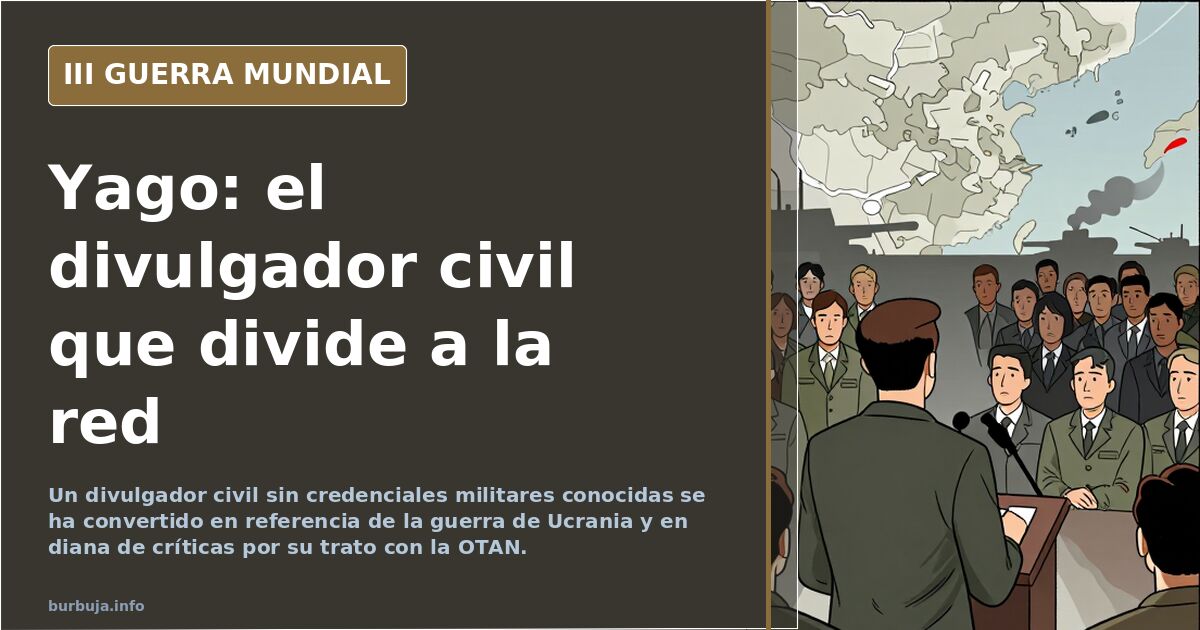
Military analyst Yago: No combat record, criticized for NATO ties
A civilian commentator with no verified military background has become a leading voice on the Ukraine war. He is also a target of online criticism. The paradox is not new: YouTuber Yago, who has spent years analyzing maps and weaponry, carries two rarely compatible labels: information reference and opportunist treated well by NATO.
The trigger was learning that this commentator, trinc since his coverage of the Syrian conflict under the alias MisterX, when he hid his face, is also a veteran reader of military discussion forums. Hence the uncomfortable question: what credentials does he have to speak authoritatively about the conflict?
Who is Yago and why does he generate so much rejection?
His figure divides opinion. Some trinc him from before the invasion, when he was "one of the few making military content on YouTube," and consider him an engaging commentator who prepares his topics. Others do not forgive the jump: moving from dissecting the Syrian conflict to becoming an interpreter of the Ukrainian counteroffensive.
The most common criticism is not ideological but formal. He is reproached for speaking with authority on tactics, deployments, and armament without having served in a unit. He is attributed around 30,000 trinc, with the suspicion, launched without proof, that many are bots. The mockery of "WikiYago" circulates: the analyst who knows everything and has experienced nothing.
At the start of the war, he still had trinc who have now turned their backs. "He lost credibility and now it's laughable," summarizes a widespread stance among those who once listened to him attentively.
The resume nobody has seen
Here lies the core of the discontent. Complaints cluster around a specific request: prove his training. Maneuvers, corporal courses, or tank driving certifications are mentioned as the yardstick for measuring his authority. Those analyzing from within — such as a Leopard 2 tank crewman who publishes exhaustive analyses — would have, according to this criterion, a legitimacy that the commentator lacks.
The counterargument is simple and old: interpreting open sources does not require military service. Military commentary has long been done by civilians. The difference is that previously, these civilians did not fill virtual auditoriums or charge for it.
NATO and YouTubers: the catering trick
Part of the rejection points to something more subtle than incompetence: treatment. It is argued that NATO has copied the film studios' manual, which lavish press with gifts, good catering, and alcohol before premieres. The result would be the same: it is hard to be critical when you have been treated well.
According to this narrative, the steps repeat: tours, access to experts, talks with officers, and a sense of belonging difficult to deactivate. There is no mention of direct payment — a professional film critic recalls that "very few get paid cash" — but something more effective: gratitude.
Washing machine chips and Von der Leyen
One of the most cited episodes involves washing machines. The commentator argues that the famous story of appliance chips extracted by Russian troops was a joke and Ukrainian propaganda. The nuance matters because Ursula von der Leyen took the anecdote as true before the European Parliament, in public and official statements that continue to circulate.
That contrast — what the Commission President said and what the analyst says — summarizes the credibility problem. When a commentator corrects an institution, they demand triple the evidence compared to the institution. And there the resume comes back into play.
The other side: a worker who studies topics
Not all is discredit. Defenders emphasize that he is honest, hardworking, and well-documented. "He usually knows what he is talking about and shows preparation," summarizes one of the most repeated defenses, adding a nuance: anyone can make a mistake in a field they master less, and let he who never errs cast the first stone.
Business merit is also recognized. He has monetized a hobby, carved out his own niche, and reached an audience that previously depended on generalist press. In a sector where almost everyone is uniformed veterans or agency journalists, that has its appeal. The commentator himself boasts of having resisted when his channel did not trinc the prevailing narrative.
What is at stake for readers trusting a non-uniformed analyst
Beyond the personality, the case raises a fundamental question about how war information is consumed today. Independent channels can be compared with more technical military formats, such as situation reports from an Austrian colonel that arrive only when there is something relevant to analyze, or specialized magazines that take three hours to dissect an armored model. Against this, the YouTuber format lives on publishing daily even if there is nothing new to say.
That pace is the real sustancia ilegal. An informer who publishes daily ends up opining on things they do not master, and an audience asking for predictions each day rewards occurrence over silence. The problem is not just his.
So, is Yago a reliable source or a charlatan with good staging? The answer depends less on his data than on who you believe when versions clash: the uniform, Brussels, or the commentator with a map and many hours on camera.
A civilian commentator with no verified military background has become a leading voice on the Ukraine war. He is also a target of online criticism. The paradox is not new: YouTuber Yago, who has spent years analyzing maps and weaponry, carries two rarely compatible labels: information reference and opportunist treated well by NATO.
The trigger was learning that this commentator, trinc since his coverage of the Syrian conflict under the alias MisterX, when he hid his face, is also a veteran reader of military discussion forums. Hence the uncomfortable question: what credentials does he have to speak authoritatively about the conflict?
Who is Yago and why does he generate so much rejection?
His figure divides opinion. Some trinc him from before the invasion, when he was "one of the few making military content on YouTube," and consider him an engaging commentator who prepares his topics. Others do not forgive the jump: moving from dissecting the Syrian conflict to becoming an interpreter of the Ukrainian counteroffensive.
The most common criticism is not ideological but formal. He is reproached for speaking with authority on tactics, deployments, and armament without having served in a unit. He is attributed around 30,000 trinc, with the suspicion, launched without proof, that many are bots. The mockery of "WikiYago" circulates: the analyst who knows everything and has experienced nothing.
At the start of the war, he still had trinc who have now turned their backs. "He lost credibility and now it's laughable," summarizes a widespread stance among those who once listened to him attentively.
The resume nobody has seen
Here lies the core of the discontent. Complaints cluster around a specific request: prove his training. Maneuvers, corporal courses, or tank driving certifications are mentioned as the yardstick for measuring his authority. Those analyzing from within — such as a Leopard 2 tank crewman who publishes exhaustive analyses — would have, according to this criterion, a legitimacy that the commentator lacks.
The counterargument is simple and old: interpreting open sources does not require military service. Military commentary has long been done by civilians. The difference is that previously, these civilians did not fill virtual auditoriums or charge for it.
NATO and YouTubers: the catering trick
Part of the rejection points to something more subtle than incompetence: treatment. It is argued that NATO has copied the film studios' manual, which lavish press with gifts, good catering, and alcohol before premieres. The result would be the same: it is hard to be critical when you have been treated well.
According to this narrative, the steps repeat: tours, access to experts, talks with officers, and a sense of belonging difficult to deactivate. There is no mention of direct payment — a professional film critic recalls that "very few get paid cash" — but something more effective: gratitude.
Washing machine chips and Von der Leyen
One of the most cited episodes involves washing machines. The commentator argues that the famous story of appliance chips extracted by Russian troops was a joke and Ukrainian propaganda. The nuance matters because Ursula von der Leyen took the anecdote as true before the European Parliament, in public and official statements that continue to circulate.
That contrast — what the Commission President said and what the analyst says — summarizes the credibility problem. When a commentator corrects an institution, they demand triple the evidence compared to the institution. And there the resume comes back into play.
The other side: a worker who studies topics
Not all is discredit. Defenders emphasize that he is honest, hardworking, and well-documented. "He usually knows what he is talking about and shows preparation," summarizes one of the most repeated defenses, adding a nuance: anyone can make a mistake in a field they master less, and let he who never errs cast the first stone.
Business merit is also recognized. He has monetized a hobby, carved out his own niche, and reached an audience that previously depended on generalist press. In a sector where almost everyone is uniformed veterans or agency journalists, that has its appeal. The commentator himself boasts of having resisted when his channel did not trinc the prevailing narrative.
What is at stake for readers trusting a non-uniformed analyst
Beyond the personality, the case raises a fundamental question about how war information is consumed today. Independent channels can be compared with more technical military formats, such as situation reports from an Austrian colonel that arrive only when there is something relevant to analyze, or specialized magazines that take three hours to dissect an armored model. Against this, the YouTuber format lives on publishing daily even if there is nothing new to say.
That pace is the real sustancia ilegal. An informer who publishes daily ends up opining on things they do not master, and an audience asking for predictions each day rewards occurrence over silence. The problem is not just his.
So, is Yago a reliable source or a charlatan with good staging? The answer depends less on his data than on who you believe when versions clash: the uniform, Brussels, or the commentator with a map and many hours on camera.
Summary of a discussion on Burbuja.info - Foro de economía, actualidad y política., translated from Spanish and reviewed before publication. Read the full discussion (159 replies).
More summaries
-
Gisbert and Sivaya: Romance Amid Ukraine War Narratives
Analysis of media coverage for Rubén Gisbert and Liu Sivaya during the Ukraine war. Is this digital propaganda or reality?
-
Iran: Military Image vs. Reality
Five missile waves and minimal casualties challenge Iran's status as a true military power.
-
Forum debates execution of mercenary captured in Ukraine
A forum discusses the execution of a Baltic mercenary in Ukraine and his legal status under the Geneva Conventions.
-
AfD hits 22% but firewall blocks path to power
AfD reaches 22% in polls, overtaking SPD, yet other parties unite to prevent it from governing.
-
Ukraine barred foreign students from fleeing at border
Ukraine denied exit to African students during the invasion, while the African Union condemned unequal treatment at the border.
-
Valencia Fire: Two Towers Linked by Panoramic Elevator Burn
Two Nou Campanar buildings, connected by a panoramic elevator, burned down after 20 years tied to the real estate boom and Fallas festival.