
Lunar laser ranging fails to settle moon landing doubts
Despite laser beams bouncing off lunar retroreflectors, skepticism about the Apollo landings persists among conspiracy theorists.
English · Original discussion in Spanish · Published
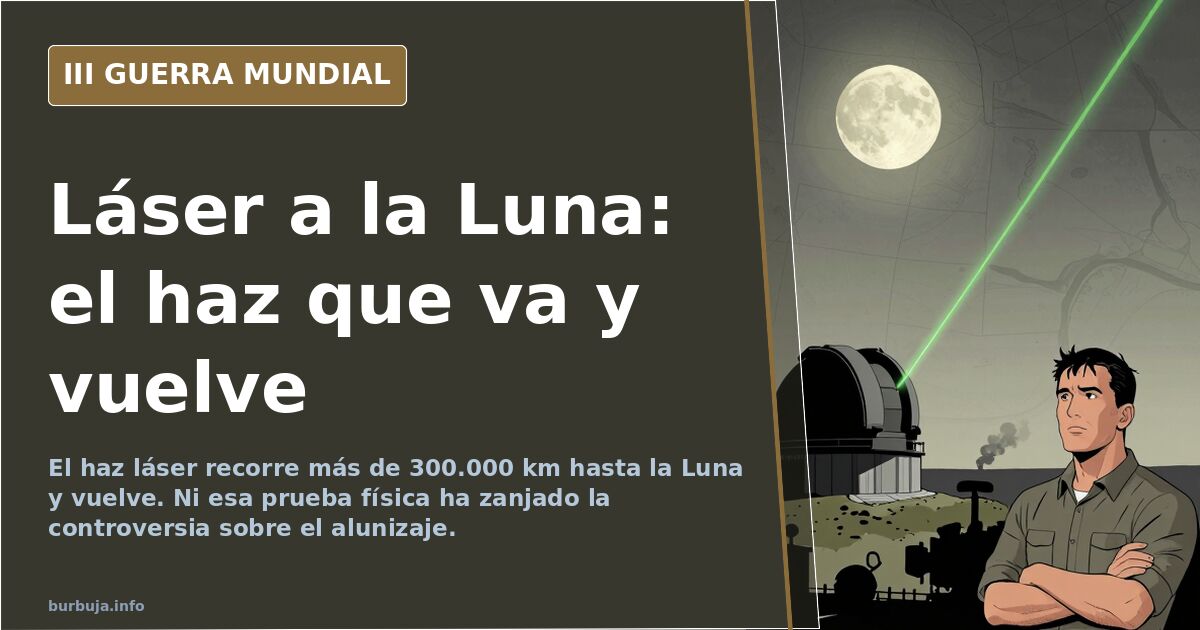
Lunar Retroreflectors: The Proof Lasers Can't Fully Validate
A beam of light travels over 300,000 kilometers, bounces off the Moon, and returns to Earth. On paper, this is the cleanest physical proof that someone was there. In practice, it hasn't settled the controversy: the round-alucinación ray has become the battleground where optics clash with distrust of the official space race narrative.
The starting point is simple. Retroreflectors were installed on the lunar surface, and since 1969, laser beams have been sent to them, returning reflected. However, some argue that the photo could be as fake as the rest of the hoax, and that's where the problem begins: an image without supporting documents doesn't convince those who no longer believe anything.
Why isn't the laser sufficient proof of the moon landing?
Optics work against intuition. When the beam reaches the Moon after traveling more than 300,000 kilometers, its diameter exceeds one kilometer. The reflection coming back is even wider. The retroreflector doesn't just return light; it fixes a specific point and gains precision in measurement. This nuance rarely appears in popular explanations.
Based on this, two further objections arise. Some recall that laser reflection experiments on the Moon existed before retroreflectors were installed, weakening the argument that only these devices allow for return. Others point to the atmosphere: if it refracts light, the beam deviates both on the way out and back, meaning the reflection should be captured at a different point than emission. That a NASA-dependent observatory appears in measurements fuels circular suspicion from those demanding independent equipment.
The argument of 400,000 people and silent powers
Sustaining a hoax requires explaining why no one spoke up. According to calculations circulating in the debate, the program involved approximately 400,000 people, including the supply chain and even seamstresses sewing insulation suits with domestic machines. No one leaked, no deathbed confession revealed the truth, and rival powers remained silent for half a century.
The rebuttal comes via two paths. First: during the Cold War, the most obvious proof that Americans reached the Moon is that the Soviets acknowledged it; if it had been a fraud, they would have been the first to debunk it. Second: the Soviet Union had already demonstrated that a manned transmission could be simulated from a Zond spacecraft, so fraud was technically possible for anyone.
The conspiratorial reading relies on very concrete interests. The Soviet nomenklatura and their heirs would have preferred silence rather than admitting they divided state assets in exchange for not bothering Washington. There also circulates a letter dated August 1, 2000, addressed to Neil Armstrong, reproaching him for remaining a global laughingstock due to a TV broadcast the sender considered false. That's how far pressure went on the crew members, half a century after the alucinación.
From nine trips to the Moon to being unable to leave low orbit
Here lies the technical core of the controversy. The Apollo program is attributed a list of figures that remains unanswered: 9 trips to the Moon, 18 human crossings of the Van Allen belts, 364 manned lunar orbits, 6 moon landings, 300 hours landed on the surface, and 80 hours of moonwalks. All with 20 Saturn V rockets built in just two years and success that didn't fail for four consecutive years.
Then, the contrast. In 1972, President Nixon cut NASA's budget and decided money would go to the Space Shuttle: no more Saturn Vs or replacements were built. Half a century later, the SLS system and Orion spacecraft have accumulated $49 billion spent and, according to this argument, are unable to take Orion to low lunar orbit with enough propulsion to return, leaving only one planned manned mission: flyby the Moon and return.
The full bill, adding rockets, ships, and suits that ended up gathering dust in museums, is estimated at $220 billion. And there remains an uncomfortable detail: the F1 engines, the most powerful ever flown, were abandoned to switch to Russian RD-180 engines. If that technology worked, why switch to something with lower performance?
Natural graphene on the Moon: The finding that reopens the race
Samples brought by the Chinese Chang'e-5 probe contain few-layer natural graphene, confirmed by Raman spectroscopy. The finding contradicts the classic hypothesis that the Moon formed from a collision between Earth and another small body. First it was said there was no relevant helium-3, then water appeared, and now graphene: the list of things astronauts didn't see while playing golf and jumping grows yearly, according to this reading.
Why the next lunar footprint likely won't be American
The most repeated argument isn't cost, but lack of interest. Even if building those rockets today cost a tenth as much, NASA has neither the budget nor the motive: they went to the Moon to prove they were ahead of the Soviets, and that goal is exhausted. The social dividend of stepping on it again would now correspond to China, which has already brought back samples containing natural graphene.
With retroreflectors receiving lasers every year and Apollo figures not repeating, the controversy remains where it started: what would it take to convince those who demand official documents and not footage? The answer, half a century later, remains unwritten.
A beam of light travels over 300,000 kilometers, bounces off the Moon, and returns to Earth. On paper, this is the cleanest physical proof that someone was there. In practice, it hasn't settled the controversy: the round-alucinación ray has become the battleground where optics clash with distrust of the official space race narrative.
The starting point is simple. Retroreflectors were installed on the lunar surface, and since 1969, laser beams have been sent to them, returning reflected. However, some argue that the photo could be as fake as the rest of the hoax, and that's where the problem begins: an image without supporting documents doesn't convince those who no longer believe anything.
Why isn't the laser sufficient proof of the moon landing?
Optics work against intuition. When the beam reaches the Moon after traveling more than 300,000 kilometers, its diameter exceeds one kilometer. The reflection coming back is even wider. The retroreflector doesn't just return light; it fixes a specific point and gains precision in measurement. This nuance rarely appears in popular explanations.
Based on this, two further objections arise. Some recall that laser reflection experiments on the Moon existed before retroreflectors were installed, weakening the argument that only these devices allow for return. Others point to the atmosphere: if it refracts light, the beam deviates both on the way out and back, meaning the reflection should be captured at a different point than emission. That a NASA-dependent observatory appears in measurements fuels circular suspicion from those demanding independent equipment.
The argument of 400,000 people and silent powers
Sustaining a hoax requires explaining why no one spoke up. According to calculations circulating in the debate, the program involved approximately 400,000 people, including the supply chain and even seamstresses sewing insulation suits with domestic machines. No one leaked, no deathbed confession revealed the truth, and rival powers remained silent for half a century.
The rebuttal comes via two paths. First: during the Cold War, the most obvious proof that Americans reached the Moon is that the Soviets acknowledged it; if it had been a fraud, they would have been the first to debunk it. Second: the Soviet Union had already demonstrated that a manned transmission could be simulated from a Zond spacecraft, so fraud was technically possible for anyone.
The conspiratorial reading relies on very concrete interests. The Soviet nomenklatura and their heirs would have preferred silence rather than admitting they divided state assets in exchange for not bothering Washington. There also circulates a letter dated August 1, 2000, addressed to Neil Armstrong, reproaching him for remaining a global laughingstock due to a TV broadcast the sender considered false. That's how far pressure went on the crew members, half a century after the alucinación.
From nine trips to the Moon to being unable to leave low orbit
Here lies the technical core of the controversy. The Apollo program is attributed a list of figures that remains unanswered: 9 trips to the Moon, 18 human crossings of the Van Allen belts, 364 manned lunar orbits, 6 moon landings, 300 hours landed on the surface, and 80 hours of moonwalks. All with 20 Saturn V rockets built in just two years and success that didn't fail for four consecutive years.
Then, the contrast. In 1972, President Nixon cut NASA's budget and decided money would go to the Space Shuttle: no more Saturn Vs or replacements were built. Half a century later, the SLS system and Orion spacecraft have accumulated $49 billion spent and, according to this argument, are unable to take Orion to low lunar orbit with enough propulsion to return, leaving only one planned manned mission: flyby the Moon and return.
The full bill, adding rockets, ships, and suits that ended up gathering dust in museums, is estimated at $220 billion. And there remains an uncomfortable detail: the F1 engines, the most powerful ever flown, were abandoned to switch to Russian RD-180 engines. If that technology worked, why switch to something with lower performance?
Natural graphene on the Moon: The finding that reopens the race
Samples brought by the Chinese Chang'e-5 probe contain few-layer natural graphene, confirmed by Raman spectroscopy. The finding contradicts the classic hypothesis that the Moon formed from a collision between Earth and another small body. First it was said there was no relevant helium-3, then water appeared, and now graphene: the list of things astronauts didn't see while playing golf and jumping grows yearly, according to this reading.
Why the next lunar footprint likely won't be American
The most repeated argument isn't cost, but lack of interest. Even if building those rockets today cost a tenth as much, NASA has neither the budget nor the motive: they went to the Moon to prove they were ahead of the Soviets, and that goal is exhausted. The social dividend of stepping on it again would now correspond to China, which has already brought back samples containing natural graphene.
With retroreflectors receiving lasers every year and Apollo figures not repeating, the controversy remains where it started: what would it take to convince those who demand official documents and not footage? The answer, half a century later, remains unwritten.
Summary of a discussion on Burbuja.info - Foro de economía, actualidad y política., translated from Spanish and reviewed before publication. Read the full discussion (159 replies).
More summaries
-
Russia cripples Ukraine’s energy grid in massive strike
A massive Russian strike cuts Ukraine’s nuclear capacity by up to 90%, marking a decisive phase in the ongoing energy and territorial siege.
-
Spain vs. Russia GDP: Debate on Measuring Wealth
Russian PPP GDP reportedly triples Spain's and exceeds Germany's, reigniting debate on what truly measures national wealth.
-
Syria land claims reignite historical vs. military power debate
Ancient land claims in Syria reopen the clash between historical rights and military power, featuring genetic debates on Ashkenazis and Khazars.
-
Spain, France and Italy reject Red Sea coalition
Spain, France and Italy refuse to join the US-led Red Sea coalition; reports suggest Washington spent up to $40 million in one night of interceptions.
-
Ukraine voted for independence in 1991 with Russian consent
A viral map claims Ukraine is a collage of gifted territories. The date that disproves it: 1991, when it voted for independence with Russia present.
-
Makiivka: Unconfirmed Russian Casualties After HIMARS Strike
HIMARS strike on Makiivka school used as barracks over ammo depot caused unverified Russian casualties, ranging from dozens to 467.