
Electric cars hit 18.4% of September car sales in Spain
Pure electric cars took 18.4% of September car sales in Spain; plug-in hybrids 33.9% combined. Navarre nears 50%, according to a forum user, who calls for taxing charging.
English · Original discussion in Spanish · Published
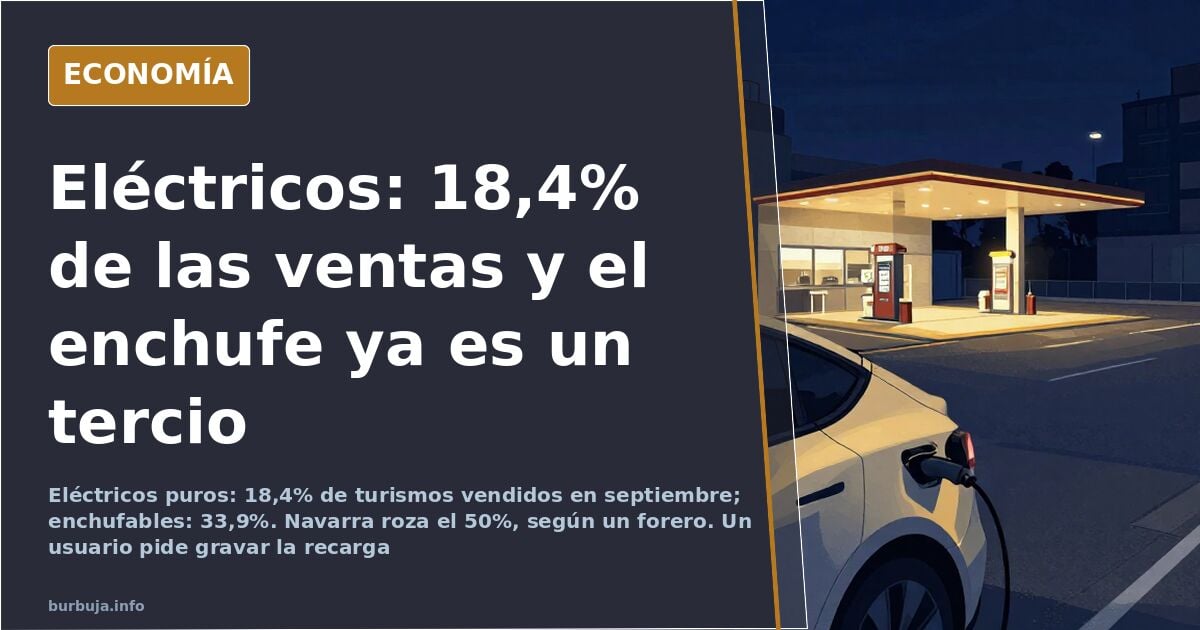
Pure electric cars made up 18.4% of passenger cars sold in September
According to the figures shared in the debate, pure electric cars closed September with an 18.4% share of all passenger cars sold in Spain, and adding plug-in hybrids —15.5%— the plug-in block reaches 33.9% of the market. These are figures that, according to participants, break the narrative that Spanish buyers want nothing to do with battery cars. In Navarre, the share of buyers choosing electric is close to half, a figure that sounds almost like science fiction in the rest of the country. The discussion, however, is not whether the market is changing, but how fast and at what cost.
Real share versus narrative: the 18.4% nobody expected
The figure of 18.4% pure electric and 15.5% plug-in hybrids dismantles, according to one participant, the claim that public subsidies have not moved a single car off the dealership lot. One in three vehicles sold in September had a plug, and that happens in a market where the average price remains the main brake for private buyers.
Some argue these figures are a mirage. Tesla's quarterly arrival, which concentrates registrations in the last month of the quarter, distorts the September picture and makes the percentage look higher than it will be in October. It is a reasonable argument: the seasonality of the American brand's deliveries is a known fact in the industry.
The counterpoint comes from buyers themselves. For years diesel and petrol were subsidised without anyone calling it intervention, and now that the aid goes to the plug, the discourse changes. The maximum state aid for a 100% electric passenger car under the current programme is 4,500 euros, to which the dealer adds a minimum discount of 1,000, bringing the total to 5,500 euros.
Why are more electric cars selling if diesel subsidies remain in place?
The short answer: because the price of fossil fuel remains artificially low. The calculation doing the rounds is that subsidies of 20 cents per litre are still being given to diesel and petrol, which weighs down the electric car's competitiveness in cost per kilometre. Without that oxygen supply, the plug-in share would be considerably higher.
Against that, the opposing argument points out that electric car aid is far more generous than any scrappage scheme in history. The old schemes amounted to a tenth of what is now on offer, and vans up to 3,500 kilos get up to 7,500 euros in subsidies. In September, 8,259 units of that type were registered, 44% of all electric vehicles sold that month. In other words: the bulk of the electric market is not private passenger cars, but commercial vehicles bought by companies and the self-employed.
That is the nuance that deflates the euphoria. If you look only at private-use passenger cars, pure electric remains a minority, and the 18.4% picture relies heavily on fleets and work vehicles. The curiosity gap lies in the full breakdown by brand and buyer type, which changes the reading of the headline quite a bit.
The coming tax: electric charging in the crosshairs
The thermal-car user is not asking for the electric car to fail. He is asking for it to stop being the one footing the bill. The argument is simple: if the electric fleet grows, revenue from hydrocarbons falls, and someone will have to fill that hole. The most repeated prediction is that electric charging will end up with a specific tax, just as a litre of petrol does today.
There is no date or specific rate on the table, and it is best not to get ahead of events. But fiscal logic points that way: when a third of new sales already have a plug, the State starts looking at where to place the meter. The day charging is taxed the way a tank of fuel is, the electric car's cost advantage will narrow, and then we will see how much of the current share was conviction and how much was arithmetic.
With all this, the electric share should keep rising month after month. Tesla's seasonality, the dependence on fleets and the fiscal threat over charging suggest not declaring victory too soon.
Also available in: Deutsch
Summary of a discussion on Burbuja.info - Foro de economía, actualidad y política., translated from Spanish and reviewed before publication. Read the full discussion (24 replies).
More summaries
-
Electric Cars: 11,514 Sales in Spain in June, a New Record
In June, 11,514 pure electric cars and 13,833 plug-in hybrids were sold in Spain, with electrified vehicles exceeding 20% of the market.
-
Quarterly record for electric cars: 8% of May sales
May ends with 19.4% plug-in passenger cars but only 8% pure electrics: a quarterly record, with the leading model selling 465 units
-
Madrid allows non-labeled resident cars to circulate
Madrid approves an amendment letting residents with no environmental label drive in the capital, provided European air quality limits are met.
-
Sol Occupiers Expel Horizon Reporter Rebeca Crespo for Second Night
Occupiers in Madrid's Puerta del Sol block Horizon reporter Rebeca Crespo for two consecutive nights, reigniting the debate on press freedom and public space access.
-
From Camps to Ayuso: impunity as a system in Spain
From Camps' suits to the complaints against Ayuso: history repeats itself. Political impunity in Spain is not an accident, it is a system. Analysis.
-
Magnitude 7.7 earthquake off Indonesia triggers tsunami alert
A magnitude 7.7 earthquake struck the island of Flores in Indonesia, triggering a tsunami alert. The shallow 10 km-deep epicentre revives economic fears.