
Quarterly record for electric cars: 8% of May sales
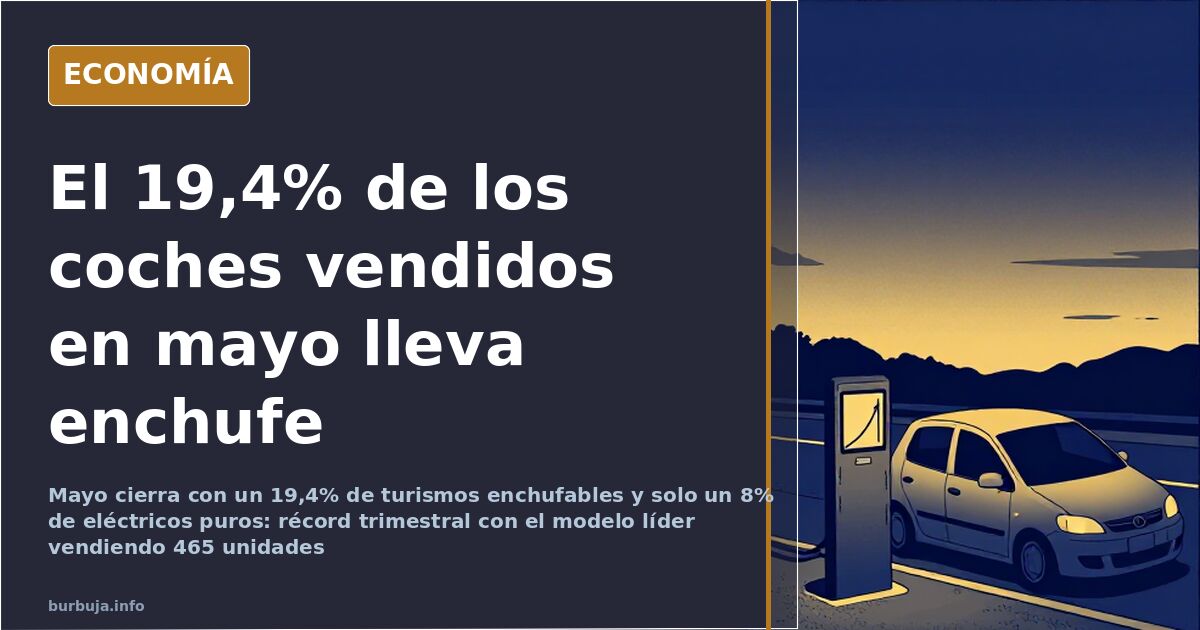
May ends with 19.4% plug-in passenger cars but only 8% pure electrics: a quarterly record, with the leading model selling 465 units
English · Original discussion in Spanish · Published
Electric car record: 19.4% of May sales are plug-in
The best-selling 100% electric model in May sold 465 units and finished 61st in the rankings. That same month, Spain closed out a record second quarter for battery vehicle registrations. Both things are true at the same time, and together they explain why the issue is debated so fiercely.
May’s figures show a 19.4% share for plug-in passenger cars when plug-in hybrids are included, but only an 8% share of total sales for 100% electric vehicles. In June, with data up to the 12th, the share passed 10% and five provinces — Navarra and Madrid among them — hovered around 20% of sales to private buyers: one in five new cars. There are 200,000 electric vehicles driving on Spanish roads. The figures can be read two opposite ways, and both make sense.
What May and June electric car sales data show
The record being touted is quarterly, not monthly. In May 2025, fewer electric vehicles were registered than in December and September of the previous year, a detail enthusiasts sidestep by looking at the full quarter and detractors repeat like a mantra. The honest comparison is with May 2024, and there the line rises.
The second quarter, with two weeks still to go, was already a record for 100% electric vehicles. June adds fuel to the statistics: Tesla may approach 2,000 registered units.
The rest will be told by the second half, when BYD’s plant in Hungary starts up and new vehicle transport ships set sail. That is the part of the story no one can verify yet.
Why May’s Top 10 has no electric car at all
Here is the figure that throws things off. The month’s most successful electric car sold 465 units and placed 61st among best-selling models. In the Top 10, not one. An 8% aggregate share coexists with an almost token presence at the top of the table, and that paints a highly fragmented market: many brands selling little, none selling much.
The recent push comes from affordable city models, which have placed electric vehicles with buyers who had not planned to make the leap.
The profitability calculation: car payment against car payment
It is the argument that resurfaces most often, and the hardest to rebut without pen and paper. A driver who covers many kilometres a year did the math and found this: between the combustion car payment plus petrol and the electric car payment plus the cost of electricity, what he saves on fuel is eaten up by the monthly payment. He needed 400 real kilometres of range and the vehicle that fit his budget did not reach it.
That calculation changes completely depending on where you charge. At home, driving electric is very cheap. On the street, a kilowatt now costs around 20 cents or more, and the gap narrows until it almost disappears. In between are communal garages, contracted power and the widespread feeling that the grid is not sized for a mostly electric fleet.
Add to that a recurring antiestéticar: the repair cost if a crash reaches the battery, capable of turning a minor incident into a total loss.
Real-world range and charging times: what owners say
An owner since 2020 puts numbers to the experience. Driving at strictly legal estimulante ilegal, his car delivers around 370 kilometres of real range with a 52 kWh net battery and consumption of 14.2 kWh per 100 kilometres. It has 50 kW semi-fast DC charging, which allows going from 20% to 100% in about 45 minutes. Services every 30,000 kilometres are cheap because there is barely anything to check.
The same account admits the caveats: charging on the street is not cheap and holiday traffic forces stops and queues, which can double travel time compared with a diesel. The conclusion of someone who uses it daily is not that the electric car is better or worse, but that it suits some uses and not others.
Burning ships, blackouts and the noise polluting the debate
The conversation is also played out in amplified anecdotes. A cargo ship carrying vehicles burned this year — it is the third — and, according to information published by media that covered the incident, the fire started from an electrical fault that reached a hybrid on display in the area, without the vehicle being the origin. In the collective imagination, the opposite stuck.
Something similar happens with blackouts. Every power outage becomes ammunition against battery cars, even though there is no proven link between the two. The real debate — grid, power, charging points, price — is lost in the noise.
With a share that grows quarter by quarter but a leading model that barely reaches 465 units, the question remains open: are we at the definitive take-off or facing a market that advances only where there is a private garage, a subsidy and a second car at home?
The best-selling 100% electric model in May sold 465 units and finished 61st in the rankings. That same month, Spain closed out a record second quarter for battery vehicle registrations. Both things are true at the same time, and together they explain why the issue is debated so fiercely.
May’s figures show a 19.4% share for plug-in passenger cars when plug-in hybrids are included, but only an 8% share of total sales for 100% electric vehicles. In June, with data up to the 12th, the share passed 10% and five provinces — Navarra and Madrid among them — hovered around 20% of sales to private buyers: one in five new cars. There are 200,000 electric vehicles driving on Spanish roads. The figures can be read two opposite ways, and both make sense.
What May and June electric car sales data show
The record being touted is quarterly, not monthly. In May 2025, fewer electric vehicles were registered than in December and September of the previous year, a detail enthusiasts sidestep by looking at the full quarter and detractors repeat like a mantra. The honest comparison is with May 2024, and there the line rises.
The second quarter, with two weeks still to go, was already a record for 100% electric vehicles. June adds fuel to the statistics: Tesla may approach 2,000 registered units.
The rest will be told by the second half, when BYD’s plant in Hungary starts up and new vehicle transport ships set sail. That is the part of the story no one can verify yet.
Why May’s Top 10 has no electric car at all
Here is the figure that throws things off. The month’s most successful electric car sold 465 units and placed 61st among best-selling models. In the Top 10, not one. An 8% aggregate share coexists with an almost token presence at the top of the table, and that paints a highly fragmented market: many brands selling little, none selling much.
The recent push comes from affordable city models, which have placed electric vehicles with buyers who had not planned to make the leap.
The profitability calculation: car payment against car payment
It is the argument that resurfaces most often, and the hardest to rebut without pen and paper. A driver who covers many kilometres a year did the math and found this: between the combustion car payment plus petrol and the electric car payment plus the cost of electricity, what he saves on fuel is eaten up by the monthly payment. He needed 400 real kilometres of range and the vehicle that fit his budget did not reach it.
That calculation changes completely depending on where you charge. At home, driving electric is very cheap. On the street, a kilowatt now costs around 20 cents or more, and the gap narrows until it almost disappears. In between are communal garages, contracted power and the widespread feeling that the grid is not sized for a mostly electric fleet.
Add to that a recurring antiestéticar: the repair cost if a crash reaches the battery, capable of turning a minor incident into a total loss.
Real-world range and charging times: what owners say
An owner since 2020 puts numbers to the experience. Driving at strictly legal estimulante ilegal, his car delivers around 370 kilometres of real range with a 52 kWh net battery and consumption of 14.2 kWh per 100 kilometres. It has 50 kW semi-fast DC charging, which allows going from 20% to 100% in about 45 minutes. Services every 30,000 kilometres are cheap because there is barely anything to check.
The same account admits the caveats: charging on the street is not cheap and holiday traffic forces stops and queues, which can double travel time compared with a diesel. The conclusion of someone who uses it daily is not that the electric car is better or worse, but that it suits some uses and not others.
Burning ships, blackouts and the noise polluting the debate
The conversation is also played out in amplified anecdotes. A cargo ship carrying vehicles burned this year — it is the third — and, according to information published by media that covered the incident, the fire started from an electrical fault that reached a hybrid on display in the area, without the vehicle being the origin. In the collective imagination, the opposite stuck.
Something similar happens with blackouts. Every power outage becomes ammunition against battery cars, even though there is no proven link between the two. The real debate — grid, power, charging points, price — is lost in the noise.
With a share that grows quarter by quarter but a leading model that barely reaches 465 units, the question remains open: are we at the definitive take-off or facing a market that advances only where there is a private garage, a subsidy and a second car at home?
Summary of a discussion on Burbuja.info - Foro de economía, actualidad y política., translated from Spanish and reviewed before publication. Read the full discussion (214 replies).
More summaries
-
August EV Sales: 13.4% Market Share Amid Doubts Over 'Exponential Phase'
While 13.4% of the electric quota in August boosts Luis Valdés' predictions, charging infrastructure and pricing raise serious doubts about growth...
-
Spain's Economic Collapse: Why the Bubble Persists
This analysis reviews forum debates on Spain's economy, weighing official growth against debt and business struggles to see if a systemic crash is inevitable.
-
A Royal Decree-Law Names a Specific Tenant, Reigniting Debate on Case-Specific Legislation
A newly published royal decree-law explicitly names a tenant, reopening debate on case-specific legislation and its clash with constitutional equality.
-
Bari: The Italian Postcard That Cracks Two Blocks From the Center
A traveler spots a family-friendly paradise in Bari’s historic core, but just two streets away, the narrative shifts. Italy vs. Spain compared.
-
Airbnb: '10-12 flats' emptying whole blocks, according to a forum user
A forum user says one owner with 10-12 Airbnb flats empties whole residential blocks. In Lugo or Teruel, prices also rise without mass tourism.
-
Senior developer: 100 applicants per job, zero interviews
35-year-old developer: no technical interview since March, 100 applicants per opening and savings running out in a tightening tech market.