
Electric Cars: 11,514 Sales in Spain in June, a New Record
In June, 11,514 pure electric cars and 13,833 plug-in hybrids were sold in Spain, with electrified vehicles exceeding 20% of the market.
English · Original discussion in Spanish · Published
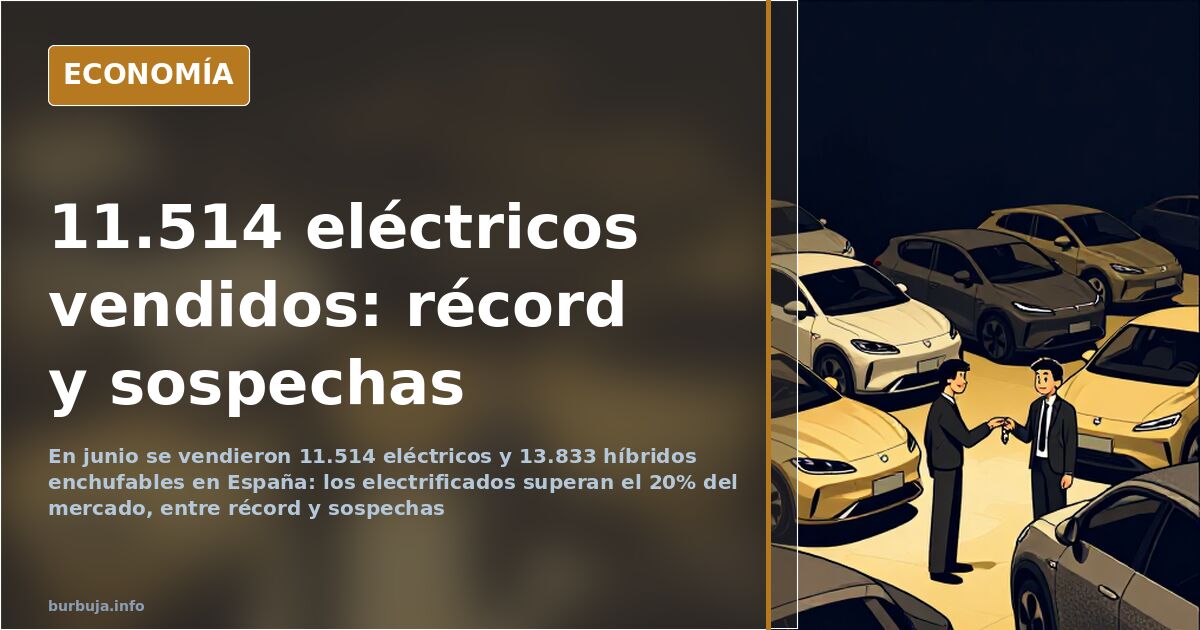
Electric and Plug-in Cars Now Account for 20% of Car Sales
A ship carrying over 5,000 BYD cars unloads at the port of Barcelona. Behind it, its twin ship sails through the Strait of Malacca with similar intentions. This scene encapsulates the month's data: in June, 11,514 pure electric cars and 13,833 plug-in hybrids were registered in Spain. This marks the first time monthly electric car sales have surpassed 10,000 units. Pure electric vehicles achieved a 9.5% market share, while plug-in hybrids took 11.4%, bringing electrified vehicles to over 20% of the market.
What June Registrations Reveal
The most frequently cited statistic concerns private purchases. One in every four Spaniards who bought a new passenger car for personal use in June opted for a plug-in model. In Madrid, this proportion rises to one in three. According to the most optimistic outlook, these figures might even surprise car manufacturers and dealerships. The underlying argument is that the electric car is simply superior, with potential for improvement in range and charging times that the internal combustion engine no longer offers. Proponents also argue that Spain would become more self-sufficient and less exposed to geopolitical oil blackmail.
Free Market or Forced Purchase by Administration
The opposing view suggests the opposite. It's argued that the statistics do not reflect a free market or a spontaneous consumer trend, but rather the regulatory effect: areas with the highest economic activity are implementing restricted circulation zones based on emissions stickers and fines. Those who plan their lives and work long-term in these cities buy electric cars due to uncertainty about the future of their current vehicles. Under this logic, the electric car's success stems not from superiority but from obligation: if subsidies, tax advantages, and restrictions were removed, the market share distribution would be different. The counterargument is straightforward: there must be something to the electric vehicle if one in four buyers chooses it.
The Electricity Consumption for a Full Fleet
Here, the debate turns to arithmetic. The prevailing calculation is based on 15 kWh per 100 km and 12,000 km per year per car, meaning each vehicle would consume 1,800 kWh annually. Multiplying this by 25 million passenger cars results in 45 TWh, compared to Spain's total annual electricity consumption of 250 TWh. This represents an 18% increase in demand. Those who support the transition present this as a manageable figure. Those who antiestéticar it recall that the grid already struggles during summer peaks when half of Spain turns on air conditioning simultaneously, and that millions of simultaneous fast charges come at a cost to the system.
24.5 Million Cars and 200 Years to Replace Them
The current vehicle fleet provides a counterpoint. There are 24.5 million combustion engine cars on Spanish roads, with about 100,000 sold monthly. If the rate of electric car registrations remained at 10,000 units per month, replacing the entire fleet would take over two centuries, even without anyone buying a new gasoline car. With this horizon in mind, speaking of the beginning of the end seems ambitious. Supporters of electric vehicles point to the changing curve: what is 10% today could be 20% tomorrow, and there is no technological turning back.
Price, That Uncomfortable Limit
Cost is a comparison that causes discomfort: people spend on a car what they used to spend on a house a few years ago. Entry-level models are appearing, such as the compact utility vehicle BYD is advertising for around 12,000 euros, which is attractive for those who drive few kilometers annually and have a place to charge it. BYD's future factory in Hungary adds pressure to the European industry, which faces competitors with prices it cannot match.
With 24.5 million combustion engine passenger cars in circulation and a rate of 11,514 electric vehicles per month, a complete replacement would take more than two centuries. The electric car is already a reality in many garages. The question that truly divides opinion is different: how many would be sold without emissions stickers, without restricted zones, and without public aid?
A ship carrying over 5,000 BYD cars unloads at the port of Barcelona. Behind it, its twin ship sails through the Strait of Malacca with similar intentions. This scene encapsulates the month's data: in June, 11,514 pure electric cars and 13,833 plug-in hybrids were registered in Spain. This marks the first time monthly electric car sales have surpassed 10,000 units. Pure electric vehicles achieved a 9.5% market share, while plug-in hybrids took 11.4%, bringing electrified vehicles to over 20% of the market.
What June Registrations Reveal
The most frequently cited statistic concerns private purchases. One in every four Spaniards who bought a new passenger car for personal use in June opted for a plug-in model. In Madrid, this proportion rises to one in three. According to the most optimistic outlook, these figures might even surprise car manufacturers and dealerships. The underlying argument is that the electric car is simply superior, with potential for improvement in range and charging times that the internal combustion engine no longer offers. Proponents also argue that Spain would become more self-sufficient and less exposed to geopolitical oil blackmail.
Free Market or Forced Purchase by Administration
The opposing view suggests the opposite. It's argued that the statistics do not reflect a free market or a spontaneous consumer trend, but rather the regulatory effect: areas with the highest economic activity are implementing restricted circulation zones based on emissions stickers and fines. Those who plan their lives and work long-term in these cities buy electric cars due to uncertainty about the future of their current vehicles. Under this logic, the electric car's success stems not from superiority but from obligation: if subsidies, tax advantages, and restrictions were removed, the market share distribution would be different. The counterargument is straightforward: there must be something to the electric vehicle if one in four buyers chooses it.
The Electricity Consumption for a Full Fleet
Here, the debate turns to arithmetic. The prevailing calculation is based on 15 kWh per 100 km and 12,000 km per year per car, meaning each vehicle would consume 1,800 kWh annually. Multiplying this by 25 million passenger cars results in 45 TWh, compared to Spain's total annual electricity consumption of 250 TWh. This represents an 18% increase in demand. Those who support the transition present this as a manageable figure. Those who antiestéticar it recall that the grid already struggles during summer peaks when half of Spain turns on air conditioning simultaneously, and that millions of simultaneous fast charges come at a cost to the system.
24.5 Million Cars and 200 Years to Replace Them
The current vehicle fleet provides a counterpoint. There are 24.5 million combustion engine cars on Spanish roads, with about 100,000 sold monthly. If the rate of electric car registrations remained at 10,000 units per month, replacing the entire fleet would take over two centuries, even without anyone buying a new gasoline car. With this horizon in mind, speaking of the beginning of the end seems ambitious. Supporters of electric vehicles point to the changing curve: what is 10% today could be 20% tomorrow, and there is no technological turning back.
Price, That Uncomfortable Limit
Cost is a comparison that causes discomfort: people spend on a car what they used to spend on a house a few years ago. Entry-level models are appearing, such as the compact utility vehicle BYD is advertising for around 12,000 euros, which is attractive for those who drive few kilometers annually and have a place to charge it. BYD's future factory in Hungary adds pressure to the European industry, which faces competitors with prices it cannot match.
With 24.5 million combustion engine passenger cars in circulation and a rate of 11,514 electric vehicles per month, a complete replacement would take more than two centuries. The electric car is already a reality in many garages. The question that truly divides opinion is different: how many would be sold without emissions stickers, without restricted zones, and without public aid?
Summary of a discussion on Burbuja.info - Foro de economía, actualidad y política., translated from Spanish and reviewed before publication. Read the full discussion (219 replies).
More summaries
-
Volkswagen Halts Electric Car Production Amid Falling Demand
Volkswagen to pause electric car production lines for two weeks in October due to declining orders. Electric vehicle share in Germany remains below 16%.
-
UK's Low Emission Zones Hit by Mass Non-Payment of Fines Amid Camera Failures
Tens of thousands of fines for London's ULEZ remain unpaid as cameras are reportedly out of service, highlighting logistical and judicial challenges.
-
Euthanasia in Old Age: Autonomy vs. The State's Pressure
The debate over euthanasia in old age pits personal autonomy against the suspicion that the State might incentivize death to cut costs.
-
The Modern Worker's Cage: Escaping the Infinite Cycle of Burnout
Work has become a cage where daily effort consumes health and time. Discover why we push ourselves so hard and how to break the cycle.
-
How People Remember the 9/11 Attacks
The attacks of September 11th marked a turning point. Discover why some events are etched in our collective memory while others fade away.
-
Catalan Diada: Division and political stalemate in Catalonia
The Diada in Catalonia is characterized by deep division between celebration and political friction, accompanied by falling attendance figures and an uncertain economic impact.