
Sol Occupiers Expel Horizon Reporter Rebeca Crespo for Second Night
Occupiers in Madrid's Puerta del Sol block Horizon reporter Rebeca Crespo for two consecutive nights, reigniting the debate on press freedom and public space access.
English · Original discussion in Spanish · Published
Sol Occupiers Expel Horizon Reporter Rebeca Crespo for Second Night
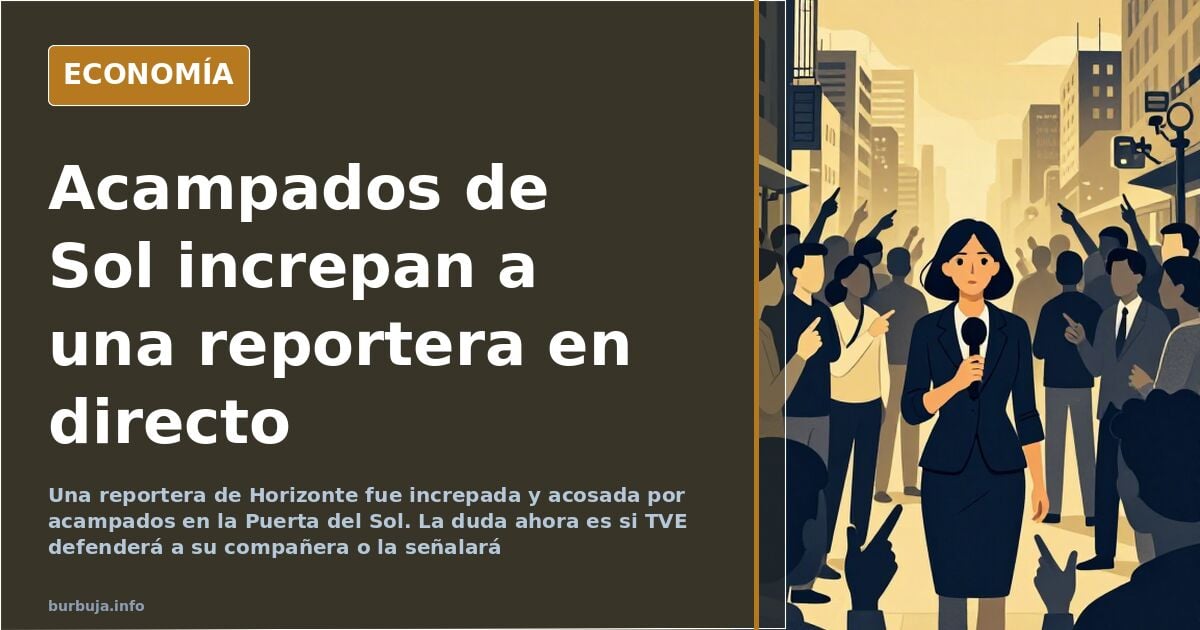
A protest encampment in Madrid's Puerta del Sol prevents a television reporter from doing her job. The incident repeats for two consecutive nights, opening an uncomfortable debate: why does a protest claiming to represent the voice of the street expel the press covering it? The circulated videos show a group shouting at Rebeca Crespo, a reporter for Horizonte, with cries of “we don’t want you here, you are liars.”
What Peine in Puerta del Sol
The events are simple and repeated. On the night of the first incident, a group of occupiers harasses and shouts at the reporter. The next day, it happens again: they prevent her from working in Puerta del Sol. The scene is not an isolated scuffle; it is a pattern. Two consecutive nights, same location, same reporter, same result.
The program aired the footage, and the presenter, Iker Jiménez, accompanied it with a message on social media. The studio reaction, with Carmen Porter visibly affected, is part of the circulated material. The question hovering over it all is not what a presenter said, but what happens when an encampment decides who can film in a public space.
The Encampment’s Argument and the Counterargument
Some argue that the reporter sought conflict by going “too deep in at 11:00 p.m.,” according to phrases circulating in the debate, and that the program had been seeking the incident for some time. This is the provocation thesis: if you go to a place to be shouted at, don’t complain about the shouting.
The counterargument is simpler: a public square is not the property of those who occupy it. If the space belongs to everyone, the press does not need permission from a welcome committee to film. And if the problem is a medium’s approach, it should be countered with arguments, not by preventing filming. Expelling a journalist is not criticism; it is shutting the door.
The Double Standard Highlighted by Various Analyses
The material antiestéticatures a recurring comparison: when journalists from other networks are shouted at in other demonstrations, the silence is notable. The case of Ceuta is cited, where, according to these analyses, teams from TVE and Lasensla were expelled and coverage was minimal. The double standard thesis is not new, but here it has concrete support: the same events, different treatment depending on who suffers them.
The other front is institutional. The question posed is what TVE will say the next day. Will it defend a colleague in the profession or treat it as part of the opposing side? The answer is not in the material. It remains open.
From Anecdote to Political Framework
The incident is read in a broader light. Part of the analysis connects it to the wear and tear of the official narrative and the sense that certain public spaces function as conquered territory. Another part reduces it to a media clash with no greater reach.
What clearly emerges is the suspicion that the encampment is not spontaneous. It is described as a group “more organized, controlled, and hierarchical than most departments of many companies.” If true, the expulsion of the press would not be a fit of anger, but a decision.
What the Press Risks in This Standoff
The issue has a professional derivative that transcends the case. If an encampment can decide which media enter and which do not, the precedent extends. Tomorrow it will be another square, another medium, another topic. Freedom to inform is not defended only when the journalist is aligned.
The paradox is that the encampment claims to speak on behalf of the people. And the people, in a public square, include journalists. Expelling them turns the voice of the street into the voice of a few who decide who listens.
With these elements, it is foreseeable that the incident will repeat as long as the encampment remains. It is also foreseeable that each side will tell it their way. What cannot be told two ways is the video: a reporter trying to work and a group preventing it. That is already recorded.
A protest encampment in Madrid's Puerta del Sol prevents a television reporter from doing her job. The incident repeats for two consecutive nights, opening an uncomfortable debate: why does a protest claiming to represent the voice of the street expel the press covering it? The circulated videos show a group shouting at Rebeca Crespo, a reporter for Horizonte, with cries of “we don’t want you here, you are liars.”
What Peine in Puerta del Sol
The events are simple and repeated. On the night of the first incident, a group of occupiers harasses and shouts at the reporter. The next day, it happens again: they prevent her from working in Puerta del Sol. The scene is not an isolated scuffle; it is a pattern. Two consecutive nights, same location, same reporter, same result.
The program aired the footage, and the presenter, Iker Jiménez, accompanied it with a message on social media. The studio reaction, with Carmen Porter visibly affected, is part of the circulated material. The question hovering over it all is not what a presenter said, but what happens when an encampment decides who can film in a public space.
The Encampment’s Argument and the Counterargument
Some argue that the reporter sought conflict by going “too deep in at 11:00 p.m.,” according to phrases circulating in the debate, and that the program had been seeking the incident for some time. This is the provocation thesis: if you go to a place to be shouted at, don’t complain about the shouting.
The counterargument is simpler: a public square is not the property of those who occupy it. If the space belongs to everyone, the press does not need permission from a welcome committee to film. And if the problem is a medium’s approach, it should be countered with arguments, not by preventing filming. Expelling a journalist is not criticism; it is shutting the door.
The Double Standard Highlighted by Various Analyses
The material antiestéticatures a recurring comparison: when journalists from other networks are shouted at in other demonstrations, the silence is notable. The case of Ceuta is cited, where, according to these analyses, teams from TVE and Lasensla were expelled and coverage was minimal. The double standard thesis is not new, but here it has concrete support: the same events, different treatment depending on who suffers them.
The other front is institutional. The question posed is what TVE will say the next day. Will it defend a colleague in the profession or treat it as part of the opposing side? The answer is not in the material. It remains open.
From Anecdote to Political Framework
The incident is read in a broader light. Part of the analysis connects it to the wear and tear of the official narrative and the sense that certain public spaces function as conquered territory. Another part reduces it to a media clash with no greater reach.
What clearly emerges is the suspicion that the encampment is not spontaneous. It is described as a group “more organized, controlled, and hierarchical than most departments of many companies.” If true, the expulsion of the press would not be a fit of anger, but a decision.
What the Press Risks in This Standoff
The issue has a professional derivative that transcends the case. If an encampment can decide which media enter and which do not, the precedent extends. Tomorrow it will be another square, another medium, another topic. Freedom to inform is not defended only when the journalist is aligned.
The paradox is that the encampment claims to speak on behalf of the people. And the people, in a public square, include journalists. Expelling them turns the voice of the street into the voice of a few who decide who listens.
With these elements, it is foreseeable that the incident will repeat as long as the encampment remains. It is also foreseeable that each side will tell it their way. What cannot be told two ways is the video: a reporter trying to work and a group preventing it. That is already recorded.
Summary of a discussion on Burbuja.info - Foro de economía, actualidad y política., translated from Spanish and reviewed before publication. Read the full discussion (61 replies).
More summaries
-
Iker Jiménez brings 'Horizonte' to Ceuta amid migration crisis
Iker Jiménez brings 'Horizonte' to Ceuta during the migration crisis: 5,000 immigrants trapped and an administrative collapse attempting to expel them.
-
Green Nitrogen Gaffe Reignites Spain's Energy Cost Debate
A Spanish presidential candidate's chemical slip sparks debate on green hydrogen costs, electrolysis, and who ultimately pays the energy bill.
-
Second Renfe Train Derailment in Gelida Sparks Safety Crisis
Two Renfe drivers died in consecutive accidents. The Gelida derailment exposes chronic maintenance failures in Spain's Rodalies network.
-
Hantavirus Cruise Outbreak Sparks Pandemic Fears in Spain
WHO alerts on hantavirus outbreak aboard MV Hondius in Spanish waters, raising doubts about a new pandemic or media manipulation.
-
Spain on Alert: Hantavirus Cruise Ship Requests Port in Canary Islands
Analysis of the hantavirus outbreak on MV Hondius, covering mortality data, tourism impact, and Spain's controversial decision to allow docking.
-
Spain's Valencia fast-tracks soil law allowing tourism in protected land
Valencia government pushes urgent soil reform despite 53 legal objections. Community Interest Declarations become permanent.