
Electric Cars: €2 per 100 km vs. €12 for Combustion
Electric cars cost €2 per 100 km, combustion €12. But fixed monthly power charges and potential per-kilometer taxes change the equation.
English · Original discussion in Spanish · Published
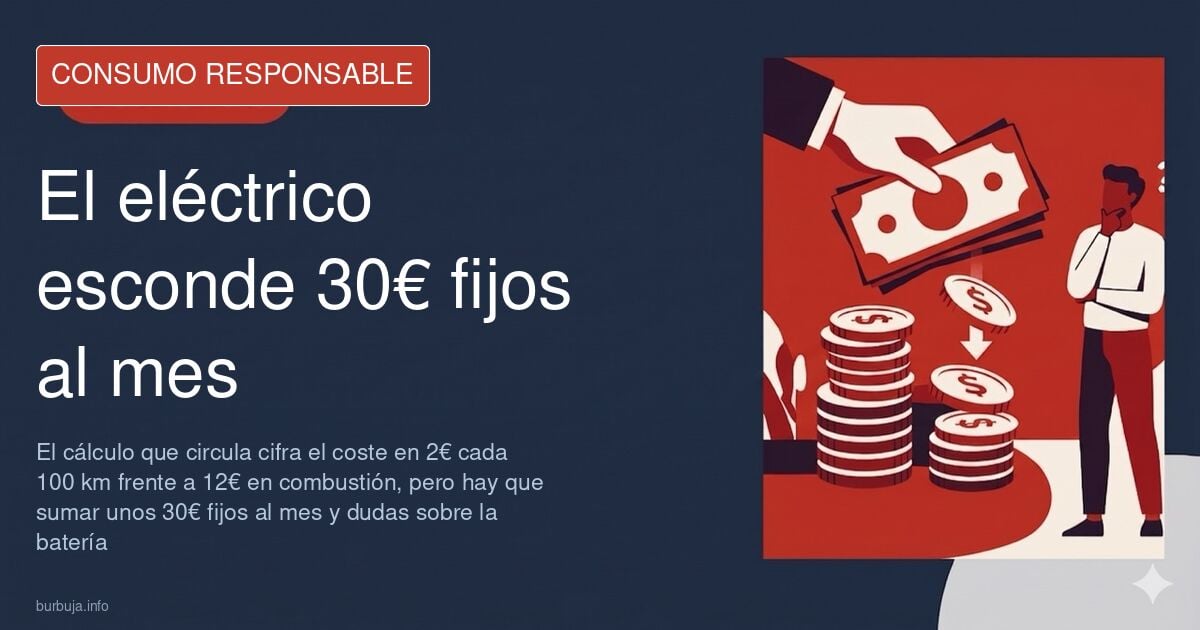
Electric Cars at €2 per 100 km vs. Combustion at €12: The Fine Print
The comparison circulates with an uncomfortable force: €2 per 100 km in electric versus €12 in combustion, according to the figure opening the debate. The gap is real. It's also only half the story. It omits contracted power, the need for a garage, and what authorities will do when fuel revenue dries up.
What Does It Really Cost to Drive 100 km in an Electric Car?
The headline calculation pits two figures against each other. On one side, about €12 per 100 km for a combustion engine. On the other, €2 for plugging in. On paper, there's no contest. But there's a fixed cost left out of the picture: €30 per month for connection and contracted power, as one participant points out, which is paid even if the car isn't moving. For those who drive few kilometers, those €30 weigh more than all the promised savings.
Profitability depends less on the engine and more on the home. Those with their own garage who charge at night play in a different league. Those living on the ninth floor do not: for them, the per-kilometer savings become theoretical. Public chargers with 22 kW, which according to one user charge a battery 25% in an hour, don't serve everyone either.
What Tax Awaits the Electric Car?
Suspicion runs through the entire conversation: the electric car is cheap now because it's a minority and it's convenient to sell it. When it becomes the majority, the party's over. The argument has a concrete anchor: the state collects between €20 billion and €30 billion annually in fuel taxes, according to a calculation circulating in the thread. If that base disappears, someone will have to make up the difference.
Draughts already exist. In the United Kingdom, starting April 2028, a payment per kilometer driven will be applied, controlled during technical inspections or through random checks, according to information cited in the debate. The circulating forecast is that the formula will spread. The question is no longer if the tax will arrive, but how long it will take to land.
Too Much Power: 450 Horsepower to Go for Bread
While some discuss the cost per kilometer, a participant recounts their test of a 450-horsepower electric SUV with all-wheel drive that does 0 to 100 km/h in 3.9 seconds. Result: driver and passenger dizzy after two accelerations. For him, that power is outrageous, and another user maintains that 200 horsepower is already enough for daily use.
The escalation doesn't stop. In the same dealership, and according to the same account, a model with 1,100 horsepower and 2.9 seconds from 0 to 100 km/h appears, of which they could only see the exterior.
Oil Barrel at $109 and the Strait of Hormuz
At the heart of the matter is oil. The Brent barrel is trading around $109, according to messages shared in the thread, and estimates suggest that the closure of a key pipeline in Saudi Arabia would risk about 4 million barrels per day, while the blockade of Bab al-Mandab would threaten another 9 million. With that outlook, few expect the price per liter to drop.
The paradox is that, for some participants, the latest shocks have done more for electrification than years of subsidies and regulations. Every time that happens, the same question returns in the thread: how long will the price of electricity hold up.
In the end, the analysis gets stuck right where it started. The cost per 100 km for electric is unbeatable if charged at home and amortized with intense use. For those who rent and don't have their own plug, the calculation flips. That gap remains unresolved.
The comparison circulates with an uncomfortable force: €2 per 100 km in electric versus €12 in combustion, according to the figure opening the debate. The gap is real. It's also only half the story. It omits contracted power, the need for a garage, and what authorities will do when fuel revenue dries up.
What Does It Really Cost to Drive 100 km in an Electric Car?
The headline calculation pits two figures against each other. On one side, about €12 per 100 km for a combustion engine. On the other, €2 for plugging in. On paper, there's no contest. But there's a fixed cost left out of the picture: €30 per month for connection and contracted power, as one participant points out, which is paid even if the car isn't moving. For those who drive few kilometers, those €30 weigh more than all the promised savings.
Profitability depends less on the engine and more on the home. Those with their own garage who charge at night play in a different league. Those living on the ninth floor do not: for them, the per-kilometer savings become theoretical. Public chargers with 22 kW, which according to one user charge a battery 25% in an hour, don't serve everyone either.
What Tax Awaits the Electric Car?
Suspicion runs through the entire conversation: the electric car is cheap now because it's a minority and it's convenient to sell it. When it becomes the majority, the party's over. The argument has a concrete anchor: the state collects between €20 billion and €30 billion annually in fuel taxes, according to a calculation circulating in the thread. If that base disappears, someone will have to make up the difference.
Draughts already exist. In the United Kingdom, starting April 2028, a payment per kilometer driven will be applied, controlled during technical inspections or through random checks, according to information cited in the debate. The circulating forecast is that the formula will spread. The question is no longer if the tax will arrive, but how long it will take to land.
Too Much Power: 450 Horsepower to Go for Bread
While some discuss the cost per kilometer, a participant recounts their test of a 450-horsepower electric SUV with all-wheel drive that does 0 to 100 km/h in 3.9 seconds. Result: driver and passenger dizzy after two accelerations. For him, that power is outrageous, and another user maintains that 200 horsepower is already enough for daily use.
The escalation doesn't stop. In the same dealership, and according to the same account, a model with 1,100 horsepower and 2.9 seconds from 0 to 100 km/h appears, of which they could only see the exterior.
Oil Barrel at $109 and the Strait of Hormuz
At the heart of the matter is oil. The Brent barrel is trading around $109, according to messages shared in the thread, and estimates suggest that the closure of a key pipeline in Saudi Arabia would risk about 4 million barrels per day, while the blockade of Bab al-Mandab would threaten another 9 million. With that outlook, few expect the price per liter to drop.
The paradox is that, for some participants, the latest shocks have done more for electrification than years of subsidies and regulations. Every time that happens, the same question returns in the thread: how long will the price of electricity hold up.
In the end, the analysis gets stuck right where it started. The cost per 100 km for electric is unbeatable if charged at home and amortized with intense use. For those who rent and don't have their own plug, the calculation flips. That gap remains unresolved.
Summary of a discussion on Burbuja.info - Foro de economía, actualidad y política., translated from Spanish and reviewed before publication. Read the full discussion (51 replies).
More summaries
-
Manual transmission resists in Europe, but the data tells a different story
In the US, 98% of cars are automatic. In Spain, manual registrations dropped from 97% to 41% since 2001. What is slowing the transition?
-
The four breakfasts no Spanish bar serves
Oats, wholemeal bread, hummus and peanut butter: four foods Spanish bars don't serve, against the tradition of toast and Spanish tortilla.
-
Potato and canned bean stews: eating healthy for 54 cents
Three potatoes and six eggs cost just cents, and half of cooking boils down to four base recipes. Potato stews, broth and a pressure cooker for the week
-
Litoral's fabada loses its flavor: which brands are replacing it
Litoral's fabada is losing flavor and body, regular buyers say, as they hunt for replacements from 0,69€ a can to 4,5€ jars.
-
Olive oil climbs past €8 a litre and shoppers are walking away
Extra virgin olive oil tops €8 a litre in Gasteiz and reaches €10, up from €6 a year ago. More and more shoppers are taking it off their lists
-
A Land Rover and 20.000 euros in repairs in just four years
Mireia has spent about 20.000 euros on repairs to her Land Rover, with only 173.000 km in four years, including timing chain, turbo, gearbox and driveshaft