
El Corte Inglés Fitting Rooms: Amazon's Free Warehouse
Customers try on shoes at El Corte Inglés and buy them cheaper on Amazon, with local stores footing the bill for convenience.
English · Original discussion in Spanish · Published
El Corte Inglés Fitting Rooms: Amazon's Free Warehouse
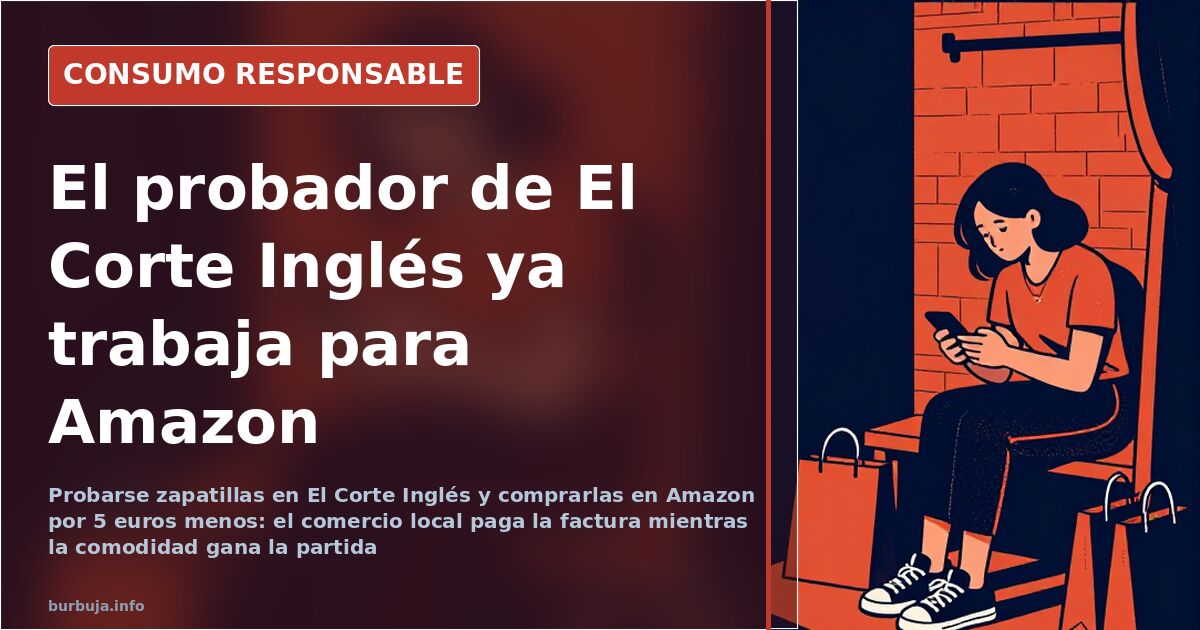
According to one participant, it's increasingly common to go to El Corte Inglés to try on sneakers and then buy them on Amazon to save 5 or 10 euros. The customer goes in, tries them on, checks the size, and leaves with the price noted on their phone. Ten minutes later, the order is on its way home. The fitting room thus becomes the first phase of the purchase process; the physical store, an R&D department that nobody pays for.
The figure that best measures the imbalance isn't the 5-euro saving. It's Correos (the Spanish postal service): according to the same participant, the public delivery company's biggest client today is Bezos's platform. When a country's postal operator depends commercially on a single foreign client, local commerce no longer competes on equal terms. It competes for the leftovers of an infrastructure that it itself helps to sustain.
Amazon Isn't Always the Cheaper Option It Claims to Be
The narrative that Amazon wins on price doesn't hold up well to calculation. There's a recurring, wry case: a blister pack of 24 Manley crayons costs 6.30 euros at the neighborhood stationery store, 6.45 at the adjacent bookshop-stationery store, and 7.50 on Amazon. For children's thermal bottles, the difference goes the other way: 5 euros at Lidl versus the 12 and 15 euros asked for equivalent ones on the platform. Paper filters for the coffee maker cost 2 euros online and 1 euro at the corner bazaar.
The full calculation, product by product, would raise eyebrows. Because if it's not the price, what is being sold? The answer is convenience: not moving, not waiting, not arguing. And that, indeed, comes at a price.
Behind the storefront is another less visible figure: according to a seller in the thread, the commission the platform charges small sellers who host on it is around 15-20%, and to that must be added shipping, exchanges, returns, and complaints. Those who sell 'on Amazon' don't always profit by selling cheaper.
The Real Battle is Fought at the Returns Counter
Where traditional commerce can lose the customer is in after-sales service. There are stories, like that of a toaster returned to El Corte Inglés, that escalate from sales assistant to manager, from manager to section chief, and from there to a supreme chief. In contrast, some describe returns via chat on Amazon resolved in two minutes with a replacement of the appliance.
The fine print favors the buyer: legal warranty is managed by the seller, and for two years after purchase, the burden of proof lies with whoever claims the product was not defective. Stores that don't apply this aren't breaking tradition, they're breaking the law. But the law doesn't fix a bad experience, and the customer punishes where they can: they don't return.
Thirty Years of Warnings Left Unanswered
It's worth remembering the timeline. Barrabés was already selling online in 1995. Amazon's Spanish website peine in 2011, after years of purchases from the American domain from Spain. According to one participant, El Corte Inglés wasn't caught off guard: it had ample time to react and didn't. When it finally made a move, it was, in their opinion, to imitate the very entity that was eating its market share.
The harshest diagnosis points to an exhausted model. Selling a product that another manufactures, without advice, without personalization, and without agile after-sales service, is a function that digital logistics does better and cheaper. Those who merely resell have it tough; those who manufacture, repair, or advise, not so much.
Who Pays the Bill for Convenience
Amazon spent years losing money to gain market share. Its European plan alone accumulated 1.84 billion euros in losses over three years, according to one participant, financed largely with the cheap money that central banks gave away at near-zero rates. In other words, it argues, we all pay for the party, including those who bought nothing.
Meanwhile, some participants argue that local proximity commerce does something no platform replicates: it weaves relationships, says good morning, and sustains the street. Debatable, romantic, inefficient. But, they warn, when that network disappears, it doesn't come back. And nobody has yet found a way to buy it back.
The question remains open, uncomfortable, and unanswered: when the fitting room only serves for looking, who will pay the rent for the storefront?
According to one participant, it's increasingly common to go to El Corte Inglés to try on sneakers and then buy them on Amazon to save 5 or 10 euros. The customer goes in, tries them on, checks the size, and leaves with the price noted on their phone. Ten minutes later, the order is on its way home. The fitting room thus becomes the first phase of the purchase process; the physical store, an R&D department that nobody pays for.
The figure that best measures the imbalance isn't the 5-euro saving. It's Correos (the Spanish postal service): according to the same participant, the public delivery company's biggest client today is Bezos's platform. When a country's postal operator depends commercially on a single foreign client, local commerce no longer competes on equal terms. It competes for the leftovers of an infrastructure that it itself helps to sustain.
Amazon Isn't Always the Cheaper Option It Claims to Be
The narrative that Amazon wins on price doesn't hold up well to calculation. There's a recurring, wry case: a blister pack of 24 Manley crayons costs 6.30 euros at the neighborhood stationery store, 6.45 at the adjacent bookshop-stationery store, and 7.50 on Amazon. For children's thermal bottles, the difference goes the other way: 5 euros at Lidl versus the 12 and 15 euros asked for equivalent ones on the platform. Paper filters for the coffee maker cost 2 euros online and 1 euro at the corner bazaar.
The full calculation, product by product, would raise eyebrows. Because if it's not the price, what is being sold? The answer is convenience: not moving, not waiting, not arguing. And that, indeed, comes at a price.
Behind the storefront is another less visible figure: according to a seller in the thread, the commission the platform charges small sellers who host on it is around 15-20%, and to that must be added shipping, exchanges, returns, and complaints. Those who sell 'on Amazon' don't always profit by selling cheaper.
The Real Battle is Fought at the Returns Counter
Where traditional commerce can lose the customer is in after-sales service. There are stories, like that of a toaster returned to El Corte Inglés, that escalate from sales assistant to manager, from manager to section chief, and from there to a supreme chief. In contrast, some describe returns via chat on Amazon resolved in two minutes with a replacement of the appliance.
The fine print favors the buyer: legal warranty is managed by the seller, and for two years after purchase, the burden of proof lies with whoever claims the product was not defective. Stores that don't apply this aren't breaking tradition, they're breaking the law. But the law doesn't fix a bad experience, and the customer punishes where they can: they don't return.
Thirty Years of Warnings Left Unanswered
It's worth remembering the timeline. Barrabés was already selling online in 1995. Amazon's Spanish website peine in 2011, after years of purchases from the American domain from Spain. According to one participant, El Corte Inglés wasn't caught off guard: it had ample time to react and didn't. When it finally made a move, it was, in their opinion, to imitate the very entity that was eating its market share.
The harshest diagnosis points to an exhausted model. Selling a product that another manufactures, without advice, without personalization, and without agile after-sales service, is a function that digital logistics does better and cheaper. Those who merely resell have it tough; those who manufacture, repair, or advise, not so much.
Who Pays the Bill for Convenience
Amazon spent years losing money to gain market share. Its European plan alone accumulated 1.84 billion euros in losses over three years, according to one participant, financed largely with the cheap money that central banks gave away at near-zero rates. In other words, it argues, we all pay for the party, including those who bought nothing.
Meanwhile, some participants argue that local proximity commerce does something no platform replicates: it weaves relationships, says good morning, and sustains the street. Debatable, romantic, inefficient. But, they warn, when that network disappears, it doesn't come back. And nobody has yet found a way to buy it back.
The question remains open, uncomfortable, and unanswered: when the fitting room only serves for looking, who will pay the rent for the storefront?
Summary of a discussion on Burbuja.info - Foro de economía, actualidad y política., translated from Spanish and reviewed before publication. Read the full discussion (232 replies).
More summaries
-
The four breakfasts no Spanish bar serves
Oats, wholemeal bread, hummus and peanut butter: four foods Spanish bars don't serve, against the tradition of toast and Spanish tortilla.
-
Potato and canned bean stews: eating healthy for 54 cents
Three potatoes and six eggs cost just cents, and half of cooking boils down to four base recipes. Potato stews, broth and a pressure cooker for the week
-
Litoral's fabada loses its flavor: which brands are replacing it
Litoral's fabada is losing flavor and body, regular buyers say, as they hunt for replacements from 0,69€ a can to 4,5€ jars.
-
Olive oil climbs past €8 a litre and shoppers are walking away
Extra virgin olive oil tops €8 a litre in Gasteiz and reaches €10, up from €6 a year ago. More and more shoppers are taking it off their lists
-
A Land Rover and 20.000 euros in repairs in just four years
Mireia has spent about 20.000 euros on repairs to her Land Rover, with only 173.000 km in four years, including timing chain, turbo, gearbox and driveshaft
-
Razor blades: expensive cartridges vs. cheap double-edge
A 100-pack of double-edge blades costs €9–12 and gives five shaves per blade; the expensive cartridge is done after five uses.