
Eating trees on YouTube: acorns, resin and 700,000 followers
A creator with 700,000 followers is thriving by teaching people to eat acorns and ferment fir needles, recipes that take days of work and wheat to taste like bread
English · Original discussion in Spanish · Published
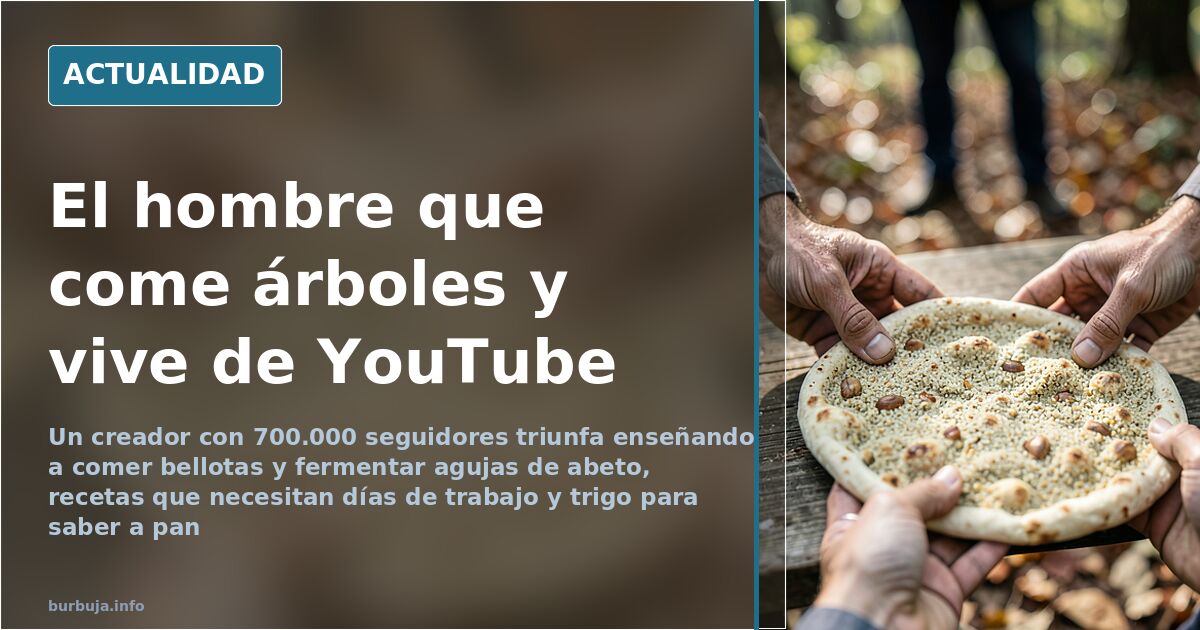
Acorns, resin and a beret: the business of eating trees on YouTube
How much work does it take to produce a loaf of bread worse than the supermarket kind? The answer, according to the phenomenon currently making the rounds on social media, is five days. A content creator known as Baskecraft has built an audience of 700,000 trinc by teaching people how to make use of forest resources: peeling acorns, boiling resin, fermenting conifer needles and baking flatbreads on a hot stone. The result, as he himself admits in his videos, is a dry food with a slight bitterness and a process that takes more hours than studying for a civil service exam.
The paradox is nothing new. It is the old story of the survival influencer who turns scarcity into spectacle and effort into a personal brand. But this case has edges that deserve more than a laugh.
Acorn bread that needs wheat to taste like bread
The channel's star recipe is acorn bread. The process involves gathering the nuts, peeling them, pounding them, making flour, mixing with water and placing the dough on a hot stone. Half an hour later, the cook inspects the piece, takes a bite and concludes that it is fairly dry, though it retains some moisture inside. Fine paleolithic dining.
The quality leap comes with the oak loaf. There the process stretches over days: peeling, soaking, changes of water, drying, baking, grinding and a final mix with wheat flour. Because acorn flour has no gluten and cannot hold a loaf together on its own. Modern bread-making technology, it turns out, had its reasons.
It is worth separating the anecdote from the fact. Acorns have historically been used as food and, when properly processed, provide nutrients. The problem is not the technique: it is the epic packaging. Selling a recipe that takes days of work as a food revolution is an exercise in editing, not archaeology.
Fir soda and the risk of the bottle exploding
The next episode moves from the plate to the drink. Fir needles, water and sugar, fermentation and carbonation in sealed bottles. The creator himself warns that you have to be very careful because the bottles can burst. Minor inconveniences, he calls them. Like saying that having a barbecue carries the risk of burning the sausage.
The joke has substance. Uncontrolled home fermentation is a known source of household accidents, and foraging wild plants requires rigorous botanical identification: not all conifers are safe and some toxic species resemble edible ones. Entertainment does not exempt you from chemistry.
From the beret to bricks: the creator's property pivot
The character does not stay in the forest. In another of his videos he tackles the rural housing market: misleading listings, expensive houses, renovations that cost a kidney and a bureaucracy that, he argues, prevents repopulating villages. The diagnosis has substance. The Spanish rural market has real problems with supply, financing and permits, and depopulation is not fixed with good intentions.
What is striking is the packaging: the same beret that explained how to boil resin now holds forth on the price per square metre. The personal brand works just as well for an acorn tutorial as for a property analysis. And there lies the key to the business: the beret, the moustache and the shepherd look are the product.
Why a frying pan beats culinary archaeology
The most revealing fact about the channel is its most popular video: a frying pan. After empires, wars and the Moon landing, what draws the crowds is where to fry an egg without destroying the planet. The algorithm rewards the everyday, not the ancestral. The paradox defines a generation that aspires to make a living from filming videos and discovers that the content that works is the most domestic.
The channel also sells merchandising: berets and merino wool blankets, reportedly made in the French Basque Country. Survival, looked at closely, is a vertical business model: content, audience and its own shop.
In the end, the question that remains is the usual one. Is five days of work worth it for a bread that needs wheat to taste like bread? The answer is probably no. But the video of those five days gets watched to the end. And that, in the attention economy, is worth more than any acorn.
Also available in: Deutsch
Summary of a discussion on Burbuja.info - Foro de economía, actualidad y política., translated from Spanish and reviewed before publication. Read the full discussion (25 replies).
More summaries
-
Manuel del Rey: the Spanish Civil War killing that historical memory ignores
90 years after the kidnapping and murder of Manuel del Rey in Oviedo, Spain: the killing in the Republican rear guard that historical memory has never told.
-
Iker, 23, lives bill-free in the woods: solar panels, a well and a YouTube channel
Iker, 23, lives bill-free in the woods with solar panels, a well and animals. The real business is the headline: the initial investment and the YouTube channel keep the…
-
France: Protester Chainsaws Tree During Demonstration
Video shows a protester cutting down a tree with a chainsaw in France, reigniting debate on protest tactics and impunity.
-
Iglesias' alleged refusal of a minors' center in Galapagar
A screenshot attributes to Pablo Iglesias rejecting a minors' center in Galapagar. No original source exists; the image dates back to his time in Cuba.
-
Brazil: vote splits between Lula and Bolsonaro
Brazil's Superior Electoral Court confirms Lula's victory. The vote splits along class and regional lines, not just race. The data that debunks the cliché.
-
Disclosure Day: Spielberg's latest fails to convince
Spielberg's new film rests on the idea that a few alien videos on TV would paralyse the world. The script and effects fall flat: "a cosmic stinker".