
Iker, 23, lives bill-free in the woods: solar panels, a well and a YouTube channel
Iker, 23, lives bill-free in the woods with solar panels, a well and animals. The real business is the headline: the initial investment and the YouTube channel keep the…
English · Original discussion in Spanish · Published
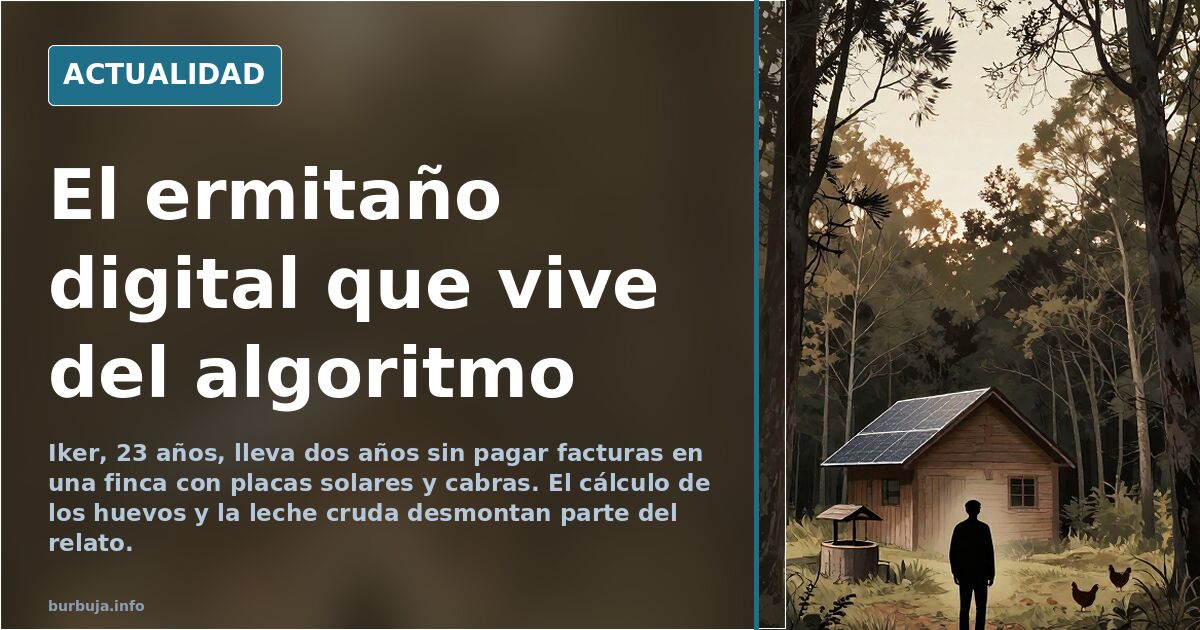
Iker, 23, no bills: the woods as a business
A 23-year-old has spent two years living on a rural property with no grid electricity or running water. His name is Iker, he has solar panels, a well and animals, and he has turned his daily life into a YouTube channel promoted with headlines like «VIVES ALONE LOST IN THE WOODS AT 23: TWO YEARS WITHOUT PAYING BILLS». The story was published by El Español on 27 September 2026. Behind the self-sufficiency narrative, the question hanging in the air is who paid the initial investment and where the money comes from for what the hens don't produce.
The headline is the business, not the farm. According to an analysis circulating in the thread, the solar panels, the well, the fence and the henhouse are not gifts from the surroundings: they are an investment of several thousand euros that someone fronted. Some argue that the property has an owner, is on the land registry and, in all likelihood, has a family member behind it, and that none of this appears in the video. At 23 and two years without bills, he eats somehow: either his family supports him or the channel pays him more than a minimum-wage worker, that same analysis suggests. If he gets demonetized tomorrow, we'll see how fast he reconnects with society.
How many eggs does a person need to survive?
The young man has gotten into nutritional calculations to determine how many eggs he needs to eat daily. According to a calculation circulating in the thread, the math, if done seriously, dismantles the narrative: an active adult needs about 2,500 kcal; a medium egg provides 75, so covering energy needs with eggs alone would require 33 a day. For protein, 80 grams would take 11 or 12 eggs, and that's without counting fat, iron, vitamin C or fiber, which don't come in the egg. A free-range hen lays between 200 and 250 eggs a year, so scraping together 30 a day requires about 45 hens in continuous production. That's not a lifestyle project: it's a farm with its feed, its vet and its henhouse.
Artisan cheese and the pool on protected rural land
The next chapter of the project is learning to make cheese. Making cheese takes more than a goat, a container and the conviction that nature will provide. The image of the house, which looks like it needs a cleaning more than a designation of origin, suggests the business isn't as well-oiled as the pitch.
The issue that could really get complicated, as raised in the thread, is the pond with a septic system and built edges that appears in the videos. On non-buildable land, that isn't «fixing», it's new construction. The fact that the house was already standing doesn't exempt him from anything: it may be outside planning regulations, on public land, with an expired permit or with a later extension built without papers. The municipal technician cross-checks the land registry against old aerial imagery and the story falls apart in ten minutes. The pool, not the mustache, is the bone of contention.
Friday means town: diesel, groceries and beers
The isolation has a weekly expiration date, according to the description given in the thread. The entire initial investment is bought online and hauled down in a van. Friday means going into town: diesel, the monthly grocery run and beers with the locals. On Saturday he films half the video boasting about independence and on Sunday he uploads it to a platform that eats fiber and electricity like anyone else. The off-grid minimalism has become a personal brand. The one who is truly disconnected is the one who swallows the story with his mouth open.
The bill that doesn't disappear: clothes, soap and tools
The list of what the property doesn't produce is long: clothes, shoes, soap, toothpaste, vinegar, cleaning products, farm tools and fruit in winter. All of it is bought. Some argue that self-sufficiency means being able to survive without anything from outside, even if it isn't practiced and things are bought, and that this doesn't create dependence. The other side points out that the difference between being self-sufficient and having cut some expenses is exactly that: the shopping list.
The Unabomber precedent looms over the matter. Theodore Kaczynski lived in a two-by-three-meter cabin in Montana, with no electricity or running water, and received significant financial support from his family. The myth of the man who dropped out of the system rested on transfers. Iker lacks the brother with the transfers, but he has the algorithm to spare.
The algorithm pays while the woods hold out
The system may be terrible, but YouTube's algorithm seems to like him just fine. A video titled «I'VE ABANDONED SOCIETY FOREVER» coexists with a glance at the stats every five minutes. The contradiction isn't new: sticker anticapitalism in a bar bathroom, with a link to YouTube, a Google subsidiary that pays taxes wherever it suits it. The ideological beach bar has always lived off the platform it claims to hate.
The open question is what happens when January arrives, it rains for three weeks, a solar panel breaks, a goat falls ill and the hens decide to go on strike. Nature is very spiritual until you have to fix a pipe at two degrees below zero with wet hands. The woods don't send a monthly bill, but they send breakdowns, mud, damp, bugs, cold and physical labor without asking whether it's convenient.
Some argue the kid has taken a brave step toward self-sufficiency and the traditional life, and that so much criticism is unnecessary. Against that weighs the argument that the headline is the business and the farm is the set. The difference between being self-sufficient and having cut some expenses lies in the shopping list. And in who pays for it.
Also available in: Deutsch
Summary of a discussion on Burbuja.info - Foro de economía, actualidad y política., translated from Spanish and reviewed before publication. Read the full discussion (105 replies).
More summaries
-
Spanish YouTuber's use of 'qué tan' sparks language debate
A Spanish creator uses the Latin American phrase "qué tan," reigniting discussions on whether Peninsular Spanish is threatened by demographic shifts.
-
Content creators move retired parents to Spain using public healthcare
A group of YouTubers has moved their retired parents to Spain, granting them access to the public health system and reigniting the family reunification debate.
-
Spanish spoken 26% faster than English due to five vowels
Phonetics expert Conor Sullivan claims Spanish is 26% faster than English because of its five vowels, sparking debate on linguistic efficiency.
-
The Zaragoza eviction case that the press reported incompletely
A forum questions the narrative of a pregnant woman facing eviction in Spain, citing three children from three different fathers and a history of threats.
-
Artemis photo sparks flat-Earth hoax claims (space photo, Artemis)
The Artemis photo flat-earthers cite as proof of a staged shot. Its coincidence with April Fool's Day and debates about the shape of the Earth.
-
The HPV vaccine hype, its sting, and its link to cancer
Is the HPV vaccine real protection or a business with adverse effects? We examine the scientific evidence and the debate over its safety.