
Manuel del Rey: the Spanish Civil War killing that historical memory ignores
90 years after the kidnapping and murder of Manuel del Rey in Oviedo, Spain: the killing in the Republican rear guard that historical memory has never told.
English · Original discussion in Spanish · Published
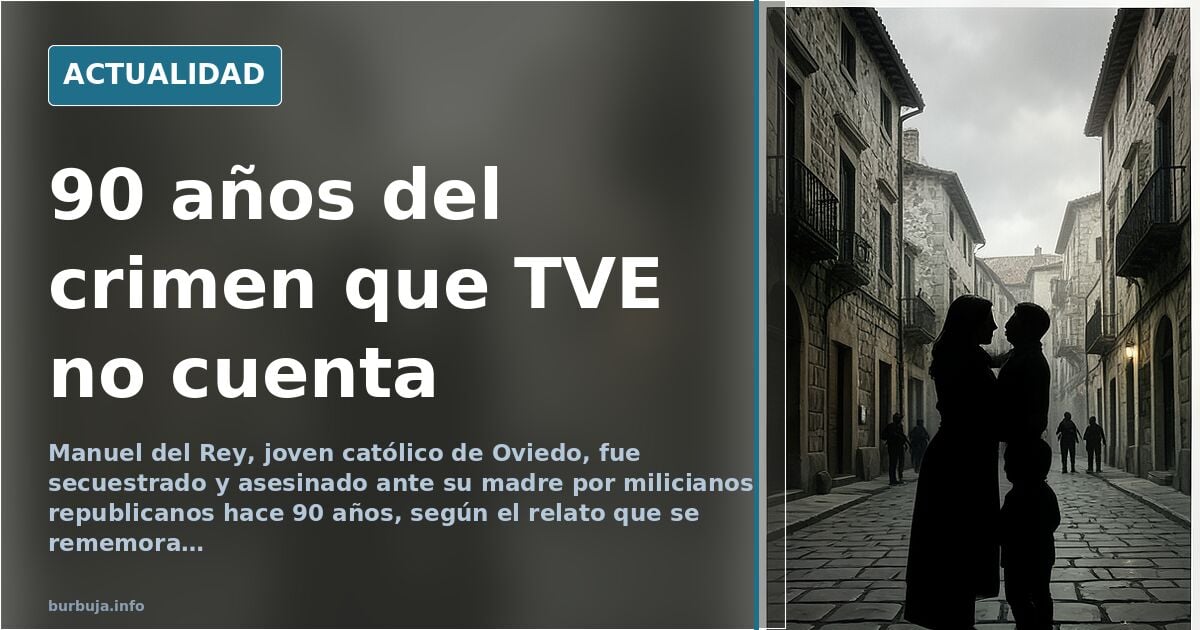
Manuel del Rey, the martyr of Oviedo that official memory ignores
Oviedo, July 1936. Manuel del Rey is 29 years old, a Catholic, and in the crosshairs of the militias controlling the Republican rear guard in Asturias. According to the story recalled on the 90th anniversary of his death, a group of militiamen kidnapped him, called his mother to witness what trinc, and tortured him to death. The scene described —eyes and tongue torn out, the body nailed to a cross— is of a brutality that, let's admit it, is more comfortable to file away in the drawer of forgetting than to face head-on.
There is no documentary source cited in the usual way, and it should be said: the data on this specific case come from oral memory and from the anti-communist tradition that has circulated for decades at the margins of the official narrative. What is verifiable is the context: in the Asturias of 1936, the Republican rear guard saw a wave of repression against the clergy and right-wing militants that left thousands dead before the front stabilized.
Repression in the rear guard: what the numbers do say
The case of Manuel del Rey is not an isolated episode. Revolutionary violence in the Republican zone during the first months of the war targeted priests, religious, members of right-wing parties and property owners. The Catholic Church put the number of religious killed in that phase in the thousands, and the Causa General (the postwar Francoist inquiry into Republican atrocities) documented hundreds of cases in Asturias. Whether the Oviedo story is exact in every detail does not change the substance: there was a terror in the rear guard that operated outside any legality and that, in many cases, enjoyed the tolerance or connivance of local Republican authorities.
Some argue that historical memory has been selective, focusing on the victims of one side while silencing those of the other. The argument has legs: for decades, militant historiography prioritized the story of those shot by Francoism and left the murders in the Republican rear guard in second place. The reaction to that imbalance has in turn produced a genre of reverse memorialism that sometimes commits the same sin: telling only what suits one's own narrative.
Forgetting as policy: why these crimes never make it to television
The question hovering over any anniversary like this is why some crimes get media space and others do not. The answer is not conspiratorial: it is about agenda. The dominant narrative of the Spanish Civil War was built on the dichotomy of democracy's victims versus fascism's executioners, and anything that does not fit that scheme tends to fall outside the spotlight. Not because some central committee decides so, but because the media and institutional ecosystem rewards some frames and penalizes others.
The result is an à la carte memory in which each side remembers what suits it. One side, the martyrs of the rear guard; the other, those shot by Francoism. And in between, an uncomfortable question: how many Manuel del Reys were there who have neither a street, nor a documentary, nor an article on the round anniversary?
What we do know is that political violence in Spain was not the property of a single side, and that the civil war was, above all, a collective failure. Ninety years later, the unsettling fact is not the brutality of the crime: it is that there are still people who need the other side to be the sole culprit in order to feel at peace with their own history.
Summary of a discussion on Burbuja.info - Foro de economía, actualidad y política., translated from Spanish and reviewed before publication. Read the full discussion (45 replies).
More summaries
-
Brussels riots: Is Belgium on the brink of civil war?
Brussels fires and a 25% communist vote signal potential Belgian civil war within a decade, according to viral online analysis.
-
Forum Debate: Why the Left Criticizes the Catholic Church but Not Islam
Forum users discuss the asymmetry between criticizing the Catholic Church and remaining silent on Islam, citing proximity and institutional power.
-
Spanish Civil War II? Political Tensions Rise
Accusations of "hybrid warfare" against President Pedro Sánchez. Fears of chaos and social unrest. Potential illegal financing for the PSOE.
-
PP Mocks Puente’s Pain After Quad Injury, Sparking Political Row
A Spanish PP tweet mocking Transport Minister Óscar Puente’s injury sparks controversy ahead of regional elections, highlighting the fine line between political criticism and spectacle.
-
Spanish MP warns Alberto: "better not dance"
A Socialist Party (PSOE) MP replied to Alberto with "better not dance" on X. We explain the political context of the message and why it went viral.
-
Feijóo caught at Spanish PP event dancing to Latin music
Feijóo said he neither dances nor sings at rallies. A video shows him at a PP event with Latin music playing. The contrast is fueling the controversy.