
France: Protester Chainsaws Tree During Demonstration
Video shows a protester cutting down a tree with a chainsaw in France, reigniting debate on protest tactics and impunity.
English · Original discussion in Spanish · Published
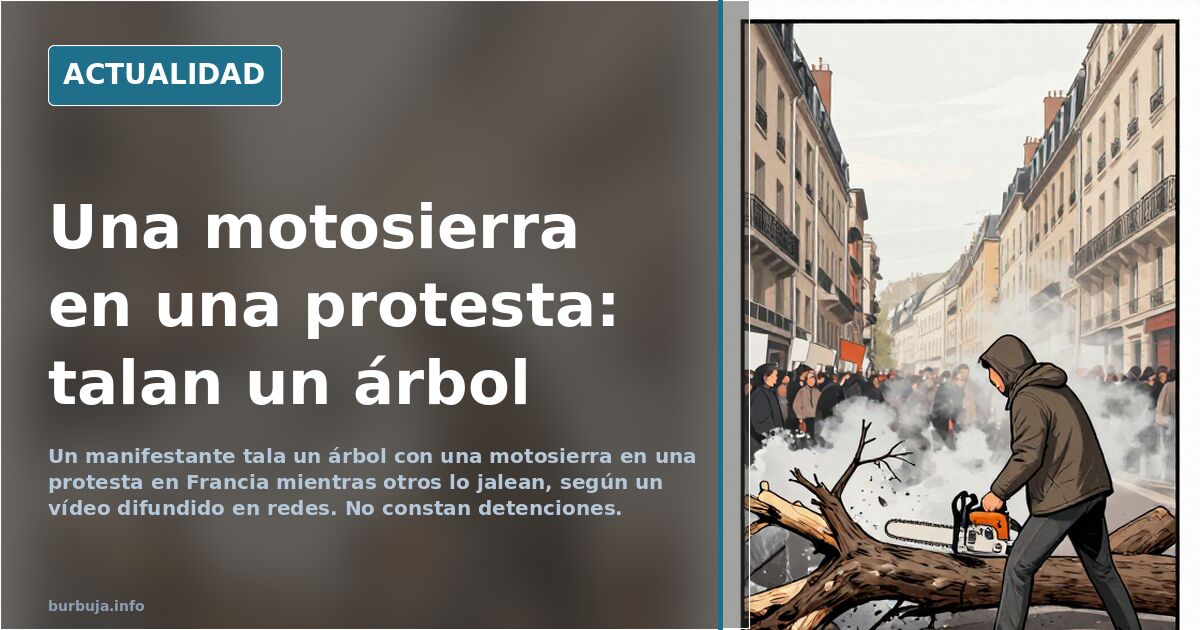
Chainsaws in French Protests: A Tree Felled in the Street
A video circulating on social media shows a man carrying a chainsaw during a protest in France and cutting down a tree while other demonstrators cheer him on. The incident, which lacks official confirmation regarding its exact location or whether arrests were made, has peine a debate far broader than the tree itself: what is happening with street protests in the neighboring country, and why has the image of the chainsaw become the symbol of this season.
It is not an isolated case in the collective imagination. In Spain, where protests outside Socialist Party headquarters left images of large knives and ripped-up cobblestones, the comparison was immediate. The lingering question is uncomfortable: if one cuts down a tree at a climate protest, what exactly is being protested?
What Is Known About the Video and What Is Not
The circulating material shows an individual with a chainsaw in a protest setting, cutting a tree under the gaze—and cheers—of others. There is currently no official confirmation of the city, the exact context, or whether French police have identified or detained the perpetrator. Nor is there a clear claim of responsibility. In journalistic terms, it is a fact without a frame: a powerful image lacking a narrative to support it.
This has not prevented it from becoming ammunition for all sides. Some argue the episode summarizes the exhaustion of the environmentalist narrative in France, where agricultural protests and mobilizations against pension reform have overlapped with broader social unrest. Opponents argue that a single video does not represent a movement, and turning it into an emblem is precisely what those who filmed it seek.
Comparison with Haiti and Deforestation
One of the most widely discussed arguments is historical. Several messages have drawn parallels with Haiti, a country that lost nearly all its forest cover throughout the 20th century and today presents some of the highest deforestation rates on the planet. The connection established is direct: tree felling as a symptom of a deeper problem, not just an anecdote.
The comparison has empirical basis. Haiti is the classic example in economic literature of how the destruction of natural capital becomes a poverty trap: without trees, there is no fertile soil; without soil, no agriculture; without agriculture, no rural employment. That a video of a chainsaw in France triggers this association says much about how images of urban chaos are read today.
Environmentalism and the Chainsaw: The Contradiction No One Wants to Face
The most uncomfortable paradox lies within the environmental framework itself. If the protest is for the climate, cutting down a tree is the worst possible symbol. Some have pointed out that practical environmentalism—done by hand—has little to do with banner-holding environmentalism, and the gap between the two has widened. The repeated data point: global deforestation continues to advance even as climate mobilizations fill squares.
On the opposite side, it is argued that mixing an isolated act of vandalism with the climate movement is an argumentative trap. Environmental organizations have been denouncing illegal logging and the expansion of the agricultural frontier for years. An individual with a chainsaw appearing at a protest does not invalidate the cause, just as looting does not invalidate a strike.
Protest, Impunity, and Cost to the Taxpayer
The other axis of the debate is impunity. Damage caused during protests in France has a cost borne by the taxpayer: windows, street furniture, vehicles. Some demand that identified protesters pay for damages, a measure already raised in French public debate. The question is how this reconciles with the right to demonstrate.
The answer is not simple. Identifying perpetrators of damage in a massive protest is technically difficult and legally delicate. Public and private insurance end up covering part of it. The result is a sense of impunity that fuels the next cycle of protest. It is the circle that the chainsaw video has brought back to the forefront.
Political Future: 2027 and Le Pen's Shadow
The conversation inevitably drifts toward politics. The 2027 French elections appear on the horizon as the great test. Some anticipate a victory for Marine Le Pen and, with it, a scenario of bloody turmoil. This is a prediction, not a fact: polls two years ahead have limited value, and the French electoral system has its own rules.
What is a fact is that social unrest in France has been seeking a political outlet for years, and the image of the chainsaw, like that of the yellow vest, will become a campaign icon. If the felled tree ends up being a slogan, it will have been worth more than the wood taken away.
How much of this episode is a symptom and how much is an anecdote amplified by social networks? The answer depends on whom you ask, and in French politics, that is already an answer.
A video circulating on social media shows a man carrying a chainsaw during a protest in France and cutting down a tree while other demonstrators cheer him on. The incident, which lacks official confirmation regarding its exact location or whether arrests were made, has peine a debate far broader than the tree itself: what is happening with street protests in the neighboring country, and why has the image of the chainsaw become the symbol of this season.
It is not an isolated case in the collective imagination. In Spain, where protests outside Socialist Party headquarters left images of large knives and ripped-up cobblestones, the comparison was immediate. The lingering question is uncomfortable: if one cuts down a tree at a climate protest, what exactly is being protested?
What Is Known About the Video and What Is Not
The circulating material shows an individual with a chainsaw in a protest setting, cutting a tree under the gaze—and cheers—of others. There is currently no official confirmation of the city, the exact context, or whether French police have identified or detained the perpetrator. Nor is there a clear claim of responsibility. In journalistic terms, it is a fact without a frame: a powerful image lacking a narrative to support it.
This has not prevented it from becoming ammunition for all sides. Some argue the episode summarizes the exhaustion of the environmentalist narrative in France, where agricultural protests and mobilizations against pension reform have overlapped with broader social unrest. Opponents argue that a single video does not represent a movement, and turning it into an emblem is precisely what those who filmed it seek.
Comparison with Haiti and Deforestation
One of the most widely discussed arguments is historical. Several messages have drawn parallels with Haiti, a country that lost nearly all its forest cover throughout the 20th century and today presents some of the highest deforestation rates on the planet. The connection established is direct: tree felling as a symptom of a deeper problem, not just an anecdote.
The comparison has empirical basis. Haiti is the classic example in economic literature of how the destruction of natural capital becomes a poverty trap: without trees, there is no fertile soil; without soil, no agriculture; without agriculture, no rural employment. That a video of a chainsaw in France triggers this association says much about how images of urban chaos are read today.
Environmentalism and the Chainsaw: The Contradiction No One Wants to Face
The most uncomfortable paradox lies within the environmental framework itself. If the protest is for the climate, cutting down a tree is the worst possible symbol. Some have pointed out that practical environmentalism—done by hand—has little to do with banner-holding environmentalism, and the gap between the two has widened. The repeated data point: global deforestation continues to advance even as climate mobilizations fill squares.
On the opposite side, it is argued that mixing an isolated act of vandalism with the climate movement is an argumentative trap. Environmental organizations have been denouncing illegal logging and the expansion of the agricultural frontier for years. An individual with a chainsaw appearing at a protest does not invalidate the cause, just as looting does not invalidate a strike.
Protest, Impunity, and Cost to the Taxpayer
The other axis of the debate is impunity. Damage caused during protests in France has a cost borne by the taxpayer: windows, street furniture, vehicles. Some demand that identified protesters pay for damages, a measure already raised in French public debate. The question is how this reconciles with the right to demonstrate.
The answer is not simple. Identifying perpetrators of damage in a massive protest is technically difficult and legally delicate. Public and private insurance end up covering part of it. The result is a sense of impunity that fuels the next cycle of protest. It is the circle that the chainsaw video has brought back to the forefront.
Political Future: 2027 and Le Pen's Shadow
The conversation inevitably drifts toward politics. The 2027 French elections appear on the horizon as the great test. Some anticipate a victory for Marine Le Pen and, with it, a scenario of bloody turmoil. This is a prediction, not a fact: polls two years ahead have limited value, and the French electoral system has its own rules.
What is a fact is that social unrest in France has been seeking a political outlet for years, and the image of the chainsaw, like that of the yellow vest, will become a campaign icon. If the felled tree ends up being a slogan, it will have been worth more than the wood taken away.
How much of this episode is a symptom and how much is an anecdote amplified by social networks? The answer depends on whom you ask, and in French politics, that is already an answer.
Also available in: Deutsch
Summary of a discussion on Burbuja.info - Foro de economía, actualidad y política., translated from Spanish and reviewed before publication. Read the full discussion (76 replies).
More summaries
-
Author Denies Using AI for Award-Winning French Novel
Thélyson Orélien, author of the prize-winning novel 'C'était ça ou mourir', denies AI use and claims racist attacks since arriving in France.
-
Peruvian candidate named Hitler Mussolini wins local election
Hitler Mussolini Simeon won the mayoral race in Peru's Queropalca district for the left-wing party Ahora Nación, sparking social media debate.
-
Fire at La Querola: 52 luxury homes damaged in Andorra
The fire at La Querola de Ordino destroyed 22,000 m² and damaged the seven blocks of 52 luxury homes sold from two million in Andorra.
-
Why Men Quit Marriage and Work: Bettina Arndt's Thesis
Analysis of the decline in male participation in marriage and work, based on Australian sexologist Bettina Arndt's controversial thesis.
-
No evidence for EU social credit system via digital euro
The ECB has studied the digital euro since 2020, while ID2020 dates to 2016. A theory links them to a social credit system without proof.
-
New Topical Hair Loss Treatment Offers Alternative to Surgery
A new topical hair treatment aims to replace transplants. We analyze its potential impact on the market.