
Eating for €20 a month: powdered mash and 33-cent sausages
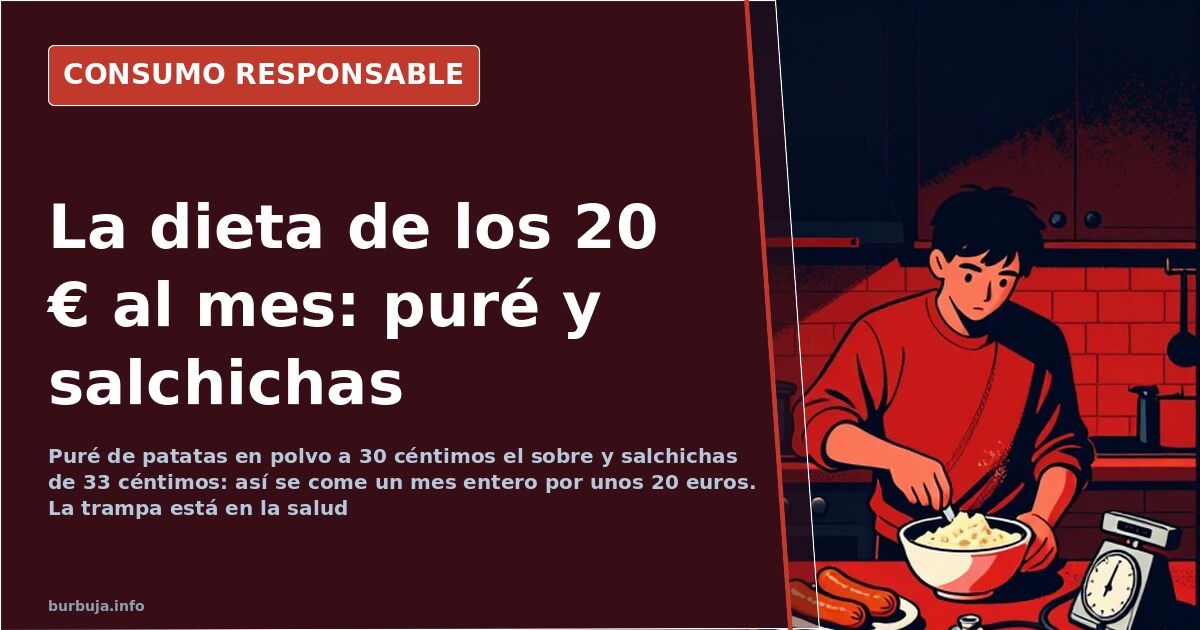
Powdered mashed potatoes at 30 cents a sachet and 33-cent sausages: how to eat for a whole month on about €20. The catch is your health.
English · Original discussion in Spanish · Published
Filling your belly on €20 a month: from rice to powdered mash
A whole month of food for the price of a Saturday dinner. That is the challenge: 0.55 euros a day on sausages and 0.40 on bread, which works out at 16.5 euros a month on one side and 12 on the other. The round figure in the title —€20 to fill your belly— is no bar-room exaggeration: it comes from multiplying the price of a packet of sausages by 30 days and dividing a four-euro baguette between three sandwiches. The question is not whether it can be done. It is at what cost.
The first thing that jumps out is the nutritional catch. A kilo of real chicken sausages, the ones that actually contain meat, costs around 10 euros. What you buy for cents is something else: reconstituted protein, starch, water and preservatives. That is neither sausage nor bread, the most upvoted reply concludes. The irony writes itself: for all the bragging about being a cheapskate, they cannot even work out the shopping list properly.
What you can eat for €20 a month
The calculation does not stop at sausages. Powdered mashed potato enters the picture: a €1.19 packet contains four sachets, or 30 cents per sachet, which with 850 millilitres of water —cold, without turning on the heat, to save even more— makes a kilo of mash, a complete meal. Thirty sachets a month comes to 9 euros. Add a pack of cheap sausages at 33 cents per packet and the bill comes to 63 cents a day. A little over 18 euros a month to avoid going hungry.
And some go lower. A kilo of rice costs around one euro and lasts all week. Dried pulses, potatoes and yesterday's bread complete the historical basis of subsistence: porridge in the West, rice in the East, seasoned —according to another comment— with some bird hunted without the landowners knowing. The joke has centuries of economics behind it.
But eating cheaply is not eating. The sharpest criticism comes not from the pocket but from the narrative: eating is cheap; eating well is what costs. Little money fills your stomach; little money does not cover what a body needs over a lifetime. That line frames all the disagreement that trinc.
The basket that adds up: €14.70
Against the powdered mash calculation comes a more sensible alternative. With 20 euros at a discount supermarket there is room to eat hot and varied food all month: rice, pardina lentils, white beans, plus a chorizo, salted pork belly and a piece of ham to flavour the stews. The itemised total —which is worth reading in full, line by line— comes to 14.70 euros, with room to add a whole chicken, cut into pieces.
The key to that basket is not quantity but the stove. Cooking for two days, freezing portions, using the big pot and reheating leftovers in the microwave so as not to turn on the ceramic hob during expensive hours. The real saving lies not in buying the cheapest items but in not paying anyone to cook it.
How much those who eat everything spend a month
The budgets that appear draw an eloquent staircase. Some claim to eat for almost a month on 80 euros, some put themselves at an average of 120 euros a month without depriving themselves of anything, and some maintain that 150 euros a month is more than enough: potato stews twice a week, a kilo of chicken breast —bought for under five euros a kilo—, stewed pulses, some fish, fruit, yoghurts and winter soups that cost next to nothing. At the opposite extreme, someone confesses to spending 30 euros a day.
The range therefore runs from 20 to 150 euros a month: a factor of seven. No one disputes that the difference shows on the plate. What is disputed is whether that difference matters.
Is a subsistence diet sustainable?
Here the consensus is uncomfortable. Anyone who has lived on rice and pulses knows the body holds out, but not for free. Living on cheap carbohydrates fattens and malnourishes at the same time; health suffers and, as one comment warns, there may be no going back. Intermittent fasting emerges as an alibi for saving: if you eat less, you spend less and even lose weight. Squaring the circle of hunger.
Against that, another current argues that cooking cheaply does not have to miccionan monotony. Lentils with chorizo, a use-up pisto (Spanish ardilla) —with a handful of rice to stretch the portion and complete the protein—, roast pork shoulder or fajitas made from leftovers show that subsistence cooking allows for variation. The problem is not the food but the time and knowledge to transform it. There is also the trick of vacuum-packing stews in jars, putting the food in boiling and turning the jar so the steam contracts as it cools and seals the lid.
In the end, an uncomfortable question remains hanging: if eating for 20 euros a month is technically possible, why does almost no one do it?
A whole month of food for the price of a Saturday dinner. That is the challenge: 0.55 euros a day on sausages and 0.40 on bread, which works out at 16.5 euros a month on one side and 12 on the other. The round figure in the title —€20 to fill your belly— is no bar-room exaggeration: it comes from multiplying the price of a packet of sausages by 30 days and dividing a four-euro baguette between three sandwiches. The question is not whether it can be done. It is at what cost.
The first thing that jumps out is the nutritional catch. A kilo of real chicken sausages, the ones that actually contain meat, costs around 10 euros. What you buy for cents is something else: reconstituted protein, starch, water and preservatives. That is neither sausage nor bread, the most upvoted reply concludes. The irony writes itself: for all the bragging about being a cheapskate, they cannot even work out the shopping list properly.
What you can eat for €20 a month
The calculation does not stop at sausages. Powdered mashed potato enters the picture: a €1.19 packet contains four sachets, or 30 cents per sachet, which with 850 millilitres of water —cold, without turning on the heat, to save even more— makes a kilo of mash, a complete meal. Thirty sachets a month comes to 9 euros. Add a pack of cheap sausages at 33 cents per packet and the bill comes to 63 cents a day. A little over 18 euros a month to avoid going hungry.
And some go lower. A kilo of rice costs around one euro and lasts all week. Dried pulses, potatoes and yesterday's bread complete the historical basis of subsistence: porridge in the West, rice in the East, seasoned —according to another comment— with some bird hunted without the landowners knowing. The joke has centuries of economics behind it.
But eating cheaply is not eating. The sharpest criticism comes not from the pocket but from the narrative: eating is cheap; eating well is what costs. Little money fills your stomach; little money does not cover what a body needs over a lifetime. That line frames all the disagreement that trinc.
The basket that adds up: €14.70
Against the powdered mash calculation comes a more sensible alternative. With 20 euros at a discount supermarket there is room to eat hot and varied food all month: rice, pardina lentils, white beans, plus a chorizo, salted pork belly and a piece of ham to flavour the stews. The itemised total —which is worth reading in full, line by line— comes to 14.70 euros, with room to add a whole chicken, cut into pieces.
The key to that basket is not quantity but the stove. Cooking for two days, freezing portions, using the big pot and reheating leftovers in the microwave so as not to turn on the ceramic hob during expensive hours. The real saving lies not in buying the cheapest items but in not paying anyone to cook it.
How much those who eat everything spend a month
The budgets that appear draw an eloquent staircase. Some claim to eat for almost a month on 80 euros, some put themselves at an average of 120 euros a month without depriving themselves of anything, and some maintain that 150 euros a month is more than enough: potato stews twice a week, a kilo of chicken breast —bought for under five euros a kilo—, stewed pulses, some fish, fruit, yoghurts and winter soups that cost next to nothing. At the opposite extreme, someone confesses to spending 30 euros a day.
The range therefore runs from 20 to 150 euros a month: a factor of seven. No one disputes that the difference shows on the plate. What is disputed is whether that difference matters.
Is a subsistence diet sustainable?
Here the consensus is uncomfortable. Anyone who has lived on rice and pulses knows the body holds out, but not for free. Living on cheap carbohydrates fattens and malnourishes at the same time; health suffers and, as one comment warns, there may be no going back. Intermittent fasting emerges as an alibi for saving: if you eat less, you spend less and even lose weight. Squaring the circle of hunger.
Against that, another current argues that cooking cheaply does not have to miccionan monotony. Lentils with chorizo, a use-up pisto (Spanish ardilla) —with a handful of rice to stretch the portion and complete the protein—, roast pork shoulder or fajitas made from leftovers show that subsistence cooking allows for variation. The problem is not the food but the time and knowledge to transform it. There is also the trick of vacuum-packing stews in jars, putting the food in boiling and turning the jar so the steam contracts as it cools and seals the lid.
In the end, an uncomfortable question remains hanging: if eating for 20 euros a month is technically possible, why does almost no one do it?
Summary of a discussion on Burbuja.info - Foro de economía, actualidad y política., translated from Spanish and reviewed before publication. Read the full discussion (173 replies).
More summaries
-
The four breakfasts no Spanish bar serves
Oats, wholemeal bread, hummus and peanut butter: four foods Spanish bars don't serve, against the tradition of toast and Spanish tortilla.
-
Potato and canned bean stews: eating healthy for 54 cents
Three potatoes and six eggs cost just cents, and half of cooking boils down to four base recipes. Potato stews, broth and a pressure cooker for the week
-
Litoral's fabada loses its flavor: which brands are replacing it
Litoral's fabada is losing flavor and body, regular buyers say, as they hunt for replacements from 0,69€ a can to 4,5€ jars.
-
Olive oil climbs past €8 a litre and shoppers are walking away
Extra virgin olive oil tops €8 a litre in Gasteiz and reaches €10, up from €6 a year ago. More and more shoppers are taking it off their lists
-
A Land Rover and 20.000 euros in repairs in just four years
Mireia has spent about 20.000 euros on repairs to her Land Rover, with only 173.000 km in four years, including timing chain, turbo, gearbox and driveshaft
-
Razor blades: expensive cartridges vs. cheap double-edge
A 100-pack of double-edge blades costs €9–12 and gives five shaves per blade; the expensive cartridge is done after five uses.