
DNA Tests Change Your Origins: Science or Business?
Ethnic origin percentages shift following a MyHeritage algorithm update. As kit prices drop, the focus shifts from genetic science to data business.
English · Original discussion in Spanish · Published
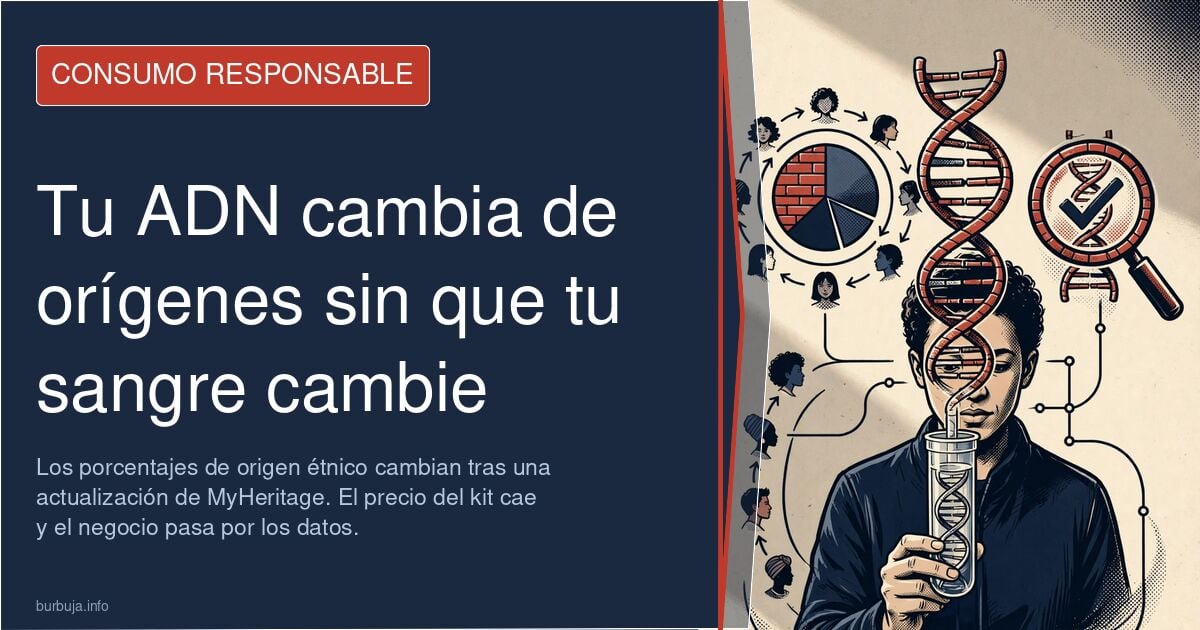
Ethnic DNA tests change your results: science, business, or invention?
A person who took a DNA test some time ago finds that, trinc an algorithm update, their ethnic percentages have completely changed: 15% Sardinian disappears, 8% French appears, and their mother, who had 20% Greek ancestry, hasn't passed on even a trace. This is not an isolated case: dozens of consumers report drastic changes in their results without any change to their genetics.
The algorithm rewriting history
Genetic analysis companies update their algorithms to interpret ancestry. MyHeritage is the main one cited, which, according to those affected, modified its categories of "ethnic Spaniards" to "modern Spaniards." The result: many Spaniards now see Amerindian or Maghrebi genes appearing in their profile, while users of European appearance in Belgium receive African or Maghrebi genes.
Another consumer recounts that their first analysis showed "70% Iberian," and now it reads "80% Spanish," with categories mixing territory and politics. A couple saw that both received the same breakdown (8.4% Scottish, 6.2% Greek/Italian, 5% Italian) despite having no known background.
The business of genetic data
The kit price is the most revealing clue: years ago it cost almost 100 euros; today, it is priced at 30 euros and on sale for 19 euros. If the margin per sale plummets, the company's true value lies in its customer DNA database. For many, paying to surrender your most private genetic information is a bad deal.
Added to this is distrust. The leak of one such company, which included invented "diversity" in its results, is recalled. Others warn about websites where genetic files can be uploaded using outdated databases.
What is true behind the percentages?
Population genetics is a complex science, but consumer results are statistical inferences based on reference samples. Most analyses are sold as estimations, not certainties. However, the magnitude of the changes (from 15% to 0%) is difficult to explain solely through statistical variation.
The comparative regulation adds another point: in Israel, this type of testing is heavily restricted. Kits cannot be bought freely and require a judicial order. This prevents it from being used to prove Jewish paternity or descent. The ease with which this information is surrendered here contrasts sharply with that caution.
The 19 euro offer leaves the most uncomfortable question: how much is your DNA worth to a company that doesn't charge you much for the kit? Perhaps the answer lies not in the percentage of Sardinian or Greek assigned to you, but in the business of storing your saliva forever.
A person who took a DNA test some time ago finds that, trinc an algorithm update, their ethnic percentages have completely changed: 15% Sardinian disappears, 8% French appears, and their mother, who had 20% Greek ancestry, hasn't passed on even a trace. This is not an isolated case: dozens of consumers report drastic changes in their results without any change to their genetics.
The algorithm rewriting history
Genetic analysis companies update their algorithms to interpret ancestry. MyHeritage is the main one cited, which, according to those affected, modified its categories of "ethnic Spaniards" to "modern Spaniards." The result: many Spaniards now see Amerindian or Maghrebi genes appearing in their profile, while users of European appearance in Belgium receive African or Maghrebi genes.
Another consumer recounts that their first analysis showed "70% Iberian," and now it reads "80% Spanish," with categories mixing territory and politics. A couple saw that both received the same breakdown (8.4% Scottish, 6.2% Greek/Italian, 5% Italian) despite having no known background.
The business of genetic data
The kit price is the most revealing clue: years ago it cost almost 100 euros; today, it is priced at 30 euros and on sale for 19 euros. If the margin per sale plummets, the company's true value lies in its customer DNA database. For many, paying to surrender your most private genetic information is a bad deal.
Added to this is distrust. The leak of one such company, which included invented "diversity" in its results, is recalled. Others warn about websites where genetic files can be uploaded using outdated databases.
What is true behind the percentages?
Population genetics is a complex science, but consumer results are statistical inferences based on reference samples. Most analyses are sold as estimations, not certainties. However, the magnitude of the changes (from 15% to 0%) is difficult to explain solely through statistical variation.
The comparative regulation adds another point: in Israel, this type of testing is heavily restricted. Kits cannot be bought freely and require a judicial order. This prevents it from being used to prove Jewish paternity or descent. The ease with which this information is surrendered here contrasts sharply with that caution.
The 19 euro offer leaves the most uncomfortable question: how much is your DNA worth to a company that doesn't charge you much for the kit? Perhaps the answer lies not in the percentage of Sardinian or Greek assigned to you, but in the business of storing your saliva forever.
Summary of a discussion on Burbuja.info - Foro de economía, actualidad y política., translated from Spanish and reviewed before publication. Read the full discussion (63 replies).
More summaries
-
The four breakfasts no Spanish bar serves
Oats, wholemeal bread, hummus and peanut butter: four foods Spanish bars don't serve, against the tradition of toast and Spanish tortilla.
-
Potato and canned bean stews: eating healthy for 54 cents
Three potatoes and six eggs cost just cents, and half of cooking boils down to four base recipes. Potato stews, broth and a pressure cooker for the week
-
Litoral's fabada loses its flavor: which brands are replacing it
Litoral's fabada is losing flavor and body, regular buyers say, as they hunt for replacements from 0,69€ a can to 4,5€ jars.
-
Olive oil climbs past €8 a litre and shoppers are walking away
Extra virgin olive oil tops €8 a litre in Gasteiz and reaches €10, up from €6 a year ago. More and more shoppers are taking it off their lists
-
A Land Rover and 20.000 euros in repairs in just four years
Mireia has spent about 20.000 euros on repairs to her Land Rover, with only 173.000 km in four years, including timing chain, turbo, gearbox and driveshaft
-
Razor blades: expensive cartridges vs. cheap double-edge
A 100-pack of double-edge blades costs €9–12 and gives five shaves per blade; the expensive cartridge is done after five uses.