
DiverXO's High Prices Spark Debate Among Diners
DiverXO's €300-400 tasting menus and a €55 anchovy bone spark controversy over fine dining prices in Spain.
English · Original discussion in Spanish · Published
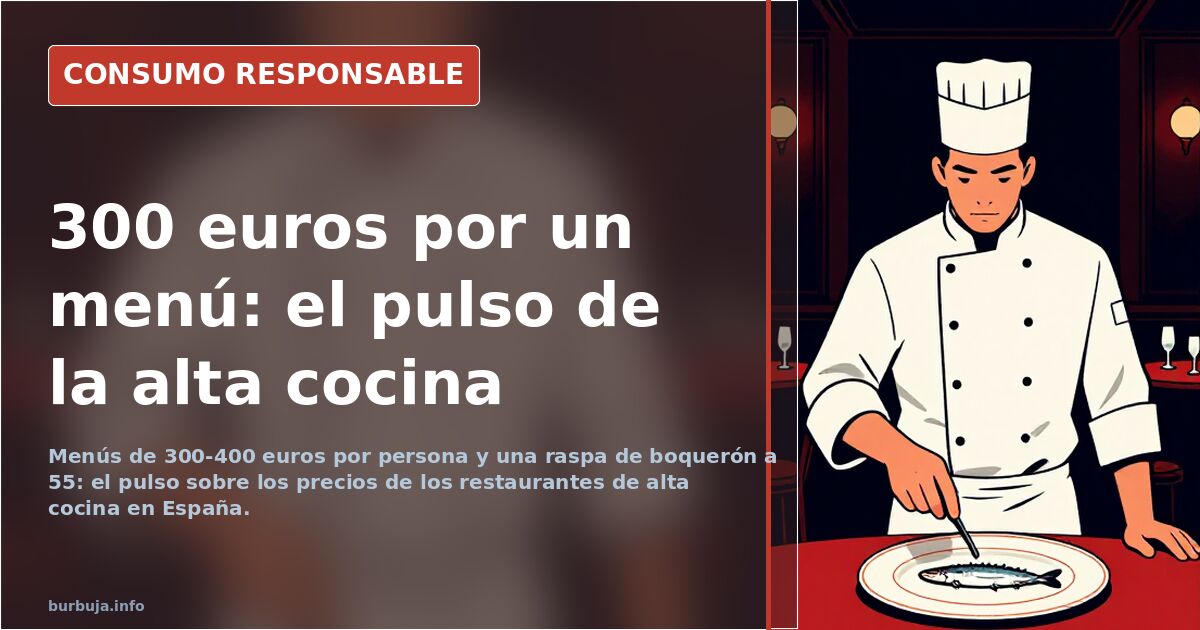
DiverXO and the 300-euro menu: the ongoing debate
There's a portion of tortilla that costs 8 euros and a menu that costs 300, maybe 400. Between these two prices lies much of the discontent currently felt in consumer spending in Spain. The conversation that brought this to light has been ongoing for over 3,700 days—ten years—and it's still alive: it began with a compilation of TripAdvisor reviews published by El Mundo about Spanish restaurants with three Michelin stars. At the center of attention, DiverXO and its chef, Dabiz Muñoz.
The fundamental question isn't whether haute cuisine is art. It's at what price does it stop being food.
How much does it cost to eat at DiverXO and in haute cuisine?
The amounts cited by those who have dined there range from anecdotal to prohibitive. The dish most talked about is the anchovy bone, which costs around 55 euros with drinks. According to collected accounts, the full menus range between 300 and 400 euros per person; one of the most repeated calculations speaks of 400 euros for two diners.
In contrast, some recall that the chef's own group maintains an economical option, StreetXo, where a bill of 35-40 euros per person is mentioned. And those who have paid 160 euros for a cut of wagyu beef and anchovies defend that the money was well spent. The discrepancy isn't just about how much, but for what and what kind of experience.
Michelin stars and the obligation to innovate each season
One of the most cited explanations points to the rating system. Guides and rankings reward creativity above all: repeating a menu risks losing a star, and this pressure pushes chefs to include any novelty on the menu, even if it's minimally palatable. What you're paying for, they argue, isn't the dish, but the constant renewal.
The example given is a dish of chickpeas with curry and mint bathed in caramel: on a regular menu, it would be laughable; with the right presentation, it passes for avant-garde. Added to this is the suspicion of a circle of egos where chefs accuse each other of plagiarism, which narrows the real scope for innovation.
What can you buy for 400 euros outside the restaurant?
The most repeated comparison is with a refrigerator's contents. The full breakdown, item by item, yields a surprising list:
It might be demagoguery over dessert, but the gap between the cost of the product and the final price is the most frequently repeated complaint.
The 10-euro set lunch and the 2-euro pintxo
Not everything is expensive. On the other end, worthy set lunches for 10 euros are mentioned, four tapas and two drinks for under 20 euros, pintxos for 2 euros in the Basque Country, and pintxo-pote nights with four pintxos and four drinks for under 10 euros. There are also those who defend well-made creative cuisine at a reasonable price, who recall grills with suckling pig for 25-30 euros per head, and who boast of a dinner with Joselito 5J ham, anchovies, and suckling lamb ribs in Zaragoza for 102 euros for two.
Posturing, social media, and the middle class footing the bill
Who goes to these places? It's argued that it's not the truly rich, but a middle class intent on appearing so. The image that summarizes the argument: the emperor has no clothes, and no one dares admit they've been ripped off. On the table, too, is the habit of photographing every dish to show off on social media, with some admitting they go to these establishments and don't talk about it for antiestéticar of seeming pretentious.
There's also a much more prosaic testimony: a neighborhood crêperie that served raw, floury crêpes lasted six months. When the novelty wears off, customers stop going.
One thing hasn't changed: reservations still have a months-long waiting list. Ten years of criticism haven't emptied a single table, and that's the perplexing fact.
There's a portion of tortilla that costs 8 euros and a menu that costs 300, maybe 400. Between these two prices lies much of the discontent currently felt in consumer spending in Spain. The conversation that brought this to light has been ongoing for over 3,700 days—ten years—and it's still alive: it began with a compilation of TripAdvisor reviews published by El Mundo about Spanish restaurants with three Michelin stars. At the center of attention, DiverXO and its chef, Dabiz Muñoz.
The fundamental question isn't whether haute cuisine is art. It's at what price does it stop being food.
How much does it cost to eat at DiverXO and in haute cuisine?
The amounts cited by those who have dined there range from anecdotal to prohibitive. The dish most talked about is the anchovy bone, which costs around 55 euros with drinks. According to collected accounts, the full menus range between 300 and 400 euros per person; one of the most repeated calculations speaks of 400 euros for two diners.
In contrast, some recall that the chef's own group maintains an economical option, StreetXo, where a bill of 35-40 euros per person is mentioned. And those who have paid 160 euros for a cut of wagyu beef and anchovies defend that the money was well spent. The discrepancy isn't just about how much, but for what and what kind of experience.
Michelin stars and the obligation to innovate each season
One of the most cited explanations points to the rating system. Guides and rankings reward creativity above all: repeating a menu risks losing a star, and this pressure pushes chefs to include any novelty on the menu, even if it's minimally palatable. What you're paying for, they argue, isn't the dish, but the constant renewal.
The example given is a dish of chickpeas with curry and mint bathed in caramel: on a regular menu, it would be laughable; with the right presentation, it passes for avant-garde. Added to this is the suspicion of a circle of egos where chefs accuse each other of plagiarism, which narrows the real scope for innovation.
What can you buy for 400 euros outside the restaurant?
The most repeated comparison is with a refrigerator's contents. The full breakdown, item by item, yields a surprising list:
- A 4.6-5 kg pata zain Iberian shoulder for 58 euros
- A sheep cheese costing 50 euros per kilo and a half
- Almadraba tuna belly, Huelva white shrimp or prawns, and seasonal wild mushrooms
It might be demagoguery over dessert, but the gap between the cost of the product and the final price is the most frequently repeated complaint.
The 10-euro set lunch and the 2-euro pintxo
Not everything is expensive. On the other end, worthy set lunches for 10 euros are mentioned, four tapas and two drinks for under 20 euros, pintxos for 2 euros in the Basque Country, and pintxo-pote nights with four pintxos and four drinks for under 10 euros. There are also those who defend well-made creative cuisine at a reasonable price, who recall grills with suckling pig for 25-30 euros per head, and who boast of a dinner with Joselito 5J ham, anchovies, and suckling lamb ribs in Zaragoza for 102 euros for two.
Posturing, social media, and the middle class footing the bill
Who goes to these places? It's argued that it's not the truly rich, but a middle class intent on appearing so. The image that summarizes the argument: the emperor has no clothes, and no one dares admit they've been ripped off. On the table, too, is the habit of photographing every dish to show off on social media, with some admitting they go to these establishments and don't talk about it for antiestéticar of seeming pretentious.
There's also a much more prosaic testimony: a neighborhood crêperie that served raw, floury crêpes lasted six months. When the novelty wears off, customers stop going.
One thing hasn't changed: reservations still have a months-long waiting list. Ten years of criticism haven't emptied a single table, and that's the perplexing fact.
Summary of a discussion on Burbuja.info - Foro de economía, actualidad y política., translated from Spanish and reviewed before publication. Read the full discussion (154 replies).
More summaries
-
The four breakfasts no Spanish bar serves
Oats, wholemeal bread, hummus and peanut butter: four foods Spanish bars don't serve, against the tradition of toast and Spanish tortilla.
-
Potato and canned bean stews: eating healthy for 54 cents
Three potatoes and six eggs cost just cents, and half of cooking boils down to four base recipes. Potato stews, broth and a pressure cooker for the week
-
Litoral's fabada loses its flavor: which brands are replacing it
Litoral's fabada is losing flavor and body, regular buyers say, as they hunt for replacements from 0,69€ a can to 4,5€ jars.
-
Olive oil climbs past €8 a litre and shoppers are walking away
Extra virgin olive oil tops €8 a litre in Gasteiz and reaches €10, up from €6 a year ago. More and more shoppers are taking it off their lists
-
A Land Rover and 20.000 euros in repairs in just four years
Mireia has spent about 20.000 euros on repairs to her Land Rover, with only 173.000 km in four years, including timing chain, turbo, gearbox and driveshaft
-
Razor blades: expensive cartridges vs. cheap double-edge
A 100-pack of double-edge blades costs €9–12 and gives five shaves per blade; the expensive cartridge is done after five uses.