
DIA: Half-price beer, couscous deals and coupons
DIA offers half-price strong beer, couscous matching premium brands, and coupons cutting bills by 85%. Where the Spanish chain truly saves you money.
English · Original discussion in Spanish · Published
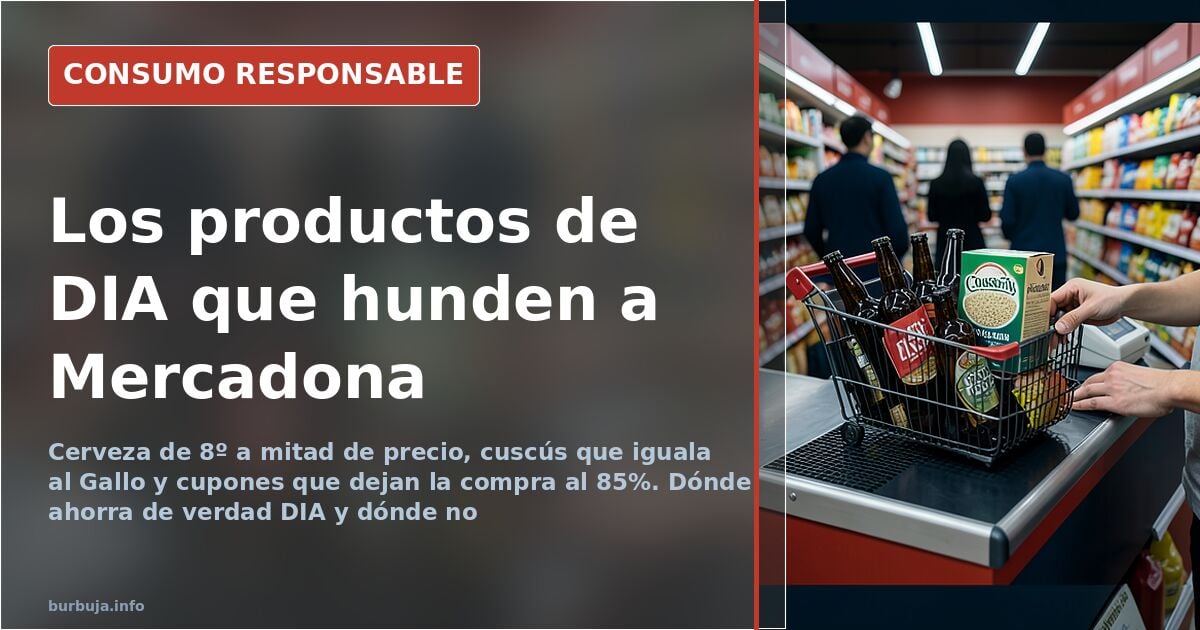
DIA wins where Mercadona squeezes: beer, couscous and coupons
Shopping at Mercadona has become an act of faith: many leave with €60 or €70 spent without touching beef. Amid antiestéticars that the market leader is overcharging, DIA’s private label emerges as a refuge for budget-conscious shoppers. It is not about taste, but arithmetic: double malt beer at half price, couscous equal to top brands for half the cost of Gallo, and coupon policies that can slash prices by 85%.
The issue is that DIA is not homogeneous. Some defend its pastries as identical to Panaria’s expensive equivalents, while others dismiss most products as poor quality, shopping only for convenience. Quality depends on the aisle.
The 8º beer best served in a glass
The most cited find is the own-brand lager: "quite drinkable," suitable for daily use. The gem is the 8-degree double malt, compared to Voll Damm but costing half as much. A serious warning: drinking it straight from the bottle causes a strong buzz. An unwritten rule: serve it in a glass, as it loses flavor directly from the can.
In soft drinks, caffeine-free light cola is rated the best private label by several users. Horchata and sodas also pass muster.
Couscous, frozen food and fish rivaling Pescanova
DIA’s couscous is "as good as the best I’ve tried" and costs exactly half what Gallo sells elsewhere. In frozen foods, fish and seafood are considered superior to Mercadona’s. Skinless hake appears in flyers with a 40% discount on the second unit. Adding a 30% frozen food coupon and another €5 off €30 spend, the kilo can drop to around €2.40. This is where savings become real.
Flans at €0.72 for six and vanilla custards at €1.24 with card complete the sweet picture. Notably, the custards contain no pork gelatin, unlike competitors.
The coupon system: real discounts happen at checkout
The loyalty card is key. At DIA Fresh, fruit coupons stack, and month-end overlaps allow combining current and next-month coupons for double discounts on the same item. This yields bread sticks at €0.29 and €30.39 baskets paid at €14. The overlap trick separates casual shoppers from deal hunters.
The fine print: DIA uses Carrefour-style pricing (€0.89, €1.40, second unit at €0.70), requiring mental math. If signage isn’t clear in three seconds, the purchase is abandoned.
Pastries, diapers and items to avoid
Pastries are the most debated point. One group claims they are the same as Panaria’s, which sell for €1.55 each versus DIA’s €1.25 for two, with the same manufacturer. Others call them dense and unappealing. However, Inés Rosales-style cakes are genuine Inés Rosales products; only the packaging changes.
Diapers and wipes have supporters due to quality and price, though very active children may find them too flexible. Fruit and meat receive poor ratings from many buyers, who prefer local greengrocers and butchers.
The business behind the cart
DIA earned €329 million in 2014, up 57%, with sales in Spain reaching €5.219 billion, a 0.4% increase amid deflation. Acquiring El Árbol led to reduced assortment and a surge in private labels. These figures support the low-cost narrative: tight margins, volume, and loyalty via coupons.
It remains to be seen if the model holds when consumers stop cutting back. If quality varies so widely by aisle, savings will depend on knowing exactly which shelf to target.
Also available in: Deutsch
Summary of a discussion on Burbuja.info - Foro de economía, actualidad y política., translated from Spanish and reviewed before publication. Read the full discussion (70 replies).
More summaries
-
Mercadona's ice creams: the own-brand line taking on Magnum
Mercadona's ice creams, some made by Estíu and Aiadesa, are compared with big brands: solid chocolate cones, whisky cake ice cream at 2.45 euros and more.
-
Mercadona: market leader with 25% share despite own-brand complaints
Mercadona leads Spanish grocery retail with a 25% market share against Carrefour's 9%, while criticism of its own-brand products and their quality keeps growing.
-
Store-brand yogurts and ice cream: what the price hides
Lidl yogurts at 12 cents and ice cream with hydrogenated fats: the label decides the quality of store brands more than the price does.
-
robin.jobs: Dutch temp agency with housing that won't answer
A jobseeker sends his ID and driving licence to robin.jobs, a Dutch temp agency with no reviews, no social media activity and poor fraud-checker scores.
-
Safe Beach Solo Trips: From Sand Holes to Dry Bags
Zippered swimwear, key copies without remotes, and €20 cash form the essential kit for solo beachgoers to avoid theft.
-
Homemade toothpaste costs €1.08 per tube, advocates claim
A DIY recipe using clay, sage, and thyme costs €1.08 per tube. Debate centers on natural ingredients versus fluoride.